


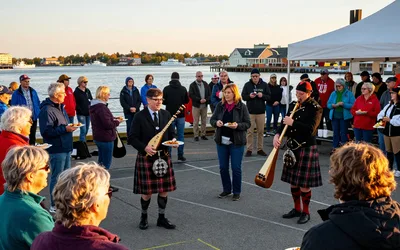
For three days in late October, the stone courtyards and pier buildings of Halifax's newest waterfront district will be given over to something considerably older. Scotoberfest, running October 22 to 24, 2026, plants a Scottish-inspired festival across Queen's Marque and the neighbouring Historic Properties, filling the boardwalk with food and drink, live music, movies, games and a slate of friendly competitions that borrow directly from the Highland Games tradition.
The event is organized by the Downtown Halifax Business Commission, which lists it on its downtown events calendar. The schedule spreads across three days: Thursday and Friday from 4 to 9 p.m., and Saturday from 11 a.m. onward, with the festival's own site advertising a Saturday program that runs into the evening. The centrepiece is what organizers call The Gathering Grounds, an all-ages beer garden set in the Queen's Marque Courtyard, where visitors can take a seat, work through a lineup of Scottish-inspired food and drink, and watch the weekend's action unfold, including live music and contests.
Saturday carries the bulk of the programming. The Bairns' Barn, aimed at what the festival calls "little Highlanders," offers free family activities near Cafe Lunette: Unicorn Fluff cotton candy, archery, a Castle Conquest challenge, colouring, and a game of pin the horn on some of Scotland's favourite creatures. Later, Move 100.1's Erin Hopkins and Peter Harrison of Move Mornings host a tug-o-war, described as one of the most iconic events of the Scottish Highland Games, with two teams going head-to-head for bragging rights and a $100 gift card to the Queen's Marque restaurant of their choice.
Then there is the wife carrying contest, which the organizers have widened considerably beyond its traditional definition. "Whether it's your wife, husband, sibling, parent, best friend, or coworker," the event page reads, "this Scottish-inspired challenge is all about speed, strength, and a good sense of humour." The prize is a year's worth of Pizzas of the Week from Salt + Ash. The day closes with the Harbour Stein Party on the Lower Deck Patio, a 19-plus gathering with live music from Merimac and a $12 door charge.
What makes the setting interesting is how much history sits underfoot. Queen's Marque, completed in 2023 and designed by MacKay-Lyons Sweetapple Architects, was built explicitly as a rebuild of the waterfront at the original landing place where Halifax began in 1749. The architects describe the site as sitting at the crossing of the historic George Street ceremonial axis, a public gathering place since the city's founding that connects the Citadel, the town clock, City Hall, St. Paul's Church, Province House and the harbour. Their design forms three public spaces, including what they call the sacred central court, and threads pedestrian passages beneath a 350-foot floating sandstone bar supported by copper-clad pier buildings, so that the city grid runs physically into the water. The project won a 2024 RAIC National Urban Design Award. A festival courtyard, in other words, that was drawn on the plan as a courtyard from the start.
Next door, the Historic Properties, also known as Privateers' Wharf, are a different kind of old. The warehouses there began going up during the Napoleonic Wars, built by Nova Scotian businessmen including Enos Collins, a privateer, smuggler and shipper whose vessels defied Napoleon's blockade to supply the Duke of Wellington. The buildings helped make Halifax prosperous in Canada's early days through trade and commerce, though they were also frequently used as vehicles for smuggling and privateering; during the War of 1812, two of the most successful Nova Scotian privateer ships were the Liverpool Packet and the Sir John Sherbrooke. Folk singer Stan Rogers made the wharf famous in "Barrett's Privateers" and "Bluenose." The district was designated a National Historic Site in 1963, and in the late 1960s it faced the wrecking ball before being saved and restored.
The Scottish framing is not a costume the city is borrowing. Scottish Gaels settled in Nova Scotia from 1773, beginning with the arrival of the ship Hector, and continued arriving until the 1850s; Gaelic has been spoken in the province ever since, on Cape Breton Island and the northeastern mainland. The Hector carried 189 Scots from Loch Broom in the Highlands to Pictou, and a replica of the ship stands at the Hector Heritage Quay there. Roughly a third of Nova Scotians trace descent to those passengers. A tug-o-war and a wife-carrying race on a Halifax pier are, in that light, less an import than a return.
Scotoberfest is a young event, and coverage of it so far comes almost entirely from the organizer's own channels rather than independent press. Details that remain unconfirmed include whether admission to the festival grounds themselves is ticketed; the only price published is the $12 door charge for the 19-plus Harbour Stein Party. Visitors planning around Saturday should also check the schedule directly, since the Downtown Halifax listing and the festival's own site give different end times for the day. What is clear is the shape of the thing: an open, wander-in festival on a stretch of waterfront that has been a public gathering place since 1749, with archery and cotton candy for the kids, steins and a cover band for the grown-ups, and a tug-o-war in between.