


The night of March 14, 2024, began like so many spring nights along Indian Lake's shore, with the wind building and the sky turning that sickly green. Then the EF-3 tornado, with winds estimated at 155 miles per hour, tore a thirty-two-mile path through Auglaize and Logan counties, leveling everything in its way. When dawn came, the people of Russells Point discovered that the unthinkable had happened: the 43-foot Our Lady of Fatima shrine that had stood watch over the lake for nearly sixty years was gone, and so was Mary herself. The 19-foot fiberglass statue, one of the tallest statues of the Blessed Virgin in the United States, had been picked up by the storm and hurled into the water, vanishing beneath the surface of Indian Lake.
The statue would have turned sixty that August. She had been the dream of George B. Quatman Sr., a Lima man who founded the American Society of Ephesus, a nonprofit devoted to the Virgin Mary, and who had spent six years planning the shrine before it was unveiled in June 1964 at St. Mary's Point. Hundreds of people walked, came by car, and came by boat to see the monument, according to the Lima News of June 29, 1964, and it was formally dedicated on August 30 of that year to St. Mary of the Woods Catholic Church. Quatman died just two weeks after that dedication, at the age of seventy-four, never knowing how deeply his gift would root itself in the community. For decades, the shrine—which rotated slowly, lit by lights, complete with fountains and music—became known simply as Our Lady of the Lake, visible from across the water at night, a beacon for swimmers, boaters, and the faithful who gathered each August for Mass.
When the tornado struck, the loss felt personal. Bill Quatman, George's grandson and the current president of the American Society of Ephesus, visited the ruined site in the days after the storm and found himself surrounded by residents begging him to build it back. We knew that the shrine was important to the community, he said, but we have been overwhelmed at the requests to build her back. The statue, however, was nowhere to be found. For more than two weeks, searchers combed the shoreline and the sky. Drone pilots Jeff Lang and Aaron Shirk scanned from above. Then, on March 30, 2024, a volunteer dive team consisting of Jimmy Dawson of Russells Point, Richard Martin of Marysville, and Josh George of Delaware made the discovery about 150 feet offshore: the statue of Mary, broken into many pieces, resting on the bottom of the lake. The divers floated her head to shore, and the photograph of that recovery—a fiberglass face lifted from the murky water—became a symbol of the community's determination.
The pieces could not be saved, but the determination could. Rather than simply replicate the old shrine, the American Society of Ephesus decided to do something bolder: honor the history while imagining the next century. We wanted to explore new ideas for the next century, said Bill Quatman. The result is something that feels familiar yet different. The society launched a statewide design contest, and although it drew on ideas from all entries, a three-person group called Faith in Action from the nearby town of Minster stood out. Their winning concept? The base of the statue would echo the House of the Virgin Mary in Ephesus, Turkey, the humble stone dwelling where tradition holds that Mary spent her final years—a fitting tribute from an organization named for that ancient city. Freytag and Associates Inc. handled the architecture, and Touchstone CPM, a local firm whose senior project manager Drew Gillespie grew up on Indian Lake, took on the construction.
Sculptor Mike Major of Urbana created the new works: a welcoming statue of Mary with open arms, nearly 20 feet tall, fashioned from fiberglass and stainless steel, alongside three bronze statues representing the Fatima children—Lucia, Francisco, and Jacinta—to whom Mary is said to have appeared in Portugal in 1917. The new shrine no longer rotates, and the fountains are gone, but the site was reimagined with butterfly sidewalks that arc out and curve back into a Rosary Walk surrounding the center, where salvaged benches from the original shrine were cleaned and reinstalled, along with the original kneeler. The statue will still be illuminated at night, glowing across the lake for a new generation. Around the site, three bronze informational plaques offer QR codes for visitors to learn the story, and a new granite bench replaced the one the tornado destroyed.
Perhaps the most poignant touch is the cornerstone, which holds a stainless steel time capsule scheduled to be opened in one hundred years. Inside are photographs, articles, and artifacts submitted by the faithful, along with letters from the community. The capsule also contains a letter from the mayor of Fatima, Portugal, who signed a sister-city agreement with the mayor of Russells Point, binding the Ohio lake town to the very village where the Fatima apparitions occurred—a bridge across the Atlantic, and across the century.
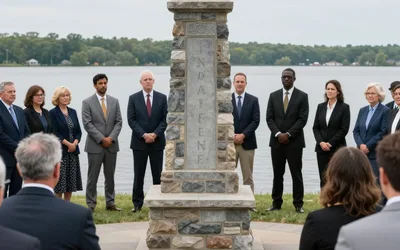
On Friday, August 14, 2026, more than two years after the storm, the community gathered at the Indian Lake Harbor to dedicate the new shrine. Russells Point Mayor Jason Huffman addressed the crowd, and many members of the Quatman family shared memories of the original shrine and what it had meant to the lake. Ohio House Speaker Matt Huffman was on hand as well. Attendees parked at St. Mary of the Woods Church on Madison Avenue and rode free shuttles to the site, since public parking was limited. The following day, Saturday, August 15, the annual Catholic Mass returned to the shrine on the Feast of the Assumption, just as it had for decades before the storm.
A landmark that was broken and lost is now whole again, though changed. The statue that once stood rigid and rotating now stands with open arms. The shrine that was nearly sixty years old when it fell now looks forward to its next century. The woman whose fiberglass face was pulled from the bottom of the lake has risen again, not as a replica, but as something familiar yet different—just as her keeper promised.