


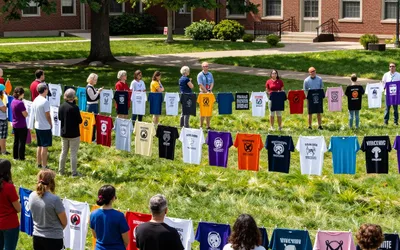
Every October, a clothesline goes up at Ohio University Southern, and the shirts pinned to it carry stories that were never meant to be spoken aloud. The Clothesline Project returns to the Ironton campus on Friday, Oct. 16, 2026, from 8 a.m. to 5 p.m., as part of Domestic Violence Awareness Month. The display is free and open to the public.
The shirts are the point. Each one was decorated by a survivor of violence, or by someone who lost a person they loved to it. Some carry names, dates, and messages; others are covered in artwork, symbols, or simply a single word. Hung together on a line, they turn private grief into something public and impossible to walk past.
The color of each shirt is deliberate. In the project's long-established code, white honors people who died as a result of violence. Yellow marks survivors of physical assault or domestic violence. Pink is for survivors of rape or sexual assault. Blue stands for survivors of incest or childhood sexual abuse. Purple represents people attacked because of their sexual orientation or gender identity, and black honors those attacked for political reasons. Different host organizations have added their own colors over the years — green, for instance, has been used for survivors of military sexual trauma — but the core palette has stayed remarkably consistent since the project's earliest days.
That consistency is part of what has let the Clothesline Project travel so far from where it began. The idea took shape in the summer of 1990 on Cape Cod, Massachusetts, when a coalition of women's groups was confronted by a statistic that refused to sit quietly. According to the Men's Rape Prevention Project in Washington, D.C., 58,000 soldiers had died in the Vietnam War. During that same period, roughly 51,000 women were killed — most of them by men who claimed to love them. The numbers were staggering, and the women wanted a way to make them impossible to ignore.
The answer came from Rachel Carey-Harper, a visual artist in the group, who had been moved by the power of the AIDS Memorial Quilt. If a quilt could hold that much grief and demand that much attention, she reasoned, then a clothesline of shirts could do the same for violence against women. The clothesline itself was not an arbitrary choice. Doing laundry had long been treated as women's work, and in the era of close-knit neighborhoods, hanging clothes out to dry was one of the few times women spoke across the fence about what was really happening inside their homes. The line became a metaphor for the conversations that had been happening in whispers all along.
In October 1990, the original Clothesline Project went up on the village green in Hyannis, Massachusetts, as part of an annual Take Back the Night march and rally. It consisted of 31 shirts. The founding group, the Cape Cod Women's Defense Agenda, had built the project around a simple premise: let each woman tell her story in her own way, using words or artwork to decorate a shirt, then hang it on the line. The act of hanging the shirt served several purposes at once. It educated anyone who stopped to look. It became a form of healing for the person who made it — a way, as the project's own history puts it, to literally turn your back on some of the pain and walk away. And it told anyone still suffering in silence that they were not alone.
From those 31 shirts, the project spread. It has since been replicated in communities across the United States and around the world, each iteration assembled from shirts made by local survivors and their families. The format has proven durable precisely because it is so adaptable: no two displays look alike, because no two communities' losses are alike.
At Ohio University Southern, the project has become a recurring fixture of the campus's Domestic Violence Awareness Month programming. In past years, the display has been mounted in the Shafer Courtyard and in the university's Art Gallery in the Dingus Building, with the campus library serving as a place where people could decorate a shirt of their own to add to the line. The 2026 event continues that tradition at the campus at 1804 Liberty Ave. in Ironton.
The project's power lies in its refusal to abstract. Statistics about intimate partner violence are easy to read past; a line of shirts is not. The display makes visible what usually stays behind closed doors — the specific, individual lives behind the numbers, rendered in fabric and ink and hung where anyone walking by can see them.
For those who attend, the experience tends to be quiet. People read the shirts. They stop. Some cry. The clothesline does what it was designed to do: it bears witness, and it breaks a silence that has lasted far too long.
The Clothesline Project will be on display at Ohio University Southern on Friday, Oct. 16, 2026, from 8 a.m. to 5 p.m. Admission is free and the public is welcome.