


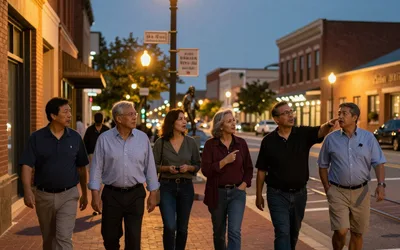
On a Saturday evening in October, a small crowd gathers at the James Garner statue where Main Street crosses the railroad tracks in downtown Norman. They have paid $13 each, and in return they get a commemorative sticker, a walk of about eight-tenths of a mile on public sidewalks, and roughly 80 minutes of stories about the stranger side of a city most people know mainly for a university and a football team.
The Downtown Norman Ghost Tour is the work of Jeff Provine, an author, college professor, and history buff who has spent more than a decade and a half building ghost tours across Oklahoma. His route through downtown is not a haunted house and not a paranormal investigation, and he is careful to say so. "This isn't a 'jump-and-scare' tour like a haunted house nor an investigation," the tour's own description reads, though it adds that several guests have captured an apparition in photos. Every story, Provine says, has been researched from interviews and public archives.
That research habit is the through-line of his career. Provine began leading a ghost tour of the University of Oklahoma campus in 2009, according to his author biography, and the OU tour still runs on select October and November nights, free with donations supporting the Boys & Girls Club of Norman. He went on to write "Campus Ghosts of Norman, Oklahoma" for the Haunted America series, then co-wrote "Haunted Oklahoma City" with paranormal investigator Tanya McCoy. His byline has appeared on Visit Norman's own "Ghostly Guide to Norman," where he collected local legends ranging from a brewery's self-appointed "cowboy ghost" to Mex, the Boston terrier who served as OU's first mascot from 1915 to 1928 and was buried on the 50-yard line of Owen Field so he could keep attending home games.
The downtown tour draws on a similar mix of the documented and the folkloric. Among the recurring tales is that of a barber who, the tour says, is still working his shop despite a grisly death roughly a century ago. Another concerns a gangster buried near his hideout just east of town. The tour also visits haunted restaurants of Norman, and the 2026 version adds new material about Griffin Memorial Hospital, the long-running psychiatric facility whose grounds began, in the 1890s, as a girls' school before the state took over the site.
The meeting point itself carries local history. The bronze James Garner statue honors the actor raised in Norman, star of television's "Maverick" and "The Rockford Files," and it stands at the corner of Main Street and Jones Avenue, catty-corner to the Sooner Theatre. It is a fitting starting line for a tour about a town's memory: a monument to a hometown celebrity, at the edge of a downtown that has been rebuilt and revived more than once since Norman was settled in 1889.
Provine's tours have become enough of a fixture that they show up in the city's cultural calendar alongside other downtown events. One October, the Downtown Norman Ghost Tour shared Main Street with the Second Friday Art Walk, the two events overlapping as galleries stayed open and the walking tour set out at 8 p.m. The Oklahoman has twice rounded up the tour in its Halloween coverage, once in a metro-wide ghost story feature and again in a 2025 guide to Oklahoma history-haunted events, describing the Main Street walk in the same terms the organizers use: 80 minutes, eight-tenths of a mile, public sidewalks.
The practical details are deliberately modest. The tour meets fifteen minutes before start time at the Garner statue, 10 W Main St. Tickets are $13, and each guest receives a commemorative sticker as their ticket. Masking and vaccination are recommended. There is no capacity cap and no need to be a believer; the appeal is closer to a history lecture delivered at night, on foot, with the occasional chill.
Provine's own site notes that the monthly public haunted-history walks in Oklahoma City and Norman pause during the colder months and resume when warmer weather returns, with private group tours available in the meantime. The October 10, 2026 date falls squarely in the season when the tours run. For anyone who has walked Main Street a hundred times without knowing what allegedly happened in the buildings along it, that is the point: the ghosts are the hook, but the history is the substance.