


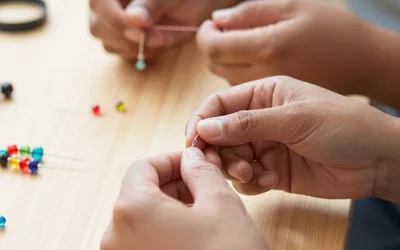
In the south lobby of the BancFirst Tower, a nonprofit keeps a small gallery and sales floor devoted to Native American art. On an autumn evening, a corner of that space turns into a classroom, and a handful of people sit down at a table with trays of tiny glass beads in front of them.
The Beginner Beaded Earring Class at the Red Earth Art Center is a two-hour workshop built for people who have never threaded a bead in their lives. Participants learn the basics of beadwork through a simple strand earring design — choosing colors, following an easy pattern, and building the foundational skills that more elaborate work grows out of. By the end, each person leaves with a handcrafted pair of earrings and, presumably, a new appreciation for how much patience the craft demands.
The class is open to all skill levels, though the framing is squarely aimed at first-timers and at anyone who wants a refresher. Red Earth charges $30 per person, and all materials are provided. The organization notes that discounted rates are available for enrolled citizens of federally and state-recognized tribes, with inquiries handled by email before purchase. Space is limited, and Red Earth asks that participants provide a phone number at checkout in case the instructor needs to reach them before class. No refunds are given after purchase.
The instructor is Danny Sands, who has worked with Red Earth for more than three years. Of Seminole descent, Sands has spent years honing his own beadwork and now shares it through teaching. Red Earth describes him as dedicated to preserving and promoting Indigenous art and culture through his instruction — a mission statement that reads as more than boilerplate once you understand what the organization actually is.
Red Earth is one of Oklahoma's most established Native arts institutions, and its roots run deeper than the gallery's modest footprint suggests. The Red Earth Festival began in 1987, founded by people who wanted to create a dedicated place for Native American artists to sell their work and to hold a powwow. The group behind it grew out of an older organization, the Center of the American Indian, a cultural center and art museum that had started in 1978. In 1992, the two merged into what is now Red Earth. The annual festival, held in June in most years, has drawn participants from more than 100 tribes and, by the time it marked its 30th anniversary in 2016, was attracting roughly 30,000 people. It has since expanded into other programming, including a FallFest.
The Art Center itself operates as the year-round, day-to-day expression of that same mission. Its sales gallery features original Native artwork, both contemporary and traditional, from across the United States, and one of the nonprofit's stated goals is to give Native artists a platform to sell directly to the public. The administrative offices sit on the 27th floor of the tower; the gallery and classroom space are down in the lobby, reachable through the Underground's Green tunnel or by streetcar. Visitors are encouraged to view the current exhibit and shop the gallery before class begins.
That combination — a working gallery, a sales floor for Native artists, and a hands-on classroom — is what makes a $30 beading class more than a craft-night novelty. Beadwork is one of the most recognizable and technically demanding forms of Native artistic expression, and the objects in Red Earth's collection make the point that a simple strand earring is the first step on a long road. The Northern Cheyenne cradleboard in the organization's holdings, for instance, carries a fully beaded surface in bright primary colors, with a Kiowa-style flap that reflects cross-tribal craftsmanship — the kind of piece that represents countless hours of the same basic stitches students will learn in an evening.
For anyone who has walked past the BancFirst Tower without knowing a Native art center was inside, the class is a low-stakes way in. The materials are supplied, the pattern is simple, and the instructor has both the heritage and the teaching experience to explain not just how the stitches work but why the craft matters. Participants should plan on roughly two hours, and should register early — Red Earth has been explicit that seats are limited and that the class fills.
One caveat worth noting for anyone planning around this: the listing date and the organizer's own materials do not line up cleanly. The VisitOKC event listing gives the date as October 5, 2026, but Red Earth's Learn page advertises the beginner class on a Thursday in September, and October 5, 2026 falls on a Monday. Red Earth also runs a separate Three Sisters Beaded Earring Class, priced at the same $30, listed for Thursday, November 5, from 6 to 8 p.m., and an Intermediate Beaded Earring Class teaching square stitch and fringe earrings on Saturday, October 24, from 1 to 4 p.m. Prospective attendees would be wise to confirm the exact date and time directly with Red Earth at [email protected] before making plans, since the organization's class schedule appears to shift.
What is not in doubt is the setting. A downtown tower lobby, a table of beads, and an instructor who has spent years at the craft — that is the whole proposition, and for a beginner, it is a good one.