


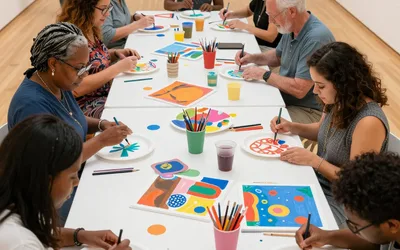
When school lets out for fall break, the Oklahoma City Museum of Art throws open its studio doors. From Thursday, October 15 through Saturday, October 17, the museum hosts Fall Break Drop-In Art, three days of come-and-go art-making that ask nothing more than a walk-in and a willingness to get your hands a little inky. There is no reserved seating, no pre-registration, and no age limit — the program is free with museum admission and free for members, and children are welcome as long as an adult stays with them.
Each day takes its cue from a different artist whose work hangs in the museum's galleries, turning the collection into a prompt. On Thursday, the theme is Pop Art Prints, built around Andy Warhol's Coca-Cola [3]. Warhol transformed everyday objects into works of art through bold, graphic prints, repeating familiar images like Coca-Cola bottles to encourage viewers to look at ordinary objects in new and unexpected ways. Visitors will translate that idea into their own hands, carving a simple design into a Styrofoam printing plate, inking it black, and pressing it onto brightly colored paper. The object of choice can be anything — a symbol, a familiar shape, a favorite thing.
Friday shifts from the graphic to the personal with Memory Collages, inspired by Njideka Akunyili Crosby's I Refuse to Be Invisible. Crosby combines photographs, patterns, and personal imagery to create layered artworks that explore memory, identity, and belonging. Her painting is currently on loan to OKCMOA from the Art Bridges Foundation, and it has already been the subject of the museum's conversation-based gallery program One Work, Many Voices, where an artist and a professor and a chef were invited to read the same canvas through their own eyes. On Friday, families will do something similar with scissors and glue, layering mixed-media materials into a collage that celebrates a memory, a place, a tradition, or a moment of their own.
Saturday closes the run with Storytelling Portraits, drawn from the work of the Oklahoma artist T.C. Cannon. Cannon was born Tommy Wayne Cannon in Lawton in 1946, an enrolled member of the Kiowa Tribe with Caddo and French ancestry, and grew up in Zodaltone and Gracemont, Oklahoma. His Kiowa name, Pai-doung-a-day, means "One Who Stands in the Sun." He studied at the newly founded Institute of American Indian Arts in Santa Fe, then served as a paratrooper with the 101st Airborne in Vietnam, earning two Bronze Stars during the Tet Offensive. He died in 1978 at just 31, but in a short career he helped redefine what contemporary Native art could look like — rejecting the idea of Native people as a vanishing culture and painting them instead as present, vivid, and enduring. His Grandmother Gestating Father and the Washita River Runs Ribbon-Like, a 1975 oil and acrylic canvas, is also on loan from Art Bridges. Using simple shapes, patterns, colors, and meaningful symbols, participants will build a portrait honoring someone important to them — weaving in the activities, places, and objects that make that person who they are.
The three-day run is an expanded version of the museum's regular Drop-In Art program, which ordinarily convenes on the third Saturday of each month from 11 a.m. to 4 p.m. That recurring series has its own history of pairing hands-on making with whatever is on view, from tissue-paper self-portraits to Rodin-inspired sculptures to "drawing" like Dale Chihuly — a fitting theme for a museum that holds one of the most comprehensive collections of Chihuly glass in the world, including the 55-foot Eleanor Blake Kirkpatrick Memorial Tower that rises through its atrium.
The museum itself has deep roots in Oklahoma City's art life. Its origins trace back to the Oklahoma Art League and the Art Renaissance Club, early groups that promoted art education in the young city, and to a Works Progress Administration experimental gallery that opened to the public during the Depression. When the museum incorporated on May 18, 1945, that federally funded gallery became a private institution. Today's OKCMOA was assembled from two predecessors — the Oklahoma Art Center, which grew out of the WPA gallery, and the Oklahoma Museum of Art — brought together after the oil bust of the 1980s strained both. It now occupies the Donald W. Reynolds Visual Arts Center at 415 Couch Drive, in the heart of downtown, with three floors of galleries, a theater that screens foreign, independent, and classic films, and a restaurant.
For families looking to fill a fall break with something more lasting than screen time, the timing is hard to beat: three days, three artists, three very different ways of looking at the world — and a finished piece of art to carry home. The activities run as drop-in sessions, so visitors can come and go as they please, though the museum notes that the exact daily hours follow its standard schedule. Admission is required for non-members; details are available at okcmoa.com.