


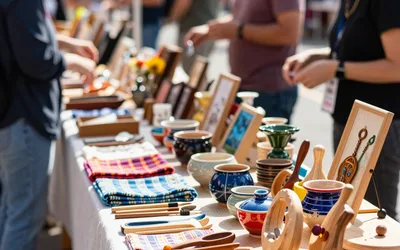
In Gananoque, Ontario, a town of just over 5,000 people perched at the gateway to the Thousand Islands, Saturday mornings from June through September mean one thing: the Gananoque Craft Market is open. From 10 a.m. to 4 p.m. in Town Hall Park at 30 King Street East, visitors can wander among tents of handmade jewellery, pottery, textiles, home décor, preserves, and baked goods, all while local musicians play and the St. Lawrence River glitters a few blocks away. The market is free, it is outdoors, and it is unreservedly local — a weekly ritual that has become as much a part of the town's summer rhythm as the boat tours that depart from the nearby waterfront.
But the market's story is older and stranger than its current pleasant setting suggests. For years, the Saturday craft market was known by a different name — Crafts on the River — and it was held not in the park but on the old train bridge that spans the Gananoque River. That bridge, a relic of the town's deep railway heritage, was where vendors would set up their tables on the planks, with the water rushing below and the rusted iron trusses overhead. It was, by every account, one of the most distinctive market settings in Ontario: shoppers browsing handcrafted goods while standing on a century-old piece of infrastructure that once carried locomotives across the river.
The bridge's history is tangled up with Gananoque's own. The town itself was founded in 1789 by Joel Stone, a United Empire Loyalist who built a sawmill on the west bank of the Gananoque River. Stone's settlement grew into a milling and manufacturing centre, and by the late 19th century, the railway had arrived, connecting the town to the wider world. The original Thousand Island Railway station was built in 1889, and the train bridge — the one that would eventually host the craft market — became part of the town's industrial backbone. Trains rumbled across it for decades, carrying goods and passengers, until the line fell into disuse and the bridge was left to rust.
In its afterlife, the bridge found a second purpose. Local artisans, recognizing the dramatic setting, began setting up there on summer Saturdays, and Crafts on the River was born. It became a beloved institution, the kind of thing that residents mention with a certain pride: a market where you could buy a hand-thrown mug while standing over a river, with the old stone town hall and the spire of a historic church rising in the near distance. The market grew to include not just crafts but live music, food vendors, and eventually even Culture Days programming with Indigenous music, storytellers, dance instruction, and art demonstrations.
Then came the pandemic. When COVID-19 shut down public gatherings in 2020, the market was displaced, and it never quite returned to the bridge. The Gananoque Craft Market, as it is now known, moved to Town Hall Park, the same green space that hosts the Thursday evening Farmers' Market. The new location is pleasant enough — shaded, grassy, close to the waterfront — but it lacks the dramatic perch of the old bridge. And the bridge itself has become a point of contention. In 2025, the Save Our Train Bridge Committee collected more than 1,000 signatures in a town of 5,200 people, arguing that the structure could be rehabilitated and preserved. They brought in professional engineers who volunteered to inspect it free of charge. Town Council voted against saving it, with one councillor dismissing the bridge as "a stock and standard replacement bridge" at the end of its lifespan.
The debate divided the town, but the market rolled on. In 2026, the Gananoque Craft Market runs every Saturday from June 6 to September 26, with the September 19 date falling in the heart of the season. Vendors pay modest fees — $28.25 for a single day, or $282.50 for a weekly spot for the entire season — and the market is organized by the Town of Gananoque itself, which also runs the Thursday farmers' market. The town's tourism and communications staff handle vendor applications and guidelines, and the market is promoted as serving not just Gananoque but the broader Leeds and the Thousand Islands region.
What makes this market worth a visit, beyond its unhurried small-town charm, is the way it embodies the town's layered identity. Gananoque has always been a place where the river and the railway meet. The town's tourism industry grew up around the Thousand Islands — those emerald islands scattered across the St. Lawrence that first drew wealthy American and Canadian vacationers in the late 19th century, arriving by steamboat and train. The old railway station is now the site of the 1000 Islands History Museum. The Gananoque Canoe Club, built in 1909 on the waterfront, was converted into the Thousand Islands Playhouse in 1982, and the 1913 Armoury became the Firehall Theatre. The town is dense with heritage, and its summer markets are part of that living history.
On a Saturday in September, the craft market offers a slice of that continuity. Tourists who have spent the morning on a boat cruise through the islands can wander through the stalls and pick up a piece of local pottery or a jar of small-batch jam. Locals come to catch up with neighbours, listen to the buskers, and support the makers they know by name. It is a modest affair — no carnival lights, no corporate sponsors, no entrance fee — but that is precisely its appeal. In an age of algorithm-driven commerce, the Gananoque Craft Market is resolutely analog: a place where you can meet the person who made the thing you are buying, where the transaction is as much about community as commerce.
The market's origins on the train bridge are not forgotten. The Save Our Train Bridge debate has kept the structure in the news, and many residents still recall the peculiar pleasure of shopping above the water. But the market itself has adapted, as markets do. Town Hall Park, with its view of the river and its proximity to the town's cafes and ice cream shops, has become a fine home. And while the bridge may be facing an uncertain future, the craft market that once called it home shows no signs of slowing down. It remains, as the town's own marketing puts it, a place to "discover unique handmade creations, artisan goods, and one-of-a-kind finds" — and, not incidentally, a place to feel the pulse of a small town that has spent more than two centuries making, selling, and trading the things its people have built with their hands.
If you find yourself in the Thousand Islands on a Saturday this summer, skip the souvenir shops and head to Town Hall Park. Bring cash, take your time, and talk to the vendors. They will likely tell you about the old bridge, the one where the market used to be, and they might even tell you which of the items on their tables were made in workshops just down the road. That is the real product here, after all: not just the goods, but the connection — to the river, to the rails, and to the stubborn, creative community that keeps showing up, every Saturday, rain or shine, to build something from nothing.