


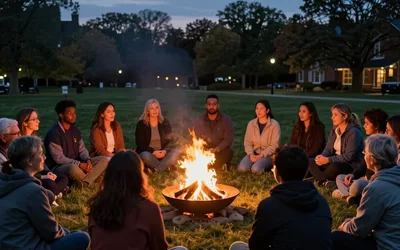
On the last afternoon of September, a fire will be lit in the open air of Agnes Benidickson Field, at the heart of Queen's University's Kingston campus. There is no ticket, no gate, no reserved seating. The fire is scheduled to begin at 1:00 p.m. on Wednesday, September 30, 2026, with invited speakers starting at about 1:15 p.m. The university's Office of Indigenous Initiatives puts the invitation plainly: this fire is open to all of the Queen's community, and those who come are asked to arrive "with a good mind and willingness to listen."
The date is not incidental. September 30 is the National Day for Truth and Reconciliation, a federal day of remembrance established in 2021 to honour the victims and survivors of Canada's residential school system, which operated from 1831 to 1996. For years before the federal designation, the same date had been observed as Orange Shirt Day, a grassroots movement that began in 2013 in Williams Lake, British Columbia. The two observances now run together, and the orange shirts that fill the field each year are a visible thread connecting a schoolchild's story to a national reckoning.
At Queen's, the sacred fire has become the centrepiece of that reckoning on campus. It is not a lecture or a panel but a gathering around a living flame, a practice rooted in Indigenous traditions in which fire carries prayers, memory, and connection between people and generations. The setting itself is a green space the university community has long fought to preserve, a lawn just south of Fleming Hall that blooms with gardens in spring and summer. It is named for Agnes McCausland Benidickson, who served as Queen's chancellor from 1980 to 1996 — the first woman elected to the post, and the first to follow a parent into it. Born in 1920 at Chaffey's Locks into the Richardson family, she was raised with the credo that "to whom much is given, much is required," and her name now sits on the ground where the university gathers to confront a history it once failed to teach.
That failure is part of the story of how the fire came to be. In 2017, Queen's struck a Truth and Reconciliation Commission Task Force to answer the national commission's calls to action for post-secondary institutions. That November, the task force released its final report at a reception in the Agnes Etherington Art Centre, before a crowd that included students, staff, faculty, alumni, and members of the local Indigenous community. The report carried a title in three languages — "Yakwanastahentéha" in Mohawk, "Aankenjigemi" in Ojibwe, and "Extending the Rafters" in English — and 25 key recommendations spanning governance, the visibility of Indigenous peoples on campus, and the incorporation of significant Indigenous content into the curriculum of every program. The evening opened with a traditional Mohawk ceremony presented by lecturer Nathan Brinklow, and included an Anishinaabe Honour Song performed by the Four Directions Women Singers and a Haudenosaunee Round Dance led by performers from Tyendinaga Mohawk Territory.
In the report's message, Principal Daniel Woolf was direct about the institution's record: Queen's had participated in traditions that caused harm to Indigenous communities, and, perhaps most importantly, had failed to educate its students on the long history of deep-rooted conflict between Canada and Indigenous peoples. To demonstrate commitment to change, Woolf announced the creation of an Office of Indigenous Initiatives. The office now builds community, advances reconciliation, and works to integrate Indigenous ways of knowing and being into the life of the university — guided, in its own words, by principles including skennen, or peace, and kahnikonriyo, the good mind.
The sacred fire grew out of that institutional commitment, and it has been held on the field in the years since. Coverage of the 2021 observance — the first year September 30 was marked as a federal statutory holiday — describes an intimate gathering on Agnes Benidickson Field that sought to reaffirm the university's commitment to reconciliation, with public remarks from Queen's Elders-in-Residence and senior university leaders. By 2024, the gathering had grown into a large crowd of campus community members, most of them in orange shirts, listening to speeches on the field. That year, Mika Henry, associate director of the Office of Indigenous Initiatives, used the occasion to press attendees — particularly non-Indigenous ones — to think critically about their own role. "Ask yourself: how can I continually work at supporting Indigenous people and my Indigenous colleagues, and the incorporation of Indigenous knowledge in the curriculum on a daily basis — beyond the National Day for Truth and Reconciliation," she said. "True allyship is showing up every day, not just to events. Release yourself from the concept of performative allyship, being an ally because you think it will help with your public image or serves as a checkbox for your EDII work. Dive deeper into true, meaningful, ongoing engagements, relationship-building and activities."
The 2024 event also included remarks by Principal and Vice-Chancellor Patrick Deane, Associate Vice-Principal (Human Rights, Equity, and Inclusion) Lavonne Hood, and Rector Niki Boytchuk-Hale. Armand Garnet Ruffo, an artist, faculty member, and member of the Chapleau Cree First Nation, read two of his poems. The programming has varied year to year, but the shape of the gathering has stayed consistent: a fire, a circle of listeners, and words meant to be carried away and acted upon.
What makes the Queen's fire unusual is its openness. Many observances of the day are ticketed, indoor, or confined to particular institutions. This one is held on a public green in the middle of a campus, and anyone who walks past can stop and stand at the edge. That accessibility is the point. The event's own framing asks participants to come with a good mind and a willingness to listen — a low bar, deliberately set, and one that places the burden of the day not on ceremony but on attention.
There is a tension built into the occasion, and the speakers at past fires have named it themselves. A single afternoon of remembrance, however sincere, is not reconciliation. The fire burns for a couple of hours and then it is out. What the Office of Indigenous Initiatives and the National Day for Truth and Reconciliation Working Group — the body that plans the campus's slate of events each year — have consistently asked of the Queen's community is that the day function as a beginning rather than a box checked. The university even invites people to read and sign a public commitment to reconciliation, an attempt to convert a moment of reflection into an ongoing practice.
So the fire on Agnes Benidickson Field is best understood as an invitation with a condition attached. It is free, it is outdoors, and it is open to anyone who shows up on the afternoon of September 30. But the people who tend it have been clear that the flames are not the destination. They are a gathering point — a place to stand in orange, to listen to Elders and students and poets and administrators, and then to leave and do the harder, less photogenic work of the other 364 days.