


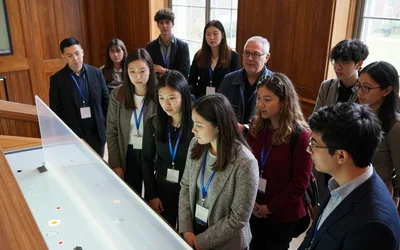
Radiation has an image problem. It glows in the popular imagination, it lurks behind lead doors, and it tends to arrive in conversation already wrapped in fear. On Saturday, October 3, 2026, a group of Queen's University researchers will spend the better part of a day trying to unwrap it. Their event has a title that doubles as an invitation: Let Curiosity Radiate: Exploring Radiation.
The setting is Chernoff Hall on Bader Lane, and the audience is deliberately narrow. The workshop is designed for high-school and first-year undergraduate students, and it is free to attend. It runs from 9:45 in the morning until 4:00 in the afternoon in Room 202, and it is part of Science Literacy Week, the nationwide celebration of discovery presented each year by the Canadian Association of Science Centres.
What makes this particular workshop unusual is not just its subject but its authorship. It is offered jointly by four of Queen's research centres and institutes, with support from the Vice-Principal Research Portfolio. That coalition includes the Arthur B. McDonald Canadian Astroparticle Physics Research Institute, the Carbon to Metal Coating Institute, the Sinclair Cancer Research Institute, and the Materials at Extremes Nuclear Research Institute. Four groups that rarely share a stage are effectively pooling their expertise to explain one phenomenon from four angles.
The day's program reflects that range. Sessions include Radiation 101; a talk titled Harnessing the atom's energy: Canada's role in the nuclear renaissance; Radiation in action: understanding, finding, and treating cancer; Seeing atoms with X-rays; and Needles in the haystack: messages from the Universe hidden behind radiation. Between the scheduled talks, participants will move through hands-on activities and conversations with working researchers, exploring alpha, beta and gamma radiation alongside X-rays and neutrons, and learning how each interacts with the world and how it can be detected and handled safely.
The four institutes each bring a distinct piece of that story. The McDonald Institute, headquartered at Queen's, is Canada's network for astroparticle physics. It is named for Arthur B. McDonald, the Queen's physicist who shared the 2015 Nobel Prize in Physics for the discovery of neutrino oscillations, the work that proved neutrinos have mass. That discovery grew out of the Sudbury Neutrino Observatory, a heavy-water detector built two kilometres underground in Ontario and led by McDonald, which solved the decades-old solar neutrino problem. Radiation, in that context, is not a hazard to be avoided but a messenger to be read.
The Carbon to Metal Coating Institute approaches the subject from materials science. Based at Chernoff Hall, it develops coatings that prevent metal corrosion and enable precise manipulation of metals at the nanometre scale, work that touches everything from transportation and green-energy infrastructure to microelectronics and the precision of nanomedicines in oncology. Its own stated vision includes improving the precision and safety of radiotherapies, which is where its interests overlap with the Sinclair Cancer Research Institute. The Sinclair institute, which houses the headquarters of the Canadian Cancer Trials Group and partners with the Kingston Health Sciences Centre on a Kingston site for the Marathon of Hope Cancer Centres Network, is the event's link to the clinic, where radiation is a tool for finding and treating disease. The Materials at Extremes Nuclear Research Institute, meanwhile, studies how irradiation damages materials, a question that matters as Canada weighs its role in what the program calls a nuclear renaissance.
Chernoff Hall itself is a fitting venue for a day about seeing the invisible. Completed in the fall of 2002 at a cost of $59 million, the building has housed Queen's Department of Chemistry ever since. It was funded through the university's Campaign for Queen's along with the Ontario Government SuperBuild program, the Ontario Innovation Trust, the Canada Foundation for Innovation, and private donations, most notably from the Chernoff family. It rose on the site of the former St. Lawrence Building, which was demolished to make room for it, and it contains more than 14,000 square metres of space, over 5,000 of which is devoted to laboratories. The architects were Brisbin Brook Beynon Architects of Ottawa, with Sauvé Boucher Associates handling structural engineering.
That the workshop is aimed at teenagers and first-year students is not incidental. Science Literacy Week exists to connect Canadians to the science shaping their world, and radiation sits awkwardly at the intersection of the everyday and the alarming. We are bathed in it, from cosmic rays to the potassium in our own bodies; we also depend on it for medical imaging and cancer treatment, and we have spent eight decades learning to handle it carefully. The organizers' framing is notably calm: discover how radiation helps us uncover the invisible, understand our Universe, and advance science, technology, and medicine.
For a free event, the ambition is large. The program asks participants to consider alpha particles and neutron beams, the legacy of Canada's nuclear industry, the mechanics of a cancer scan, and the faint signals that reach Earth from distant astrophysical events, all in a single Saturday. Registration is required, and questions go to Tetyana Levcheko at [email protected]. The event's own title makes the case better than any description could: curiosity, in this telling, is something that radiates.