


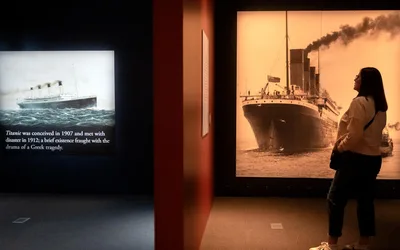
The first thing visitors to OMSI receive is not a map or a headset but a small rectangle of cardstock: a replica boarding pass bearing the name of an actual passenger who walked the decks of RMS Titanic in April 1912. It is a small piece of theater, and it is also the organizing idea behind "Titanic: The Artifact Exhibition," which opened at the Oregon Museum of Science and Industry on March 21 and runs through October 18. You are not simply looking at the Titanic. For the length of a visit, you are aboard her.
The exhibition gathers more than 100 authentic objects recovered from the ship's wreck site, arranged to move visitors from the vessel's construction and launch through life on board, into the sinking, and finally into the modern, decades-long effort to find, recover, and conserve what remains. It is, by the museum's account, a first for West Coast audiences — a substantial collection of genuine Titanic material displayed in the Pacific Northwest rather than in the permanent exhibitions in Las Vegas and Orlando.
That the objects exist at all is its own improbable story. Titanic struck an iceberg late on the night of April 14, 1912, and sank in the early hours of April 15, roughly 370 nautical miles south-southeast of Newfoundland. She came to rest about 12,500 feet down, in water so deep and so dark that for 73 years the wreck was assumed to be beyond reach. Robert Ballard of the Woods Hole Oceanographic Institution, working with the French research institute IFREMER, located the wreck on September 1, 1985, and the images that followed — a boiler, a ship's whistle, the ghostly intact bow — became some of the most widely seen photographs of the twentieth century.
Discovery raised an immediate and uncomfortable question: what should be done with the site? In 1987, two years after Ballard's find, an expedition led by explorer G. Michael Harris recovered roughly 2,000 artifacts from the debris field, and the company he founded, RMS Titanic, Inc., ultimately secured sole rights to salvage the vessel. Further dives between 1993 and 2000 brought the total recovery past 5,000 objects. A United States federal court ruled in 1994 that artifacts beyond those from the original 1987 operation could not be sold, a decision that helped push the company toward public display rather than private sale. The exhibitions that grew out of that ruling are, according to RMS Titanic, Inc., the only places in the world where genuine Titanic artifacts can be seen; the company says more than 35 million people have visited them over the past four decades.
The result is a strange kind of museum: part engineering story, part forensic investigation, part memorial. The objects that survive from the debris field are mostly ordinary things — the debris field itself is estimated to hold hundreds of thousands of items that spilled from the ship as she went down — and their ordinariness is precisely the point. A button. A deck chair. A ticket. A life vest. These are the residue of daily life interrupted, and they carry a documentary weight that no replica or film prop can match.
OMSI's presentation leans into that intimacy. Visitors move through re-created spaces and encounter the human stories attached to the objects, with the exhibition explicitly framed around empathy and personal connection rather than spectacle alone. The museum's president and CEO, Erin Graham, described the show as a window into both "a moment of remarkable innovation and ambition" and "the lives of the people whose journeys were forever changed by her voyage." The exhibition also devotes attention to the less romantic half of the story: the painstaking work of recovering artifacts from a debris field that spreads across the ocean floor, and the ongoing scientific and conservation effort to stabilize and interpret what comes up.
For Portland, the timing is notable. The exhibition opened in March and has been running for months, which means the final weeks — through October 18 — are the last chance to see it before it leaves the museum. Admission is bundled with general OMSI admission: $29.50 for adults, $27.50 for seniors 63 and over, and $22.50 for youth ages 3 to 13, with infants under 3 free. Members pay $6. Timed-entry tickets are required for all ages, and the museum advises allowing extra time for both the queue and the walk-through.
There is a particular resonance to seeing these objects in a science museum rather than an art gallery or a history hall. Titanic was, before she was a tragedy, a feat of early twentieth-century engineering — the largest ship afloat when she entered service, the second of White Star Line's three Olympic-class liners, and a vessel whose watertight compartment design was widely, and wrongly, believed to make her unsinkable. The exhibition's arc from construction to wreck to recovery is, in that sense, a story about the limits of confidence in technology, told through the things that outlasted the people who built and sailed her.
And then there is the boarding pass, which visitors keep. At the end of the exhibition, the name on it can be checked against the passenger lists — a device that has been used in these exhibitions for years and that reliably produces the same quiet effect. Some of the names belong to survivors. Many do not. It is a small, effective piece of design: a souvenir that turns, somewhere between the first gallery and the last, into something closer to an obligation.