


On a Tuesday afternoon in late August, as summer tourists drift between the Liberty Bell and Independence Hall, a far smaller, more pointed crowd will assemble at the intersection of 6th and Market streets. They will not come for the usual Revolutionary War pageantry. They will come, as they have every year for nearly a quarter century, to stand on the ground where George Washington once held nine people in slavery and to insist that a nation facing its 250th birthday not look away from that fact.
The Avenging the Ancestors Coalition will hold its 24th annual Slavery Commiseration on Tuesday, Aug. 25, at 4 p.m. at the President's House site, the archaeological footprint of the mansion that served as America's first executive residence from 1790 to 1800. The date is no accident: it marks the anniversary of Aug. 25, 1619, when the first documented enslaved Africans arrived in what was then the British colony of Virginia. The coalition describes the gathering as "a solemn remembrance of those whose forced labor helped build the United States while also renewing the public's commitment to truth, justice, and historical accuracy." Historians, attorneys, clergy, and community leaders are scheduled to speak.
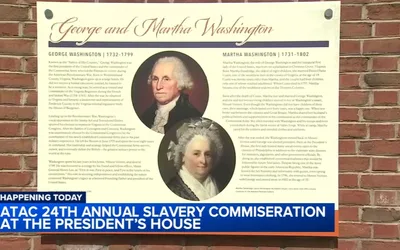
But this year's commiseration carries an urgency unlike any of the 23 before it. For the first time, the ceremony will unfold beside panels that were not written by the people who fought to build the memorial, but by a federal government that, in the name of patriotism, replaced them. The result is a public face-off between a memorial ritual hardened by two decades of persistence and a political project to rewrite what the memorial says.
The story of how this corner of Philadelphia became a battlefield over historical memory begins not with a protest, but with a discovery hidden beneath the sidewalk. In 2002, while excavating for a planned visitor center for the Liberty Bell, archaeologists working at the site of the old President's House uncovered the foundations of the mansion where Washington and John Adams had lived — and, more hauntingly, an unmarked burial ground. The find electrified the city. Here, steps from where the Declaration of Independence was signed, lay the physical remains of the enslaved household that Washington had brought north with him, carefully rotated in and out of Philadelphia so they would not remain in Pennsylvania long enough to claim freedom under the state's gradual abolition law.
The nine people held at the house had names — Oney Judge, Hercules, Austin, Giles, Richmond, Christopher Sheels, Joe, Moll, and Paris — and until that excavation, the National Park Service had told almost none of their stories on the site. The discovery prompted Philadelphia attorney Michael Coard to act. Coard, whose own search for lost ancestry had led him to confront how completely the historical record had swallowed the lives of enslaved people, founded the Avenging the Ancestors Coalition in 2002. The group's name makes its mission explicit: the ancestors were not just to be remembered, but avenged, through the insistence that their truth be told on the ground where they suffered.
For eight years, Coard and the coalition pressured, lobbied, negotiated, and organized. The National Park Service was, at first, hesitant to center slavery at a site built around the story of American freedom. But the activists' persistence paid off. In December 2010, the President's House memorial opened, a stark open-air structure of glass and steel that displayed the excavated foundations and told, in detailed panels, the stories of the nine enslaved people. It was titled "The President's House: Freedom and Slavery in the Making of a New Nation," and it was widely hailed as a national model for confronting the contradictions at the heart of the American founding.
The panels named names. They described Oney Judge's 1796 escape from the President's House and the irony that she fled the first family of the new republic to win her own freedom. They told of Hercules, the enslaved chef who escaped and disappeared from the historical record. They explained the "dower slaves" of the Washington household, the laws that enabled the institution even in the cradle of liberty, and the cruel logistics by which Washington kept enslaved people just steps from Independence Hall.
For 15 years, the memorial stood as a monument to what Coard and his coalition had won. Then, in 2025, President Donald Trump signed an executive order intended to "restore truth and sanity to American history," directing federally controlled historic sites to remove or alter displays that, in the administration's view, "disparage" Americans past or living. The President's House exhibit, with its unsparing portrait of the enslavers who founded the nation, was flagged. On Jan. 22, 2026, National Park Service workers arrived at the site and, with crowbars, ripped the panels from the walls, unbolting the signage from poles overlooking the dig and carting it away in a park service truck while tourists heading to the Liberty Bell walked past. The city of Philadelphia sued the Department of the Interior and the park service the same day.
A federal judge initially ruled that the administration could not remove the exhibit, and ordered that it be reinstalled. Park Service workers returned the panels in February. But the legal victory proved temporary. The court later cleared the way for the administration to proceed, and by the summer, workers returned again — this time to install a rewritten exhibit. The replacement panels changed the language significantly. One new panel now reads that Washington had "discomfort about the institution of slavery," a phrase critics are quick to note is at odds with the fact that he enslaved more than 300 people in Virginia and nine at the Philadelphia house. The new panels downplay, in the critics' view, both the scale of Washington's enslavership and the humanity of the enslaved.
Mayor Cherelle Parker publicly rebuked the removal, saying the federal government's decision to strip the panels at night showed it "understands this action is shameful" and that it "violates community trust." Coard, speaking after the earlier reinstallation, drew a sharp historical line: "You can say what you want and I always do about a Nixon, Reagan. About Bush one or Bush two, but they didn't cross this line." He warned that the precedent was frightening — if a president could rewrite the story of slavery at a national park because he disliked it, what would stop the next one from removing the Statue of Liberty because it welcomed too many immigrants?
The coalition, meanwhile, has vowed to keep organizing. "We're not dismayed, we're not exhausted, we're not pessimistic, we're not beaten down. We are resilient," Coard said earlier this year, drawing on the same energy, he said, that carried the group from 2002 to 2010. "The same energy and passion that we used from 2002 to 2010, it's here now on steroids."
The 2019 commiseration, which marked the 400th anniversary of the 1619 arrival, drew hundreds of people, including more than 200 Black children wearing white shirts who processed across a stage at 6th and Market, each holding a sign representing a year since the first enslaved Africans arrived. Coard explained then that the gathering was about remembering not just slavery but its long aftermath — "the black codes, which is sharecropping, convict leasing, Jim Crow, federally ignored/sanctioned lynching, gerrymandering, redlining, mass incarceration, police brutality." He chose the President's House site, he said, as a reminder that slavery was not a sin exclusive to the South — it was practiced at the very center of the nation's founding.
This year's commiseration is expected to be smaller than the 2019 commemoration, but no less pointed. The event is free and open to anyone who happens to be on Independence Mall that afternoon. Speakers will stand before the new panels and, in all likelihood, gesture toward them as evidence of the very erasure the coalition was founded to prevent. The ceremony will mark the anniversary of the arrival of the first enslaved Africans, but it will also function as a live referendum on whether a president can rename the truth of the nation's origins.
Two decades ago, Michael Coard and a small band of activists forced the National Park Service to tell the story of Oney Judge, Hercules, and the others. They won once, through persistence. Now, with the panels changed and the legal avenues narrowing, the commiseration has become something more than an annual ritual of remembrance. It is the standing act of resistance at the corner where America's first White House once stood, a refusal to let the site's own history be smoothed into patriotism. As Coard put it on the eve of the nation's 250th anniversary: "You can't love something unless you know something."