


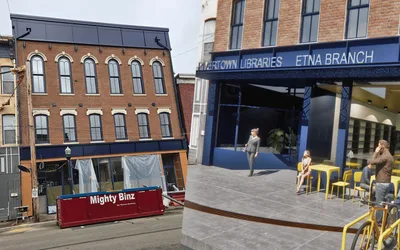
For most of its 150 years, the three-story building at 341 Butler St. in Etna has been many things to many people: a dry goods store, a post office, a speakeasy called Ochse Hall, storefronts, apartments. What it has never been, until now, is a place where the whole town could simply walk in and stay awhile. On Saturday, Oct. 17, 2026, that changes. The Etna Center for Community opens its doors with a ribbon-cutting ceremony at 11 a.m., followed by a full day of free programs and an evening garden party.
The opening caps a ten-year development process and two years of construction, according to the Etna Community Organization, the nonprofit that has driven the project. The ribbon cutting itself will take place at the rear of the building, at 54 Locust St., with remarks from key project contributors before the ceremonial cut. At 11:30 a.m., the library opens for visitors to explore. Programs run inside and outside the library from noon to 5 p.m., a street fair fills Locust Street between Walnut Street and VFW Way, and food and drink will be available throughout. The celebration continues until 8 p.m. Scheduled to appear are Congressman Chris Deluzio, Allegheny County Executive Sara Innamorato, State Sen. Lindsey Williams and State Rep. Lindsay Powell, along with staff and representatives of the Etna Community Organization and the Borough of Etna. The event is free and open to the public.
The day is not happening in isolation. It coincides with the annual Haunted Garden of Etna and other activities in and around the business district, so the borough's main street will be unusually busy. Costumes are welcome.
What is opening is not just a building but a set of answers to a problem Etna has lived with for years. According to the Etna Community Organization, the borough had zero indoor public spaces where residents could meet one another, host programs or access resources. About 35 percent of households lack internet access at home, and there are no public access points. Some 640 children in Etna have had no library, childcare or after-school programs in their own community. Per capita income sits around $26,000, roughly two-thirds that of neighboring communities, leaving less to spend on transit and education.
The new center addresses those gaps directly. It will house a library with 6,000 items available to borrow, a maker space, community meeting rooms and educational programming. Visitors with a Carnegie Library card will be able to reserve materials from a Carnegie branch and have them delivered to the Etna center. "We learned a lot about how to set up a library," executive director Megan Tuñón told NextPittsburgh. "There's no rule book for it. Although we are not part of the Allegheny County Library Association, patrons will have direct access to a wonderful collection." Board chair Bridget Barrett said the organization was fortunate to bring on a retired librarian who helped build the collection and set up the library.
Food programming has been a priority in the planning. "We've been surveying the residents for about a year now to see what programs they want to see there," Tuñón said. "Food programming has been really important because we're a food desert and there's a lot of food insecurity. We'll have social workers there and access to elected officials. Whatever the community needs, we'll keep on identifying those needs and trying to get feedback from them." Barrett added that the organization's agility will serve it well "because there just isn't a space like this in Etna."
The building's history is as layered as its renovation was. The original structure dates to the 1870s, when it was known as Ochse Hall. Over the decades it served as a dry goods store and a post office before becoming a speakeasy during the 1920s. Mayor Robert Tuñón, showing a local TV crew around before construction, pointed out a doorway: "This would have been the speakeasy door." Later the building was sectioned into storefronts and apartments and suffered from years of disinvestment and lack of upkeep. The Etna Community Organization acquired it in 2022.
The renovation took the structure "all the way down to the shell," Tuñón said. "Everything in it is brand new. We kept the historic facade and tried to restore a lot of the details of the original building. It's looking really beautiful. We brought back the historic, double-height windows, and added some modern touches with the storefront elements." The building got new systems, was remediated for asbestos, and gained a new one-story addition at the back for an all-glass library community space. GBBN was the architect; Volpatt Construction was the contractor.
Funding came from many directions. In July 2024, Congressman Deluzio announced a $3 million federal investment secured through his congressional Community Project Funding requests in the Fiscal Year 2024 spending bills. The project also received a $500,000 Multipurpose Community Facilities program grant in 2024, with support from State Sen. Lindsey Williams and State Rep. Lindsay Powell, who each represent Etna. At the 2024 announcement, Deluzio called it "a 21st century project that meets the moment for our region and will help bring us closer together."
The center is also a product of Etna's unusual approach to planning. The borough began a two-year EcoDistricts planning process in 2019 and formed the Etna EcoDistrict in 2020 to steward the resulting plan. That plan was developed with more than 400 residents attending 36 public events, led by the sustainable architecture firm evolveEA with support from the Triboro Ecodistrict and the Henry L. Hillman Foundation. EcoDistricts is a relatively new urban planning designation focused on community-centered design through alternative energy sources, affordable housing, wetland restoration, green roofs and public transit. Etna, along with neighbors Millvale and Sharpsburg, had been part of the regional Triboro Ecodistrict effort for years, and in 2019 Etna became the world's first certified EcoDistrict at the EcoDistricts Summit in Downtown Pittsburgh.
Megan Tuñón is a founding member of the Etna Community Organization who served on its board before stepping down to become executive director in 2021. She holds a degree in English from Penn State and a master's in education from Bloomsburg, served on Etna Borough Council from 2018 through 2024, and has lived in Etna since 2014. She has described the community center as the community's number one priority.
"We're really proud that we were able to achieve a level of investment that we think Etna deserves, because there's been so little of that over the years," she said. "We are seeing much more in the last five or 10 years with the new Westinghouse Mill being restored and more investment in the business district coming in. We're hoping to add to that trend and see it continue because it's such a great town."
The Etna Community Organization frames the project against a longer arc of hardship and recovery: catastrophic loss of industry, destructive flooding, and school regionalization among them. "Etna has found a way to bounce back from each event showing that it is a resilient community with irrepressible people," the organization writes. The new center is its answer to a forward-looking question — how to rebuild in a way that benefits everyone and leaves no one behind.
On Oct. 17, that answer gets a ribbon cut across it. The library doors open at 11:30 a.m., the street fair runs through the afternoon, and the garden party carries the day into the evening. After 150 years of being a store, a post office, a speakeasy and apartments, 341 Butler St. finally becomes what Etna has never had: a living room for the whole town.