


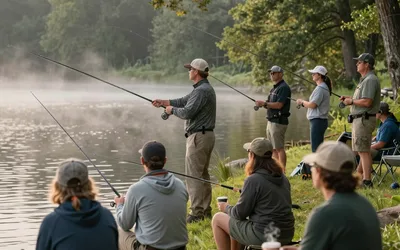
On a Wednesday morning in late October, a dozen people will stand along the shore of Holman Lake in Perry County, learning to throw a loop of fly line into the wind. The occasion is the Coffee and Casting Meet-Up, a free two-hour program run by staff of the Pennsylvania Fish and Boat Commission at Little Buffalo State Park, scheduled for 9 to 11 a.m. on October 21, 2026. Coffee is provided. So is the instruction, which is the point.
The event is deliberately small. The registration page for the program lists 12 seats, all of them open as of this writing, and the commission's own description sets the tone: these gatherings "offer minimal formal instruction, while providing on-water fishing experiences" and are "social gatherings for participants interested in learning more about basics." In other words, this is not a lecture. Participants will spend time practicing fly rod casting with PFBC staff on hand for hands-on coaching, and then, once the loops are more or less under control, they will walk down to the shoreline of Holman Lake and try their luck on actual water.
That lake is a fitting classroom. Holman Lake is an 88-acre impoundment created by damming Little Buffalo Creek, and it sits at the center of a 923-acre park in Centre and Juniata townships, roughly ten minutes south of Newport, the Perry County seat. Little Buffalo opened to the public on June 11, 1972, and it has always been a park where recreation and history sit close together. The park takes its name from Little Buffalo Creek and the adjacent Buffalo Ridge. Nobody is entirely sure why. The state's official park history notes that the origin of the name is unknown, but that local tradition holds bison once inhabited the area, a claim that would surprise anyone who has driven through central Pennsylvania lately.
The land's older history is more firmly documented. The Albany Purchase of 1754 acquired the region from the Iroquois League of Six Nations, and the area was gradually settled after the American Revolution by farmers whose descendants still work much of the surrounding ground. In 1808, David Watts of Carlisle built a charcoal-burning iron furnace along Furnace Run just south of the present park, and the demand for charcoal brought colliers into the Little Buffalo Creek valley. Their work was slow and exacting: wood was cut in winter and dried, stacked into mounds 20 to 25 feet across in summer, covered with leaves and then soil or clay, and set to smolder for eight to ten days while the colliers watched for flames and smothered them. Each mound produced 300 to 500 bushels of charcoal, and the wood from a single acre would keep the furnace running for about 24 hours. The Juniata Iron Works smelted iron until the prized hardwoods used in charcoaling were exhausted around 1848. Hikers on the Buffalo Ridge Trail can still find the circular patches of darkened earth where those burns stood.
Later came the mills. Shoaff's Mill, a 19th-century grist mill, survives in the park and still grinds cornmeal during seasonal demonstrations, its water wheel turning for visitors on select holiday weekends and during the park's October Apple Festival. Nearby stands Clay's Covered Bridge, an 82-foot span built in 1890 that once carried traffic over Little Buffalo Creek before the lake existed. The mill and surrounding structures are part of the Little Buffalo Historic District, listed on the National Register of Historic Places. The park also preserves the shallow, pond-like depressions of the old clay pits that supplied Perry County's pottery industry through the 1800s.
Holman Lake itself has a reputation among anglers. The Fish and Boat Commission's Area 7 biologist reports include a 2015 survey of the lake, and the commission stocks it with adult rainbow trout in the fall; in October 2025, 1,200 adult rainbows went into the water there. That timing is not incidental to the October 21 program. Fall is when the lake is freshly stocked and the weather is cool enough to make a morning on the shore pleasant, and it is also when a beginning caster can reasonably hope to hook something.
The commission runs a broader menu of free fishing programs across the state, from Introduction to Fishing sessions to Family Fishing Programs aimed at families with little or no experience, and dedicated fly-fishing courses for anyone 12 and older covering equipment, knot tying, casting technique and on-the-water skills. Equipment is provided at those programs, and the fishing license requirement is waived for participants 16 and older for the duration of the event. The Coffee and Casting Meet-Up belongs to the more informal end of that spectrum, closer to a standing invitation than a curriculum. The registration page lists Matthew D. Truesdale as the organizer, and it notes that cancellations must be made before 9 a.m. on Tuesday, October 20.
What the morning offers, then, is modest and specific: two hours, a cup of coffee, a rod in your hand, and a stretch of shoreline on a lake that has been stocked, studied, dammed, milled and farmed over for the better part of two centuries. Registration is required, and with 12 seats, it will not stay open indefinitely. The park is at 1579 State Park Road in Newport. Anyone who has ever watched a fly line unroll and wondered whether they could do it themselves has a Wednesday morning in October to find out.