


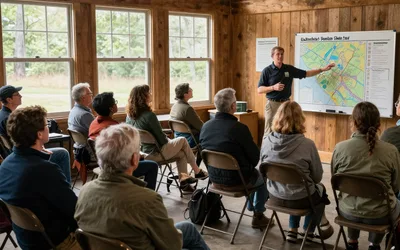
Marsh Creek State Park has never hosted a mentored hunt. That changes in January 2027, and on the afternoon of Wednesday, October 21, 2026, the park will hold a free informational session for people who don't hunt but have questions about what is coming.
The session runs from 1 to 2 p.m. at the park in Downingtown, Chester County. According to the park's event listing, it is aimed squarely at non-hunters: people who want to understand the upcoming hunt, how it fits into the park's management plan, and hunting regulations and safety in general. The park's announcement is blunt about its own novelty -- "Marsh Creek is thrilled to announce our first Mentored Hunt in January 2027" -- which makes this hour-long meeting something of a first too, a chance for the park to explain a hunt to the people who share the land with it rather than only to the people who will carry the bows.
The hunt itself is a partnership. The Pennsylvania Game Commission's hunter resources page describes a "Mentored Deer Archery Hunt at Marsh Creek State Park," noting that the commission has partnered with the Department of Conservation and Natural Resources, which operates the park, to host it. The commission frames these events as opportunities for people with little or no hunting experience to take part in a managed deer hunt while being guided by an experienced hunter. The October session is the earlier, broader conversation -- the one pitched to neighbors and park visitors who may never apply for a permit but who will notice hunters in the woods.
That hunting happens at Marsh Creek at all is not new. During established seasons, hunting is permitted daily on roughly 1,000 acres of land and 450 acres of water in the park, with migratory game bird hunting prohibited on Sundays. The park prohibits all centerfire and rimfire rifles and handguns, a rule that shapes what kind of hunting is practical there and helps explain why an archery hunt is the format for the mentored event. Hunting woodchucks is barred in all Pennsylvania state parks. The park maintains no-hunting zones that include the East Side Day Use Area and the area around Hope Springs Farm, and blinds and stands must carry the owner's contact information. In southeast Pennsylvania, Sunday hunting at Marsh Creek and a handful of nearby parks is limited to three Sundays in the 2026-27 license season: November 15, 22 and 29.
Marsh Creek is not enrolled in the Game Commission's Deer Management Assistance Program, the state tool that lets landowners target antlerless deer with additional tags. That makes a mentored hunt a different kind of instrument -- less about hitting a population number than about bringing new people into a tradition under supervision, on public land, in a park that most visitors associate with sailing, fishing and migrating waterfowl on its 535-acre lake.
The park sits in the rolling hills of north central Chester County, about two miles west of the village of Eagle off PA 100, and covers 1,784 acres. Its landscape is man-made as much as natural: Marsh Creek Lake was created by damming Marsh Creek, a project undertaken to ease local flooding, help with potential water shortages and provide a place for recreation. The lake that resulted is the centerpiece of a park that draws boaters and anglers and, each fall and winter, hunters.
What the park is doing with its January hunt is an echo of something Pennsylvania started two decades ago. In 2006, Pennsylvania became the first state to adopt a mentored hunting season, allowing an experienced mentor to take a newcomer afield under close supervision. The idea spread: according to reporting on the program, 34 additional states have since joined, and more than 1.2 million mentored hunting permits have been issued. The original Pennsylvania program was aimed at youth, launched by the Game Commission to expand youth hunting opportunities while keeping safety paramount; it has since been broadened, including a 2019 commission decision allowing hunters ages 12 to 17 to participate for a maximum of three years. Mentored hunting in Pennsylvania now requires that a mentor be at least 21, hold a valid current hunting license or otherwise qualify for an exemption, and guide the newcomer directly. First-time hunters, by law, must complete a hunter-trapper education course before buying a license -- a requirement that dates to a program begun in 1959, which the commission credits with making hunting steadily safer.
That safety record is likely to be part of the October conversation. So is the question underneath the whole enterprise: why a state park would invite hunters in at all. The Department of Conservation and Natural Resources answers it in forest terms. Deer hunting is the most popular hunting activity on state land, the agency says, and helps maintain healthy forests by managing the deer population. Too many deer browse away the understory that songbirds, small mammals and young trees depend on; hunting is the state's primary lever on that balance. Hunting is permitted in 95 of Pennsylvania's 125 state parks and across all 20 state forests, totaling 2.2 million acres of "big woods."
For a non-hunter, the October session is a low-stakes way to hear that argument made directly, and to ask the questions that listings rarely answer: where the hunt will take place relative to the trails, who the mentors are, and what a visitor should know about sharing the park during the season. The park's event page does not promise a specific agenda, and the hour is short. But the framing is unusual and deliberate. Most hunting information is written for hunters. This one is written for everyone else.
The session is free and open to the public, 1 to 2 p.m. on Wednesday, October 21, 2026, at Marsh Creek State Park, Downingtown. The park office can be reached at 610-458-5119. The park itself is open every day of the year, sunrise to sunset, with day use areas closing at dusk -- and in mid-October, the office is open daily from 8 a.m. to 4 p.m. before its seasonal hours change.