


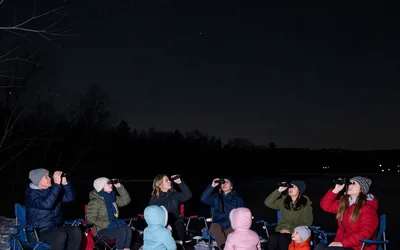
Every October, the Earth plows through a river of dust that a comet left behind centuries ago, and for a couple of hours on a Wednesday night the staff at Black Moshannon State Park want to help you watch it happen. The park's Orionid Meteor Shower program runs from 8:30 to 10:30 p.m. on October 21, 2026, at Boat Launch 2, and it is free. Bring a chair, a blanket, and a friend, the park advises. The program will meet regardless of sky conditions and will only be canceled in the event of rain.
The draw is a shower that most people have seen without knowing what they were looking at. The Orionids are the debris trail of Halley's Comet, and NASA describes them as one of the most beautiful showers of the year. The particles hit the atmosphere at roughly 41 miles per second, fast enough that they can leave glowing trains hanging in the sky for seconds or even minutes, and fast enough that some of them flare into fireballs. Under dark skies, the shower produces about 10 to 20 meteors an hour. The radiant, the point the meteors appear to stream from, sits just north of Betelgeuse in Orion, which means the shower arrives framed by some of the brightest stars in the night sky.
The Orionids are active each year from October 2 to November 7, and the peak falls around October 21, which is why the park picked that night. NASA lists the 2026 peak night as October 21-22. The shower is visible from both hemispheres in the hours after midnight, but the park's two-hour window is a compromise between a reasonable bedtime and a dark sky, and the surrounding forest does much of the work.
That setting is the reason the program makes sense here. Black Moshannon State Park covers 3,394 acres of forests and wetlands in Centre County, about nine miles east of Philipsburg, and more than 43,000 acres of Moshannon State Forest surround it, creating what the Department of Conservation and Natural Resources calls a remote and wild setting. The park sits atop the Allegheny Front, and the elevation helps. Astronomy reference site Go-Astronomy rates the park a Bortle Class 3 dark sky location, a scale on which lower numbers mean darker skies, and travel guides to central Pennsylvania routinely single it out as darker than most of the region. Pennsylvania has a famous darker site still, Cherry Springs State Park, which DCNR named the state's first dark sky park in 2000 and which later earned Gold Level International Dark Sky Park status; Black Moshannon is the more modest, closer-to-home version of the same idea.
The park's history is bound up in the same landscape that makes the sky readable. According to local tradition, Native Americans called the watershed "Moss-Hanne," meaning "moose stream," and the "black" in the name describes the tea-colored water of the 250-acre lake, tinted by tannins as clear springs and small streams filter through the surrounding bogs. Seneca people hunted, fished, and traded here when the lake was a string of beaver ponds. By 1821 the Philadelphia-Erie Pike, now PA 504, had opened and a tavern called the Antes House served travelers and livestock drovers crossing the Allegheny Front. Then came the loggers. Towering white pines and hemlocks once shaded the slopes so densely that the forest was dark even on sunny days, and the Beaver Mill Lumber Company cut them. When the timber was gone, the mills closed, and the Commonwealth began buying up the burnt and desolate land. Starting in 1933, the Civilian Conservation Corps operated ten camps in the forest and built the dam, cabins, pavilions, and trails that the park still uses; the park itself was established in 1937.
What the rangers will talk about, though, is a comet. Until the time of the English astronomer Edmond Halley, comets were believed to make only one pass through the solar system. In 1705, Halley used Isaac Newton's theories of gravitation and planetary motions to compute the orbits of several comets, noticed that the bright comets reported in 1531, 1607, and 1682 traced suspiciously similar paths, and proposed that the three were a single comet making return trips. He predicted it would come back in 1758. It did, though Halley did not live to see it; he died in 1742. The comet was later named for him, and it became history's first known periodic comet. Its appearances have since been traced back more than 2,000 years, including a star-crossed cameo in the Bayeux Tapestry, which chronicles the Battle of Hastings in 1066.
Each time Halley returns to the inner solar system, its nucleus sprays ice and rock into space, and that debris stream is what produces not one but two annual showers: the Orionids in October and the Eta Aquariids in May. The comet itself was last seen in Earth's skies in 1986, when an international fleet of spacecraft met it for close study, including Japan's Suisei and Sakigake, the Soviet Union's Vega 1 and Vega 2, the European Space Agency's Giotto, and the international ISEE-3. NASA puts its next return in 2061, on its regular 76-year journey around the Sun; the comet is calculated to reach perihelion, its closest approach to the Sun, on July 28 of that year.
That is the long game the park is playing. The Orionids are, in a literal sense, Halley's Comet as experienced from Earth in the decades between visits, and the October program frames the shower as a way to learn about the comet's discovery and history while looking ahead to its return. It is a strange and appealing pitch: come stand by a boat launch on a plateau in central Pennsylvania, watch a few streaks of ancient comet dust burn up overhead, and mark your calendar for 2061.
The practical details are simple. The program is free, it runs two hours, and it happens at Boat Launch 2 at Black Moshannon State Park, 4216 Beaver Road, Philipsburg. The park asks attendees to bring a chair and a blanket, and suggests bringing a friend. It will go on under clouds as well as clear sky, so the comet history and the meteor science are not contingent on the weather, and only rain cancels. Anyone who wants to confirm details can reach the park office at 814-342-5960.