


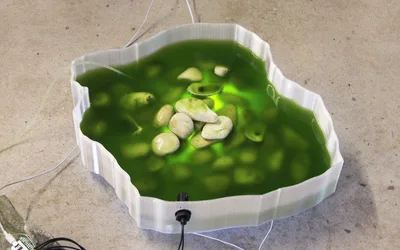
On the evening of September 3, 2026, the Galerie de l'UQAM will open its doors to something that is not quite an exhibition, not quite a laboratory, and not quite a living organism — though it is, in a sense, all three at once. Dystrophe, the graduating master's project of Montreal-based interdisciplinary artist Gabrielle Turbide, transforms the gallery's space into a speculative salt marsh, a constructed ecosystem where photosynthetic microorganisms, salvaged electronics, copper pipes, concrete, and algae-derived bioplastics coexist in precarious, ever-shifting relation. Running from September 4 through October 17, the installation is a meditation on eutrophication, resilience, and the strange co-evolution of the living and the technological.
The title itself is a clue to the work's conceptual engine. Dystrophe draws on the ecological term "dystrophization," the terminal stage of eutrophication — the process by which aquatic environments become enriched with nutrients, usually phosphorus and nitrogen, until algae and phytoplankton bloom explosively, oxygen is depleted, biodiversity collapses, and the water slowly suffocates. Accelerated by human activity, this imbalance is one of the quiet catastrophes of the Anthropocene. But Turbide is less interested in documenting the disaster than in what comes after it. In her telling, dystrophization marks a transition toward other ecological forms, a point where disappearance becomes a condition of renewal. "The installation invites viewers to observe the precarious dynamics that emerge within vulnerable environments," she writes, "where disappearance, transformation, and adaptation are all part of the same ecological cycle."
That cycle is made visible through one of the most unusual photographic processes in contemporary art: chlorophyll printing. The technique exploits the green pigment's sensitivity to ultraviolet light. In Turbide's hands, a raw cotton canvas is coated with a dense culture of phytoplankton, covered with a matrix printed on acetate, sealed between transparent acrylic plates, and exposed to UV light for roughly twenty-four hours. Where the light reaches the chlorophyll, the pigment degrades and the image appears — no chemical agents, no darkroom, no fixer. The result is an image that is alive, or at least latently so. The plankton, like the print, enters a state of latency, a resistance mechanism that allows it to survive dehydration. When the environment is right, the culture can be reactivated, regaining vitality within the image itself. The prints are, in Turbide's terms, "sensitive bioarchives" — simultaneously evolving and latent, the direct imprint of what endures at a biological level.
The matrices used to make these prints are themselves derived from photographs of eutrophic water bodies, so the images carry the trace of the very phenomenon they depict. The phytoplankton species involved — Tetraselmis and Nannochloropsis — are cultivated in a tubular reactor that maintains a continuous supply of nutrients, light, and carbon dioxide, then transferred to a decanter where gravitational sedimentation concentrates the densest particles into "water blooms" that serve as the raw material for the prints. The same cultures also feed biophotovoltaic cells, experimental devices that generate small amounts of electricity from the photosynthetic activity of the algae. Turbide calls these handcrafted biotechnologies: a low-tech, experimental, and manual reappropriation of techniques derived from life-integrating technologies, designed for accessibility and investigative potential.
The installation itself is assembled from five modular structures built from recycled and raw materials — copper pipes, concrete, bioplastics made from algae, salvaged electronic components, and 3D-printed parts. Among the works on view are Intertidal (2026), a piece combining anthotypes, 3D prints, phytoplankton, rocks, plastic, a peristaltic pump, and electronic components; Cellules biophotovoltaïques (2025), built from 3D printing, phytoplankton, concrete, copper, and electronics; and a Plankton decanter (2025) that pairs decanters, phytoplankton, ceramic, sea sponge, copper, and rock. Together they form a hybrid environment where living, industrial, and technological materials coexist, a living system that evolves according to its environment and physical conditions. Over the course of the exhibition, the chlorophyll prints will degrade and transform, following cycles of degradation and reactivation that make the work's temporality — its slow, unscripted change — an integral part of the experience.
Turbide's path to this work has been deliberately cross-border and cross-disciplinary. She holds an interdisciplinary bachelor's degree in digital arts completed jointly at the Université du Québec à Chicoutimi and the Universidad de los Andes in Colombia (2023), and she is currently completing a master's in Visual and Media Arts at UQAM. Along the way she has collected a string of recognitions: the Faculty Fund grant of UQAM's School of Visual and Media Arts (2023), the Arprim/School of Visual and Media Arts production grant (2024), and, in 2026, the New Horizons Prize from the Grantham Foundation for Art and the Environment. She is a member of the Hexagram research-creation network in Montreal and the Ubchihica Center for Research and Creation in Digital Arts in Chicoutimi, and her work has been presented in group exhibitions and conferences in Canada, Colombia, Mexico, and Morocco.
The exhibition is accompanied by a public program. On Wednesday, September 23, from 5:30 to 6:30 p.m., Turbide will give an artist talk as part of the gallery's L'art observe series, discussing her artistic approach and the research undertaken during her academic career, and revealing the processes and ideas underlying the installation.
What makes Dystrophe remarkable is not merely its technical ingenuity but its philosophical stance. Turbide refuses the easy opposition between the natural and the technological, between the pristine ecosystem and the degraded one. In her speculative salt marsh, the algae that bloom into ecological catastrophe are the same organisms that sequester carbon and form the base of the aquatic food chain; without them, our atmosphere would be radically different. Eutrophication is destructive at the ecosystem level, yet it also creates favorable conditions for microalgae proliferation. This ambivalence becomes the conceptual engine of the work, which materializes a space oscillating between regeneration and disappearance, utopia and dystopia. Marshlands, she notes, are "liminal landscapes" situated between landscape and anti-landscape, order and disorder — places whose value lies in moving beyond the picturesque toward an appreciation grounded in evolutionary biology and ecology, and in the poetics of their imperceptible phenomena.
In that sense, Dystrophe is less a warning than an invitation to look differently — at the fragile machines, the latent images, the living cultures that will shift and fade over the six weeks of the exhibition. The work asks its viewers to observe a precarious ecosystem in constant transformation, and to recognize in that transformation the dynamics of co-evolution between the living and technology. Disappearance, in Turbide's universe, is not the end of the story. It is, as she puts it, a condition for renewal.