


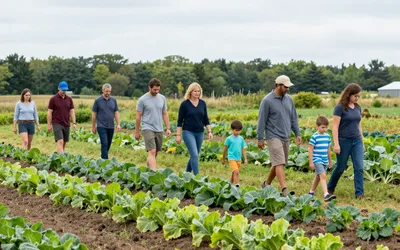
The fields at 20 Moitoza Lane don't look like much of a laboratory. They look like a farm: rows of vegetables, herbs, edible flowers, the odd patch of flax standing in for a fiber crop. But on Monday, October 5, from 5 to 6:30 p.m., the Eastern Rhode Island Conservation District will lead a free walking tour through these Portsmouth fields, and the subject is less the produce than the ground underneath it — how regenerative practices build soil, sequester carbon, and, in the process, grow more vegetables.
Registration is required through Eventbrite, but the tour is open to all. Organizers ask visitors to come dressed for the weather and prepared for uneven farm terrain; the walk happens rain or shine. The event is presented in partnership with the USDA Natural Resources Conservation Service Rhode Island, and the required accessibility notice — with a contact for disability accommodations and the 7-1-1 relay — is a reminder that this is, formally, a federal conservation outreach event as much as a farm stroll.
That framing matters, because the farm itself is a case study in how conservation money, land trusts, and a small farm business can line up. The property is two parcels totaling 11.48 acres on Moitoza Lane, inside the St. Mary's Pond and Sisson Pond drinking water supply watershed, with soils the Aquidneck Land Trust describes as 100 percent prime farmland. When the parcels hit a hot real estate market in 2021, ALT's conservation director, Alex Chuman, reached out to Paul and Sylvia Zurlo, who owned adjacent farmland, about partnering on a conservation purchase. The Zurlos bought the property that year; ALT paid for a conservation easement covering both parcels in early 2023, after an appraisal of the development rights. Apart from outzones around two existing houses, the whole property is now conserved in perpetuity — roughly two-thirds farmland, one-third natural vegetation.
"I am really pleased that this property has been conserved," Paul Zurlo said at the time. "The land will remain as open space and will provide local farmers with prime land to farm." The Zurlos then leased the farmland to Hawk & Handsaw Farm, a small market operation that sells wholesale and runs a CSA. Chuman called it "a success story for farmland conservation on the island," noting the property had been historically farmed and "was well suited to be farmed again."
Hawk & Handsaw is an openly queer-run farm — a fact the business treats not as a footnote but as part of its stated mission. The farm's own materials describe an emphasis on "creating and maintaining a welcoming, engaging, and thoughtful space for all community," and list among its practices hosting public events with local queer-run organizations, offering sliding-scale pricing and payment plans at its farm stand and markets on the principle that "access to quality local food is a right that is too often allocated as a privilege," and working with chefs who put seasonal local produce on their menus. Since 2020, the farm has supplied vegetables to the Martin Luther King Jr. Community Center in Newport through its Produce to the People program, which distributes food to underserved residents of Newport County.
The farm sits on Aquidneck Island, on land the operation acknowledges as occupied Narragansett and Pokanoket territory, and its materials point supporters toward Indigenous-led efforts including the Tomaquag Museum and the Pocasset Pokanoket Land Trust. What it grows is broader than a typical market garden: vegetable crops, culinary and medicinal herbs, edible flowers, bast fiber and natural dye crops, and native and eco-type native nursery plants sold in pots. The fiber side is not a sideline. Kidder, one of the farm's operators, is described by the artist May Babcock as bringing more than a decade of experience growing, harvesting, and processing flax fiber — the kind of knowledge that once made Rhode Island's textile economy possible and now survives mostly in small, deliberate plots. The Southeastern New England Fibershed lists the farm among its producers for exactly this reason, citing fiber flax varieties, dye plants, and other plant-based craft materials alongside the vegetables.
That combination — food, fiber, dye, native nursery stock — is what makes the farm a useful teaching site for the conservation district. Regenerative agriculture is a slippery term, but the practices the tour promises to show are concrete: keeping soil covered, disturbing it as little as possible, keeping living roots in the ground, and cycling nutrients rather than importing them. The Aquidneck Land Trust's 2023 announcement noted that the farmers practice no-till agriculture. The claims attached to those methods — building organic matter, holding carbon in the ground, improving water infiltration in a drinking-water watershed — are precisely the outcomes the NRCS pays farmers to pursue.
ERICD administers that relationship locally. Through its partnership with NRCS, the district offers Rhode Island farmland and forest owners technical and financial help addressing natural resource concerns, drawing on programs including EQIP, the agency's flagship conservation program; EQIP IRA, which targets carbon sequestration, greenhouse gas reduction, and soil health; CSP, for landowners building on existing conservation work; and ACEP, which funds the conservation easements that made this very property possible. The district lists participating landowners across Barrington, Jamestown, Little Compton, Middletown, Newport, Portsmouth, Tiverton, and Warren, and runs local farm tours as part of the outreach. The People's Garden program, funded through an agreement among Rhode Island's three conservation districts, extends the same idea to community gardens and high tunnels.
So the October walk is a chance to see the whole chain in one place: a land trust that bought development rights, a federal agency that pays for soil-building, a conservation district that brokers the help, and two farmers who took a piece of former farmland and put it back to work. The tour's own description keeps the promise modest — walk the fields, see how regenerative practice builds soil, sequesters carbon, and grows more vegetables. But the subtext is a question that matters well beyond Portsmouth: whether the practices that keep carbon in the ground can also keep a small farm in business, and whether conserved land can stay both protected and productive.
The farm sells at Anna D's Cafe Farmers Market on Sundays, the Aquidneck Growers Market in Newport on Wednesdays, and the Portsmouth Farmers Market on Thursdays at the Glen Park Polo Fields, with 2026 market details still being finalized. Visitors who want to see the fields before the season turns should register for the October 5 tour in advance; space is free, but it isn't unlimited. Sturdy shoes, as the notice says, are recommended — the terrain is uneven, and the point is to get out into it.