


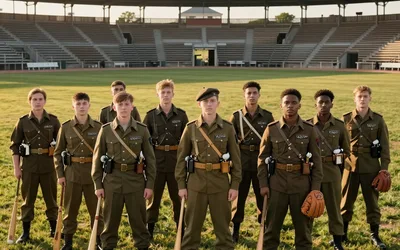
On the evening of October 6, a stretch of grass that has hosted baseball since 1908 will fill with soldiers and sailors who have been dead for more than a century — or at least with the closest thing Newport can offer. For the ninth year running, students of the U.S. Naval War College will pull on period-accurate World War I uniforms, split into Army and Navy squads, and play a free, open-gate baseball game at Cardines Field under the lights. Gates open at 4:30 p.m.; the first pitch is at 5:30.
The game is a living-history exercise, but the history it revives is real, and it happened an ocean away. On July 4, 1918, with the Great War grinding toward its final months, Rear Adm. William S. Sims — then commander of all U.S. naval forces in Europe and a two-time president of the Naval War College — organized an Army-Navy baseball game in London. Sims was a relentless modernizer who had spent his career pushing the Navy toward readiness, and he understood that the game was never only a game. As the Naval War College has put it, the contest was meant to make a statement about American spirit, identity and firepower on an international stage, and to build confidence among European allies watching from the stands.
It worked, at least as spectacle. The 1918 game reportedly drew some 70,000 spectators. Among them was King George V, who signed the game ball. For a few hours on Independence Day, an American pastime carried across the Atlantic became a piece of statecraft: a demonstration that the arriving Yanks were not merely reinforcements but a culture, a confidence, a nation.
That is the thread the Cardines Classic has been pulling since 2018, when the Naval War College hosted the first of these annual re-creations. The event is organized in collaboration with the college and the Naval History and Heritage Command, and is sponsored by the Pritzker Military Foundation on behalf of the Pritzker Military Museum & Library. Each year, students suit up as both Army and Navy, and the game is played, as the college frames it, as much for camaraderie and strategic thinking as for sport. Rear Adm. Darryl Walker, president of the war college, has described the event as a chance to engage with "historical lessons about statecraft and creative diplomacy that are part of any military conflict," adding that there is "nothing more American than baseball and no better way for our war college team to connect with our very supportive neighbors here in Newport."
The venue makes the tribute land harder. Cardines Field, at 20 America's Cup Avenue, is believed to be one of the oldest ballparks in the United States — a small urban gem, as it has been called, wedged between the residential and commercial blocks of downtown Newport. It was first used as a baseball sandlot in 1908, originally under the name Basin Field. It was later renamed for Bernardo Cardines, an Italian immigrant and U.S. Army soldier regarded as the first Newport resident killed in the First World War. According to the Newport Historical Society, he died in battle near Thiaucourt, France, in September 1918 — the same autumn the war ended, and just weeks after the London game that this event commemorates.
So the Cardines Classic is a rare kind of civic ritual: a ballgame that is also a memorial, staged on ground named for a man who never came home, in honor of a game played to steady a world at war. It costs nothing to attend. There are no tickets to chase and no reserved seats — you walk in, find a spot along the fence or in the stands, and watch students in wool uniforms play nine innings the way it might have looked a hundred years ago. The schedule has shifted over the years; the eighth Cardines Classic was held in May 2026, and this ninth edition lands in early October, a date the organizers note was moved from its original September 26 slot. Weather has nudged the game before, too, but the format has stayed constant: Army versus Navy, first pitch at 5:30, free and open to anyone who shows up.
What you get for that free admission is a small, strange, affecting evening. The uniforms are the hook, but the point is quieter. Baseball followed the fleet, as the war college's own account puts it, becoming an international calling card for American naval forces on the global stage — and for one summer evening in 1918, a diamond in London was where America introduced itself to its allies. A century later, on a patch of Newport grass named for a soldier from that same war, the introduction is repeated. The players are graduate students now, not doughboys, and the stands hold a few hundred neighbors rather than 70,000. But the first pitch still comes at 5:30, and the gates, as always, are open.