


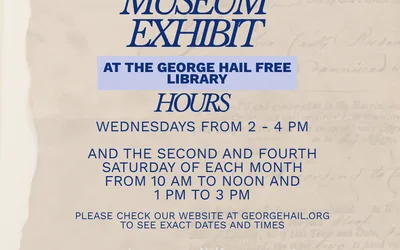
On the afternoon of October 14, 2026, a small door off the antechamber of the George Hail Free Library in Warren will be propped open, and anyone who walks through it at 530 Main Street will step into a room that has been collecting the town's oddities and treasures since 1889. The Charles Whipple Greene Museum, which keeps regular hours on Wednesdays and on the second and fourth Saturdays of each month, will be open that day from 2 to 4 p.m. for a special occasion: a new exhibit on the Revolutionary War, mounted to mark Warren's 4th of July 250th.
The exhibit is the latest chapter in a story that begins long before the museum had a name. The library itself started in 1871 as the Warren Public Reading Room Association, opening on the second floor of a commercial building at the corner of Main and Market Streets. By 1876 it had moved to the Cyrus Peabody building and held 3,200 volumes. A transformative gift arrived in 1882, when Martha Hail donated substantially in honor of her late husband, George Hail. Her condition was that the library take his name. Additional contributions from John Davol and John O. Waterman funded a new building, constructed in 1888 and dedicated in January 1889.
That building, designed in the Romanesque Revival style by the Providence firm of William Walker and Sons in the manner of H. H. Richardson, cost just over $16,000 and was built of granite. It has stood as a cornerstone of the community for well over a century. And it was on the day of its dedication, January 8, 1889, that the museum was born, set aside as an "antiquarian room" to house historic artifacts, antiques, and curiosities. According to a January 22, 1899 article in the Providence Sunday Telegram, the idea for an antiquarian room came from the efforts of Judge Benjamin M. Bosworth and Theo Warren, who became chairman of the newly established Antiquarian Committee.
What the committee gathered over the decades is a cabinet of a seafaring town's memory. The collection divides into domestic artifacts, military items, maritime objects, and Warren materials from the schools and fire department. Among the maritime holdings are astrolabes, half hulls, scrimshaw, sextants, ships' documents, and a whaling log. The manuscripts include two journals of Luther Cole, who participated in the California Gold Rush; a section of a whaling log from the ship Chariot; a George Washington signature; and the papers of L. E. Simmonds, a naval officer and Warren resident who was also the son-in-law of James Maxwell. The museum also holds works by local authors, among them Hezekiah Butterworth, who wrote books for young people and poetry, and whose ZigZag travel series is well represented, along with books by Walter Stanley and George H. Coomer.
It is a fitting place to tell a Revolutionary story, because Warren's Revolutionary story is unusually vivid. The town sits on Mount Hope Bay, and in May 1778 it found itself on the front line of the war. The Mount Hope Bay raids, conducted by British troops on May 25 and 31 of that year, struck communities along the bay's shores. In Warren itself, the British burned the Baptist meeting house and other buildings and ransacked homes and property. The new exhibit at the Greene Museum will gather the town's Revolutionary-era material into a single display, timed to the 250th anniversary of the Declaration of Independence and to Warren's own observance of that milestone.
The 250th is a statewide and national occasion. Communities across the state have been marking the anniversary with programming of their own. The library's exhibit is a quieter entry in that calendar: not a parade or a ball, but a room of objects, open for two hours on a Wednesday afternoon, free to anyone who comes in.
That openness is in keeping with the museum's character. The library has been working to improve access to the collection and would like to be open more hours, and it has put some of its history online through digital exhibits developed with the Warren Preservation Society and the Massasoit Historical Association, with funding from the Rhode Island Council for the Humanities. Those virtual projects include "Luminous Coasts," on the Warren artist, photographer, and author Henry Newell Cady, and "A Tale of Two Centuries," on Mary Merchant DeWolf and Rachel Howard DeWolf, a mother and daughter from Warren whose lives touched suffrage and public service. The museum's own collection is also available to view online, as the event listing notes.
For a visitor on October 14, the appeal is simpler than any of that. The George Hail Free Library is a granite Victorian with a story in every corner, and the Charles Whipple Greene Museum is the room where Warren has kept its proof of having lived: the scrimshaw and the sextants, the whaling logs and the gold rush journals, the Washington signature, and now a Revolutionary War exhibit assembled for the town's 250th year. The doors are open from 2 to 4 p.m., and there is no charge to walk in. For anyone who wants a private viewing or a special tour on another day, the library can be reached at 401-245-7686.