


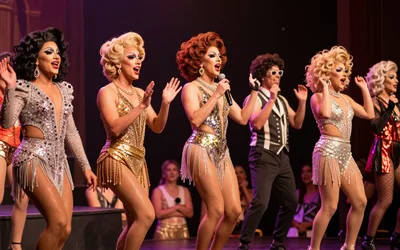
The story BERTHA tells about itself is, by the band's own admission, a tall tale. In the mid-1990s, the legend goes, a deadhead janitor working at Area 51 used top-secret time-travel technology to retrieve Jerry Garcia's severed middle finger from the moment he lost it in 1946, hoping cloning could one day bring the Grateful Dead's late guitarist back. Breakthroughs in the early 2000s, the story continues, found that a compound in LSD could activate dormant genes enough to grow a functioning human body in a lab. The plan was to mix Garcia's DNA with the original Owsley acid. Instead, the vials got switched, and the first seven clones emerged as the bastard children of Garcia's finger and the infamous Brown Acid -- musical mutants with their father's chops but a physical form previously unseen in the jam-band world. Cast out of the lab and orphaned by a failed experiment, these queens each took the name BERTHA in solidarity and formed a band.
None of that happened. But the fact that BERTHA: Grateful Drag introduces itself this way tells you something real about what the group is: a collective that treats the Grateful Dead's mythology with the same irreverent devotion Deadheads have always brought to it, and then adds wigs and full face.
What actually happened is more grounded. BERTHA was born in Tennessee in 2023 as a joyful, defiant response to anti-drag legislation, and it began as a one-night experiment. That first show, at the Analog in Nashville on October 21, 2023, sold out, and a livestream of the performance is still available through nugs.net. What was meant to be a single evening quickly turned into something bigger. Rolling Stone took notice, describing the group as giving the Dead "an irreverent, joyful makeover." The San Francisco Chronicle followed, as did Yahoo Entertainment, which observed that the musicians of BERTHA are "proving that drag queens and the Grateful Dead are not such strange bedfellows." JamBase was more direct about the musicianship: "BERTHA: Grateful Drag is far from a gimmick. These musicians are the real deal and have some of the best harmonies and vocals of any Grateful Dead tribute act."
That last point matters, because the concept could easily have been a novelty. Instead, BERTHA is an all-star collective of queer and allied East Nashville talent. The band is fronted by a harmony trio of performers all working under the name Bertha, backed by a full band likewise composed of Berthas. The sound draws on the high-octane late-1970s and early-1980s Dead, paired with powerhouse female vocals, and the format is the classic one: two sets, roughly three hours, with a fresh setlist every night. For Deadheads, that is the whole point. The band is not selling nostalgia so much as the thing itself -- the long, unspooling evening where the setlist is a rumor until the first notes land.
BERTHA also folds local performers into each stop. Every show features drag or burlesque artists from the host city, and each performance raises money for LGBTQ+ organizations, which turns a concert into something closer to a benefit with a very good house band. In Providence, that means a partnership with PLUS1: one dollar from every ticket sold goes to Rhode Island Pride, the organization that brings together the greater LGBTQIA+ community to commemorate its diverse heritage, foster inclusion, educate, and create awareness of issues while celebrating achievements in equality.
The Providence date lands on Thursday, October 15, 2026, at the Uptown Theater, 270 Broadway. Doors open at 6:30 p.m. and the show is listed for 7:30 p.m. Tickets run $35.49 to $51.49, with all fees included in the price. The venue itself is part of the draw: the Uptown is a restored theater that has been renovated by its owners, with new seating, a general admission pit for concerts, and rebuilt bars. It reopened as one of the state's larger dedicated live-music rooms, and a band that plays three-hour shows needs exactly that kind of space.
There is a particular resonance in BERTHA playing Providence. The band was born as a response to legislation aimed at drag performance in Tennessee, and it has spent the years since turning that response into a touring act that sells out rooms and shares its proceeds with local LGBTQ+ organizations in every city it visits. The Providence stop routes that money to Rhode Island Pride. The band's own framing is that every performance is both a celebration and a cause.
And then there is the name. "Bertha" is, of course, a Grateful Dead song -- one of the most recognizable in the catalog, a staple of the band's live sets from 1971 onward. It is also, in BERTHA's telling, the name seven lab-orphaned clones chose for themselves. Either way, it is a name that gets shouted at Dead shows. On October 15, a room full of first-timers and veteran Deadheads in Providence will be shouting it at a trio of Berthas instead.