


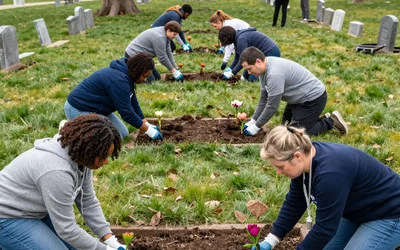
On the afternoon of October 25, 2026, a group of volunteers will gather at the North Burial Ground in Providence with trowels, bulbs and a set of maps that show something visitors cannot see: the lines of old colonial paths that once crossed the cemetery's oldest section, now buried under an unbroken sheet of turf grass. The event is called Paths to Spring, and it runs from 1:30 to 4:30 p.m. at 5 Branch Avenue. The plan is to plant spring-blooming bulbs along two of those historic pathways, so that when the snow melts the routes will reappear as ribbons of color where today there is only lawn. Volunteers will also rejuvenate the mulch pathways around the Randall tomb.
It is a small, hands-on act of remembering, and it fits a place that has been in the business of remembering for more than three centuries. The North Burial Ground opened in 1700, making it the first public cemetery in Providence. Its creation was a direct consequence of how Rhode Island was founded. Roger Williams established Providence in 1636 on a principle of strict separation between religious and civil institutions, which meant the town had no state church and therefore none of the churchyard burial grounds that most New England towns took for granted. Providence families buried their dead in private plots on their own farms instead.
By 1700, town leaders had had enough of that arrangement. A town vote established a municipal cemetery open to the deceased of all faiths, from millionaires to paupers, and even to emancipated slaves. Forty-five acres were set aside, ten of them for graves and the remainder for a town common and militia training ground. The result was a cemetery unlike the churchyards of neighboring colonies, and the difference still shows in who is buried there. The city's Parks Department, which owns and operates the grounds today, describes the North Burial Ground as a place where all of Providence's people are welcome, and notes that among the governors, mayors, Revolutionary and Civil War leaders and prominent citizens lie Black people, Indigenous people, immigrants, religious minorities and the poor.
Over three centuries the cemetery has also become a kind of outdoor textbook of American landscape design. The oldest sections still reflect the plain, utilitarian character of an eighteenth-century graveyard. In the mid-nineteenth century the Rural Cemetery Movement remade cemeteries as landscaped walking parks, with elaborate plantings, winding paths and architectural flourishes like the Receiving Tomb and the Marble Staircase entrance. Later sections follow the Lawn Park Cemetery movement, with its open vistas. Today the grounds cover roughly 110 to 113 acres, hold more than 40,000 gravestones, and accept 220 to 225 burials a year, making the North Burial Ground one of the largest municipal cemeteries in Southern New England. It was added to the National Register of Historic Places in 1977.
That layered history is exactly what makes Paths to Spring more than a gardening morning. The two pathways the volunteers will plant lie in the colonial section, covered in turf grass and otherwise unmarked. Much of the research into the grounds comes from the North Burial Ground Project, an effort begun at Rhode Island College. Francis J. Leazes Jr., a professor of political science and public administration at the college, conceived the project, and with historian Ronald Dufour he won a Rhode Island College faculty research grant to launch it in 2011. Students and faculty in public administration, political science, history, geography, computer information systems and digital media have worked on it since, producing a series of online walking tours that feature 129 individuals buried in the cemetery. The project's stated mission is to make the historic cemetery an educational and economic asset for Providence, the state and the region.
That work has helped turn the North Burial Ground from an overlooked expanse on the city's north side into a destination. The project, in cooperation with the Providence Parks Department, the Friends of Providence Parks and the Friends of NBG and Randall Park, produced a Halloween walking tour of the cemetery for four years running; before the pandemic, it drew about 150 people annually, with six or seven different figures from the grounds returning each year to tell their stories. The Randall name in that partnership points to the tomb whose mulch paths volunteers will tend on October 25, a landmark in the cemetery's older precincts.
Planting bulbs along invisible roads is a modest gesture, but it is the kind of gesture that has kept this cemetery alive as a public place rather than merely a repository of graves. A path that has been grassed over for two centuries is not gone; it is simply waiting for someone to notice it. Bulbs are a practical way of noticing. They naturalize, returning year after year without replanting, and they bloom in the first warm weeks of the year, when few people think to walk a cemetery. A drift of daffodils or tulips tracing a colonial right-of-way will do what no interpretive sign could: it will make the old geometry legible at a glance, and it will do so in the one season when the grounds are at their most inviting.
The event is free and open to the public, and it is scheduled for late October, the correct moment in southern New England to get bulbs into the ground before the first hard freeze. Volunteers should expect to spend the afternoon on their knees in the turf of the colonial section, working along lines laid out on a map, and then hauling mulch around the Randall tomb. The work is straightforward; the meaning is not. Every bulb goes into ground that has been set aside for the dead of an entire city since 1700, in a cemetery founded on the then-radical idea that no one's faith or fortune should determine where they are buried. To plant a path there is to add one more layer to a landscape that has been accumulating them for 326 years, and to leave something behind that will come up green and yellow and white every April, pointing the way down a road that only the flowers remember.