


Every September, as the prairie sky turns that particular shade of gold that means the combines will soon be rolling, the town of Rosthern, Saskatchewan, does something quietly remarkable. It throws open its doors, closes its main street, and invites everyone within driving distance to a two-day festival that costs nothing to enter and offers everything from quilts to quarter horses, from pancake breakfasts to fireworks. The sixth annual Rosthern Harvest Festival, set for September 18 and 19, 2026, is a celebration that on its surface looks like any small-town autumn gathering. But its story runs far deeper—through pandemic isolation, the trauma of a nearby tragedy, and more than a century of immigrant farming heritage.
The festival's origins are surprisingly recent and surprisingly specific. It began in 2021, organized by the Rosthern Agricultural Society, and it was born out of a peculiar kind of desperation. That year, the community's traditional July country fair and rodeo had been cancelled due to the COVID-19 pandemic, and the Ag Society was in the midst of moving its rodeo grounds to the Seager Wheeler Historic Farm, seven kilometres east of town. Guylaine Green, then secretary of both the Ag Society and the Chamber of Commerce, described the process as "good old-fashioned strategic planning"—two organizations sitting down in September and deciding to try something new.
But there was another, darker reason the town needed a gathering that fall. Just days before those first festival plans were finalized, on September 8, 2021, the community had been shaken by the arrest of Myles Sanderson, the suspect in the James Smith Cree Nation and Weldon stabbing attacks, just outside Rosthern. "People were scared," Green recalled. "Any opportunity you have to bring your family out is so crucial." The Harvest Festival became, in its first year, a way for a rattled town to exhale together—a chance to reclaim its streets, its park, and its sense of normalcy under a bright September sky.
In 2024, with the approval of the Rosthern Town Council, leadership of the festival transitioned from the Ag Society to the Town of Rosthern's Recreation Department. Today it's hosted in partnership with local sport, culture and recreation organizations, service agencies, and the business community—a sprawling coalition that includes the Rosthern & District Farmers Market, the Lions Club, the Chamber of Commerce, the Station Arts Centre, the fire department, the library, and dozens of volunteers. The key promise, repeated on the town's website, is that thanks to sponsors, most activities are offered at low or no cost, ensuring that all families can participate and feel a sense of belonging.
That spirit of belonging is woven into the festival's geography. On Friday afternoon, the celebration opens at the Rosthern Museum & Mennonite Interpretive Centre, housed in the striking red-brick building that was originally the German-English Academy, founded in 1905 by Mennonite settlers and later known as Rosthern Junior College. The building—a mix of Georgian and Colonial Revival elements—stands as one of the most visually striking heritage structures in the area, and it serves as the primary historical archive for the town and vicinity. Inside, the Mennonite Interpretive Centre tells the story of how Mennonite culture and faith took root in the Saskatchewan Valley, beginning with waves of Dutch-German-origin settlers who arrived in the 1890s from colonies in the Russian Empire, fleeing pressure toward Russification and military conscription. They came for land and freedom, and they built schools, churches, and communities along the North Saskatchewan River corridor. The quilt show and afternoon tours at the museum offer festival-goers a quiet, contemplative counterpoint to the noise and energy that awaits them in Centennial Park, where wagon rides, family games, and an outdoor movie round out the first evening.
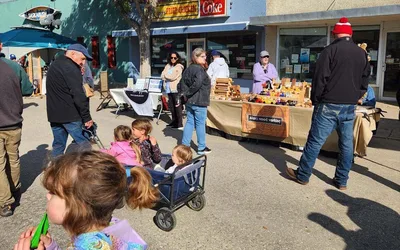
Saturday is the festival's beating heart, and it begins early. At 7:30 a.m., the Jubilee Sports Centre serves a pancake breakfast that fuels the day's parade, which steps off at 10 a.m. from the RJC High School grounds. The parade route winds along 5th Street to 4th Avenue, then over to 6th Street, past the Valley Aquatic Centre to 1st Avenue, and back to 5th Street—a loop that takes in much of the town's commercial and residential heart. Meanwhile, the business corridor along 6th Street closes to traffic to accommodate the street market and the car show, which features vintage classics and custom builds. The 1000 block closes at 8 a.m., and the 2000-3000 block closes once the parade concludes.
In Centennial Park, the day unfolds in layers. There's a slo-pitch tournament on the ball diamonds, balloon creations and face painting for the youngest festival-goers, and inside the Jubilee Sports Centre, bouncy castles, kids' games and crafts, and a Superdogs dog show act. At 2 p.m., the Rosthern Lions Club hosts bingo in the Lions Hall. Seven kilometres east of town, at the Seager Wheeler Farm, the Ag Society's arena hosts a full day of gymkhana events—the equestrian games that test horse and rider through barrel racing, pole bending, and other timed challenges—complete with a food truck and petting zoo.
There is a poetry to holding the gymkhana at Seager Wheeler Farm. The farm is named for Dr. Seager Wheeler, the English immigrant who arrived on the Isle of Wight in 1868 and emigrated to Canada at 17, breaking land by hand near Rosthern in 1897 and living in a soddy with his mother. With no formal agricultural training, only curiosity and relentless work ethic, Wheeler selected and developed Marquis 10B wheat, a hardy, fast-maturing strain adapted to the region's brutal 100-day growing season. He became a five-time world wheat champion, known as the "Wheat King of the Prairies" and "The Wheat Wizard of Rosthern." His farm, now a National Historic Site, is where Canadian agricultural history was rewritten—and it's where the festival's equestrian events now take place, connecting the town's present-day celebration to the very roots of prairie agriculture.
Outdoor events in Saskatchewan are always a weather gamble. The festival's organizers know this well. Past years have seen rain and chilly temperatures, yet the crowds still come—drawn by the chance to enjoy one last outdoor event before the cold of late fall sets in. Food vendors stay busy, the street market bustles, and children burn off seemingly endless energy. That resilience is part of the festival's character, just as it was part of the town's character when it first launched in 2021.
The festival closes as it always does, with fireworks at 9 p.m., bursting over the same prairie sky that once inspired a teenage immigrant to coax abundance from stubborn soil. In a town of roughly 1,600 people, where post offices were established as early as 1893 and the community incorporated in 1903, the Harvest Festival has quickly become a beloved tradition—one that celebrates not just the harvest, but the harvesters. It's a weekend where agriculture, heritage, and community all converge, free and open to all, in a place that knows a thing or two about coming together when it matters most.