


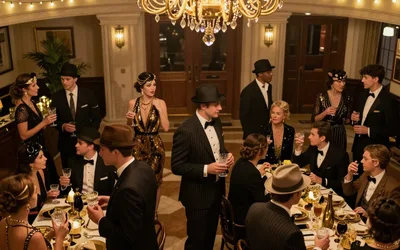
On the evening of October 17, the Biggar Town Hall at 127 1st Avenue will be transformed into something closer to a Long Island mansion than a prairie community hall. A Murder Mystery Dinner Party is coming to town, and the theme is the Roaring Twenties — a Gatsby evening of three-course dining, a fully licensed bar, and a whodunit that guests are expected to help solve.
The event is hosted by a figure named Genevieve "Gigi" Vanderbilt, and doors open at 5 PM. Costumes are encouraged, which is to say that flapper dresses, feathered headbands, and at least a few dinner jackets are likely to appear among the folding chairs. Seats are booked the old-fashioned way, by phone, at 306-430-8000. There is no online ticketing portal, no app, no QR code — just a call ahead to reserve a place at the table.
That small detail says something about how events still work in a town of about 2,100 people, 93 kilometres west of Saskatoon at the junction of Highways 4, 14, and 51. Biggar has never been a place that needed a box office to throw a party. It is a town whose identity was built on the railway, whose newspaper has been publishing since 1909, and whose most famous slogan was reportedly scrawled on a sign by a drunken survey crew.
The Gatsby theme lands with a particular kind of resonance here. Biggar's boom years were the 1910s and 1920s — the very decade F. Scott Fitzgerald wrote about. The town was founded in 1907 by the Grand Trunk Pacific Railway, incorporated as a village in 1909 and as a town in 1911. In 1910, the GTP chose Biggar as a divisional point on its line, which sparked a construction boom and a surge in population. A roundhouse went up, and the town's station was reportedly one of the largest in the Canadian west, complete with an all-night restaurant. By the mid-1920s, Biggar's population had passed 2,000 — roughly where it sits today, having peaked at 2,755 in 1966.
So a 1920s-themed evening in the Biggar Town Hall is, in a quiet way, a nod to the era when the town was at its most bustling — when trains came through at all hours and the station restaurant never closed. The Gatsby aesthetic of champagne, jazz, and conspicuous glamour is a long way from a Saskatchewan divisional point, but the timing lines up almost exactly. Fitzgerald's novel was published in 1925, the same stretch of years when Biggar's population was climbing past 2,000 on the strength of rail traffic.
The town's other claims to fame are decidedly more modern and more local. Biggar is known for its slogan, "New York is big, but this is Biggar," which local legend attributes to an early survey crew who had too much to drink one night and painted the phrase on the town sign as a prank. Evidently the townspeople liked it and adopted it. The town is also the birthplace of Sandra Schmirler, the Canadian and Olympic curling champion, honoured by the Sandra Schmirler Olympic Gold Park. And it is home to the Hanson Buck, a world-record white-tailed deer that has become one of the community's three official public symbols, alongside Schmirler's curling legacy and the slogan itself.
The murder mystery format is a different kind of gathering for a town whose social calendar tends toward agricultural fairs, sports, and community suppers. An interactive whodunit asks guests to do more than eat and mingle — it asks them to pay attention, to interrogate their tablemates, and to accuse someone of murder by dessert. The three-course meal and licensed bar provide the scaffolding; the mystery provides the reason to talk to the strangers across the table. Costumes lower the barrier further, since everyone in a feathered headband is already committed to the bit.
For anyone weighing whether to go, the practical details are simple. The event runs on October 17, with doors at 5 PM at 127 1st Avenue. A three-course meal is included, there is a fully licensed bar, and costumes are encouraged but presumably not required. The only way in is to call 306-430-8000 and book a seat. Whether Gigi Vanderbilt's guests will actually crack the case is, of course, the point — the evening is built around finding out whodunit.
What the mystery's plot holds, and who among the guests is playing the victim, is not something the listing reveals. That is part of the appeal. In a town that has spent more than a century being small enough to know everyone, an evening built on secrets, aliases, and a little bit of theatrical deceit is its own kind of novelty — and a fitting excuse to dress up like it's 1925 again.