


For most of a century, the photographs, documents and family records of Sturgeon Lake First Nation sat in collections the community did not control. This October, the people who live there will gather at the Lloyd Johnson Memorial Healing Lodge to talk about what it took to bring them home, and what happens next now that they are.
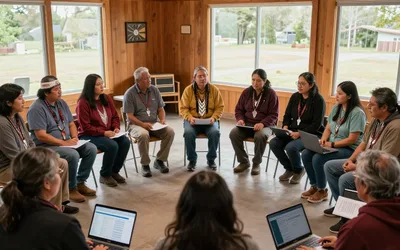
The Miyo-Pimatisiwin Conference runs Oct. 21 and 22, 2026, at the healing lodge on Sturgeon Lake First Nation, about 29 kilometres northwest of Prince Albert. It is a working gathering rather than a showcase: the two projects behind it, Miyo Pimatisiwin and Kiskisiwin, will lay out their process, their research and their findings, and the lodge is inviting community members to register by contacting Lily Naytowhow at [email protected]. Space is limited by the venue, and while people from outside the nation may be accepted, organizers say that is not guaranteed.
Miyo Pimatisiwin means "the good life," or living in a good and healthy way, in Cree. The project began as an inquiry into how a community could improve its health and state of mind by understanding how the past shapes the future. Naytowhow and her colleagues started by going through old documents, photographs and collections held by the nation, then set out to find the families of people in those images who had never been identified. That work opened into genealogies and family trees, and into the question of how those old names connect to the families living in the community today.
They interviewed the knowledge holders who could speak to the photographs and papers, recording their answers in writing and on audio, in both Cree and English. What emerged was not a tidy success story. Elders and knowledge keepers talked about the World Wars, about racism, about the 1960s, and about the struggles and life experience that carried them to the present. "A lot of the time we learned about struggles that they had to deal with and how hard it was for them to get to where they are today and how everything that they did, the way that they lived is a big reflection of why Sturgeon Lake is the way it is today," Naytowhow told the Prince Albert Daily Herald. She meant that in a positive way: from that history, she said, come Cree speakers, a map program that teaches Cree language and storytelling, and the survival of ancient hunting knowledge.
From that material the project built a wheel, a framework for healthier living drawn from Sturgeon Lake's own data rather than from outside models. Its markers include language, socialization, plant and healing knowledge, identity and belonging, understanding of history, participation in ceremony and medicine teachings, and women's teachings and childrearing. The lodge has also opened a birthing lodge, the Shirley Bighead Nihtāwiki and Ohpikihāwasowin Birthing and Childrearing Lodge, which teaches traditional knowledge around womanhood, pregnancy, birthing and the raising of children. "We are digging into the past so that we can revitalize our health in a native way," Naytowhow said.
The project has also become a memorial. Some of the elders and knowledge keepers interviewed along the way have since died, and the archive now holds their voices.
That is where Kiskisiwin comes in. The word means remembrance, or memory, in Cree, and the project, run in partnership with the University of Saskatchewan, studies the long-term health effects of having this material gathered, kept and made accessible. The information collected through Miyo Pimatisiwin has been moved into a digital archive that the nation owns, manages and can reach at any time under its own jurisdiction. Naytowhow describes it as a place where locals can look at their own records and use them however they wish: to learn who their family is, what people ate before colonial times, what the community looked like before it became a digital society.
The stakes are larger than one community's records. Indigenous data sovereignty, the principle that a nation should hold and govern its own knowledge rather than a museum or university, runs through both projects. The archive is designed as an alternative to the long-standing practice of outside institutions collecting, interpreting and controlling Indigenous material, and the conference is partly an invitation to other communities that want to build something similar, identifying their own markers of health and what helps their people live well.
Naytowhow's own story runs through the work. Before the project she did not speak or understand Cree; she has been learning it along the way, and she describes that learning as central to waking up the spirit, finding your place in your community, and finding confidence and acceptance in a Cree identity after a long history of colonialism.
"It's a good way to find out who you are, where you came from and learn just how hard our people worked to get to where we are today," she said. "A lot of people downplay reserves, and they don't recognize how hard some of our great grandfathers and great grandmothers really had to work to have these buildings, these spaces for us to live and see that they too, are responsible for the future and what it looks like."
Sturgeon Lake's history gives that weight. Chief Ah-yah-tus-kum-ik-im-am, known as William Twatt, and four headmen signed Treaty 6 near Fort Carlton on Aug. 23, 1876, and the reserve was set aside in 1878. The band was long known as the William Twatt Band and only took the name Sturgeon Lake Band in 1963. Farming took hold early, with eight tractors on the reserve by 1955; people supplemented their incomes by trapping muskrat on the Sturgeon, Shell and Red rivers, cutting cordwood and working in lumber camps and as housekeepers in Prince Albert. The healing lodge itself is named for Lloyd Johnson, and it is where Willie Ermine, the nation's traditional health coordinator and a retired professor at the First Nations University of Canada, has based decades of work on Cree medicine, knowledge and ceremony. Ermine, a co-organizer of Miyo Pimatisiwin, is widely credited with the concept of "ethical space," a framework for what happens when two societies with different worldviews sit down together.
That idea sits underneath the conference. A community that keeps its own records, in its own languages, on its own terms, is not asking an institution for permission to remember. It is doing the remembering itself, and then deciding who gets to listen. For two days in October, at the lodge on the shore of Sturgeon Lake, that work will be laid out for the people it belongs to. Those who want a seat should write to Naytowhow before the room fills.