


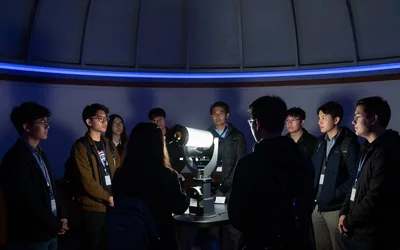
The observatory at the top of Ellis Hall is easy to miss. From the street at 58 University Avenue in Kingston, Ontario, the dome sits above the roofline, and the way in is a set of stairs that most people on campus have never had a reason to climb: through the front doors, straight ahead to the stairs on the left, right on the second floor, up again to the fourth, and down the hallway to the Observatory Presentation Room. On November 6, 2026, from noon to 1 p.m., that route is open to anyone as part of Queen's University's Thrive Month.
The tour is a small thing on a busy calendar, but it sits at the end of an unusually long story. Astronomy in Kingston goes back to 1855, and the Queen's Observatory's own account of its origins begins with a solar eclipse. A solar eclipse in the spring of 1854 stirred local interest in the sky, and the following year a 6.25-inch Alvan Clark refracting telescope was installed in City Park, just east of the Queen's campus. The Kingston Daily News announced the plans on May 3, 1855, in the expansive language of the era: within the park, the paper reported, it was in contemplation to erect an observatory "on a scale of excellence and grandeur which will not only be of great advantage to the minds and morals of the rising generation, and of the citizens at large, but will be of provincial or national reputation."
That observatory, in City Park, was the first optical observatory in Ontario. Its original site is now marked with a plaque, and slabs of the telescope's great stone pillar are still scattered around the park.
The founding push came from a group of local "Gentlemen Amateurs" interested in astronomy, led by Queen's professor James Williamson, who had pioneered the study of science at the college and wanted to connect academic and amateur stargazers in a shared pursuit. The city paid the operating costs at first, then balked. According to the Queen's Encyclopedia, some councillors objected to funding such a specialized facility "which no one knows anything about except a professor and one or two students at Queen's College," and argued that scientific investigation was beyond the city's mandate. In 1861 the city sold the observatory and an acre of the park to Queen's for one dollar, with conditions attached: the observatory had to arrange weekly corrections to City Hall's clock, and the mayor, all councillors and their successors were to have free use of the telescope.
In 1863 Williamson appointed a promising Queen's student, Nathan Dupuis, as curator of the observatory, the first step in a long career in science at the university. The building itself proved restless. Repeated acts of vandalism contributed to a move in 1881 to a site just west of where Carruthers Hall now stands. It was taken down in 1901 and rebuilt in 1909 in a small domed building at the foot of University Avenue, which was in turn destroyed to make way for McLaughlin Hall in 1946. The observatory has been on the roof of Ellis Hall since then, which makes the fourth-floor walk-up the latest chapter in a history of relocation rather than a quirk of one building.
Today the observatory is a non-profit facility run by the Queen's University Astronomy Research Group and the Queen's Physics Department, staffed by graduate and undergraduate students in astronomy. Its own history notes that for well over a century it has provided access to the campus and community through student training and public programs.
The regular public offering is the monthly Open House, usually on the second Saturday of the month, at 7 p.m. from September through April and 8 p.m. from May through August, in Ellis Hall. Each one pairs a talk by a featured astronomer on a current topic in astrophysics with a tour of the facilities, and visitors get a chance to look through the observatory's telescopes, weather permitting, while learning about astro-particle research at the McDonald Institute and the history of physics at Queen's. The observatory's website describes the open houses as a way for it to give back to the Kingston community by sharing its knowledge and facilities with inquiring minds young and old, free of charge. The university also runs daytime tours for schools, summer camps and educational institutions, including a joint programme with the Miller Museum of Geology called The Earth and the Stars!, which links to the science curricula for Grades 4, 6 and 9.
The November 6 event is a different shape: a weekday lunch-hour tour, folded into Thrive Month rather than the Saturday-night schedule. Pairing that programme with a trip to a rooftop telescope dome is not an obvious combination, but it is a coherent one: the observatory has spent more than a century and a half positioning itself as a place where the university and the wider city meet.
The practical details are modest. The tour runs from 12 p.m. to 1 p.m. on Friday, November 6, 2026, at Ellis Hall, 58 University Avenue. The observatory's public programming is free, and its open houses require no registration or RSVP, with tickets provided at the door. The event listing itself does not spell out a registration link, so anyone planning to attend should check the Queen's events calendar page or contact the observatory directly. The observatory also keeps a mailing list and posts on social media for schedule changes, which is worth noting because its open house page warns that it sometimes departs from the regular schedule.
One caveat belongs in any story about an observatory tour: a noon tour in November is not a stargazing session. The monthly open houses are held after dark for a reason, and the observatory's own guidance points visitors to a clear dark sky chart covering cloud cover, darkness and seeing before they arrive. A midday visit is a tour of the facilities and their history rather than a look through the eyepiece, so the draw is the room at the top of the stairs and the story of how it got there.
That story is worth the climb. The institution began with a public subscription of interest after an eclipse, survived a city council that could not see the point of it, changed hands for a dollar, was vandalized, dismantled, rebuilt and displaced four times, and ended up on a roof above a physics building, still run largely by students. On a Friday at noon in November, the door to it is open to anyone who walks up four flights.