


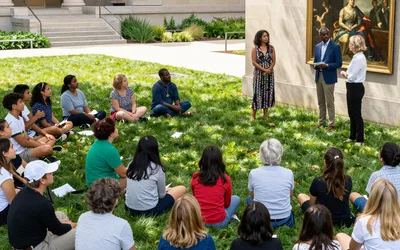
On a Sunday afternoon in mid-October, the Columbia Museum of Art will ask visitors to do something a little unusual: look at the paintings and think about the birds. The program is called Collection Tour: CMA Birdwalk, and it runs from 2 to 2:45 p.m. on October 18, 2026, at the museum at 1515 Main Street in downtown Columbia.
The premise is a genuine crossover. Erin Kuykendall, an art historian and the museum's Kress Interpretive Fellow, will lead the art side of the conversation, walking through works in the CMA Collection and talking about their history and composition. Alongside her will be John Tjaarda, a local birder, who will talk about the birds depicted in each piece. The museum's own description promises facts about the works and about the birds in them, and adds a practical note for anyone who might be picturing a dawn hike: no binoculars required. The event is free with membership or admission, and it is supported in part by a grant from the Dominion Energy Charitable Foundation.
What makes the pairing interesting is that both halves of it are grounded in real institutional history. The Columbia Museum of Art is the only art museum in South Carolina with an international collection, holding more than 7,000 works, organized around four collecting areas: American art, Asian art, European art, and Modern and Contemporary art.
That Kress connection is not incidental to this tour. Kuykendall's position, the Kress Interpretive Fellowship, is a 12-month fellowship for early-career scholars and educators that the museum began hosting in fall 2025. The fellowship is designed to put someone on staff whose job is interpretation -- helping visitors connect with objects rather than simply file past them. Kuykendall has already been visible in that role: the museum has featured her as co-curator of a reinstallation of a collection gallery and as the guide for an introductory tour of a micro-exhibition called Ground. The Birdwalk is a natural extension of that interpretive work, an attempt to give visitors a second lens -- ornithology -- through which to see familiar paintings.
Tjaarda, meanwhile, is a known quantity in Columbia's birding scene. He has led birdwatching programming in the city before, including a family birdwatching walk through the gardens of the Hampton-Preston Mansion and Gardens, organized by Historic Columbia as part of its fall plant sale. That walk, scheduled for October 10, 2026, was canceled because of anticipated bad weather, which makes the museum tour a few days later a kind of indoor consolation for anyone who had been looking forward to it -- same guide, different habitat.
The format itself is worth noting. Museum collection tours are a standard offering, and so are bird walks, but the two rarely share a room. Pairing a specialist in art history with a specialist in living birds turns a gallery stroll into something closer to a conversation between disciplines, where a painted bird is treated both as a compositional device and as a record of a real animal.
The tour is short, 45 minutes, and open to anyone who pays standard admission or is a member, with no reserved seating and no special equipment. The museum asks that visitors who need accessibility accommodations call 803-799-2810 or email [email protected] in advance.
For a city museum, a tour about the birds in the paintings is a small, specific way of looking forward -- an invitation to notice something that was always there, in the background of the frame, and to bring a little of the outdoors inside with it.