


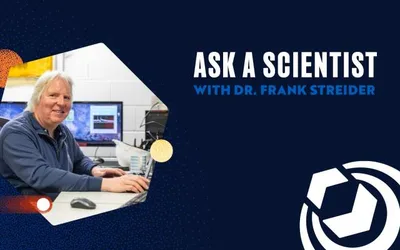
The Sanford Lab Homestake Visitor Center sits on Main Street in Lead, South Dakota, a town that exists because of what was pulled out of the ground beneath it. On the evening of September 28, 2026, one of the physicists who now works in that same ground will pull up a chair and take questions from whoever walks in.
Dr. Frank Strieder is a professor of physics at South Dakota Mines and the principal investigator for the CASPAR experiment at the Sanford Underground Research Facility. The event, part of SURF's "Ask a Scientist" series, is billed as a chance to ask about how stars forge the elements, why anyone would build an experiment nearly a mile underground, and what happens inside a stellar explosion. It runs from 6 to 7 p.m. at 160 West Main Street.
It is a modest format for a career that has been anything but. Strieder earned his master's and doctoral degrees from Ruhr-University Bochum in Germany in 1996 and 2000. Before joining South Dakota Mines in 2015, he was a principal investigator for the Laboratory Underground for Nuclear Astrophysics, or LUNA, the first underground accelerator facility in the world, housed in the Gran Sasso underground laboratory in Italy. He has logged roughly three decades working in underground laboratories around the globe, and he currently chairs the executive committee of the SURF User Association. He has also chaired or co-chaired several editions of the Conference on Science at the Sanford Underground Research Facility, usually held every other year on the South Dakota Mines campus.
His research sits at the intersection of nuclear physics, astrophysics, and particle physics, and his particular interest is nucleosynthesis: how stars build the elements during helium burning, and how the heaviest elements come to exist. The problem, as he describes it, is that the reactions that matter most happen at stellar energies, and measuring them on the surface of the Earth is nearly impossible because cosmic rays drown out the signal. That is why the measurements have historically relied on theoretical extrapolations carrying large uncertainties. It is also why accelerators go underground, where thousands of feet of rock act as a shield.
That logic is the through-line of the whole facility. The Homestake Mine was, until it closed in 2002, the largest and deepest gold mine in the Western Hemisphere, reaching 8,000 feet down and producing more than forty million troy ounces of gold over its lifetime. Its scientific second act began in the mid-1960s, when Raymond Davis Jr. built an experiment in the mine to count neutrinos emitted by fusion in the Sun. Working with theorist John N. Bahcall, Davis designed a detector that turned up only about a third of the neutrinos Bahcall's calculations predicted. That discrepancy became known as the solar neutrino problem, and it stood unresolved for decades. The experiment ran continuously from 1970 until 1994, and the mismatch was eventually explained by neutrino oscillation. Davis shared the 2002 Nobel Prize in Physics for the work.
In July 2007, the National Science Foundation selected Homestake as the site of the Deep Underground Science and Engineering Laboratory, beating out finalists including the Henderson Mine in Colorado. The lab that operates there today, SURF, hosts experiments that can only be done deep beneath the surface.
CASPAR, the experiment Strieder leads, is one of them. The Compact Accelerator System for Performing Astrophysical Research sits on the 4850 Level of SURF, nearly a mile underground, and it recreates the conditions inside stars by smashing protons into specialized targets. In a recent science run, the experiment restarted with a new target: fluorine, the ninth element on the periodic table. Leah Zimmer, a doctoral candidate in physics at the University of Notre Dame who uses CASPAR to study how fluorine forms in early stars, explained the appeal in a SURF write-up: "What I find most interesting about fluorine is that we think the reaction that created this element took place inside stars pretty early on in the universe. We're really interested in studying interactions with fluorine, as it can be a piece of the puzzle as to how the first stars were formed way back in the early universe."
The "Ask a Scientist" series itself is a relatively young tradition. When it was rounding out its first year, SURF reported that nearly a dozen scientists and engineers from the facility and its underground experiments had taken part. The format is deliberately informal. Julia Delgaudio, an experiment support scientist, recalled setting up her station at the visitor center on a miserable day in April and watching the day brighten as guests started asking questions. She brought personal protective equipment for kids to try on, so they could gear up the way scientists do before heading underground. "I love the pure curiosity I see from people," Delgaudio said. "Folks who come to the Visitor Center might be locals who already have some knowledge of what we do, but we also get travelers. People from all backgrounds exhibit this child-like delight over the chance to ask questions, to engage with scientists. In a way, Ask a Scientist events allow the public to understand that Science belongs to all of us. It makes the science accessible to them and lets them see us as real people."
Kelly Kirk, director of the visitor center, framed the program the same way: "Ask a Scientist provides the public with unique opportunities to have one-on-one conversations that are informal and wide-ranging and really connect them to the work at SURF."
The venue is well suited to that mission. The visitor center, owned and operated by the South Dakota Science and Technology Authority, which also manages SURF, describes itself as the northern gateway to the Black Hills. Its exhibits trace the region's story from the flora and fauna that supported Indigenous populations for millennia, through the creation of the deepest gold mine in the Northern Hemisphere, to the Nobel Prize-winning science and the questions still being worked on underground. Visitors can also tour the Yates Hoistroom seasonally, where the massive hoists that once hauled ore are still in use supporting the science below.
There is a certain symmetry in a physicist who studies how stars make elements standing in a building dedicated to a mine that made a town, in a region where the ground itself has been the main character for a century and a half. The Homestake deposit was discovered in 1876 during the Black Hills Gold Rush, on land guaranteed to the Lakota Nation by the Fort Laramie Treaty. The Sioux living near the deposit knew about the gold and had no use for it; the missionary Pierre-Jean De Smet warned Native people not to tell settlers, saying that white men would kill every Indian on the plains if they found out. The mine that followed produced a fortune and, eventually, a laboratory.
On September 28, the doors open and the questions go the other direction. Strieder will be there to answer them, on space, on underground science, and on whatever else a visitor happens to be curious about.