


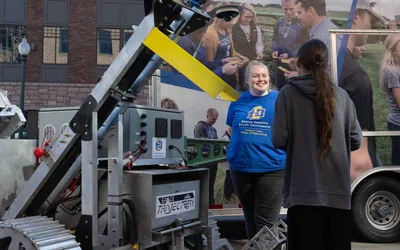
On a Friday evening in October, the stretch of Main Avenue that runs past the Washington Pavilion's quartzite facade will stop being a street. No cars, no parking meters, no through traffic — just rovers, robots and a few hundred people wandering between them. It is the kind of thing that happens in downtown Sioux Falls at the start of each summer month, when Downtown Sioux Falls runs its Open Streets series and turns a rotating block into a car-free playground. What makes Oct. 2 unusual is that Open Streets is happening in the fall at all, and that the organization it has made room for is a university from fifty miles up the interstate.
SDSU Day at the Washington Pavilion runs from 5 to 7:30 p.m. on Friday, Oct. 2, with public activities inside and outside the building at 301 S. Main Ave. Admission is free. Earlier in the day, from 10 a.m. to 3 p.m., scheduled Sioux Falls middle school groups get the run of the programming. Then the doors open to everyone, and the evening folds into the Pavilion's regular Free First Friday, when the Kirby Science Discovery Center and Visual Arts Center waive admission from 5 to 8 p.m.
According to SDSU, this is the first time the university has been invited to extend the Open Streets concept beyond its traditional summer schedule — a small piece of civic trivia that says something about how the partnership has grown. Put the two together and you get an evening with a genuinely unusual amount of free, hands-on programming and no ticket or capacity barrier standing in front of it.
The centerpiece of the outdoor showcase is SDSU Engineering's NASA competition rovers. That phrase is not marketing inflation. South Dakota State has spent years building a reputation as a rover school in NASA's Revolutionary Aerospace Systems Concepts – Academic Linkage competition, better known as RASC-AL, one of the agency's longest-running higher education design challenges. In 2023 the university won its category at the RASC-AL finals. In 2024 it placed second in its category and third overall with a concept called POSEID-N — Prospecting Observation System for Exploration, Investigation, Discovery, and Navigation — competing in a theme about large-scale lunar crater prospecting. NASA's own write-up of the 2024 results lists Virginia Tech first overall and the University of Maryland second, with SDSU third.
This spring brought a different kind of win. SDSU was one of the finalists chosen to compete in the Lunar Sample Return Concept category at the 2026 RASC-AL forum, held June 2–4 in Cocoa Beach, Florida, not far from Kennedy Space Center. SDSU took the lunar sample return category, beating out the field with a plan for extracting and returning lunar surface and subsurface samples to Earth. The other three categories were won by students at MIT.
The team that did it was not a seasoned batch of design engineers. It was three sophomores and two others, according to SDSU's account — a young group that had to pivot away from the rover-building the program is known for, because rovers weren't an option in this year's theme. Todd Letcher, an associate professor of mechanical engineering and the students' project adviser, framed the shift as a feature rather than a problem. "It was nice to have a new challenge that really stretched their understanding of design and what is needed on the moon," he said. "The theme this year forced us to think beyond designing a rover and instead think about how to take advantage of other infrastructure available on the moon and incorporate that into our new technology that we designed."
Letcher is the reason SDSU Day has a lecture attached to it. At 6 p.m. in the Sweetman Planetarium, he will give a layman's talk on lunar engineering as the inaugural speaker in a new quarterly science and research lecture series developed jointly by the Washington Pavilion and SDSU. The series is meant to give Sioux Falls an ongoing, recurring point of contact with university research — not a one-off recruiting visit but a standing appointment. Letcher's own portfolio makes a reasonable opening argument: he has overseen student teams that won an aviation new product competition as well as the lunar sample return contest, and he has been the faculty anchor for a university that has become a regular presence at NASA's student finals.
The venue for that lecture has its own story. The Sweetman Planetarium occupies what was the Wells Fargo Cinedome, renovated in 2023 with a $2 million gift from Dick and Kathy Sweetman — the largest single donation from an individual in the Pavilion's history. The upgraded facility can run laser shows, stream live space launches and host a wide range of programming, and it opened to the public during a Free First Friday in September 2023. It sits inside a building that nearly didn't exist in its current form: the Washington Pavilion of Arts and Science opened June 1, 1999, with a concert by the New York Philharmonic and cellist Yo-Yo Ma, but the bond vote that made the conversion possible passed by fewer than 750 votes in 1993, and likely would have failed without the project's pairing with a new convention center. The building itself is the old Washington High School, a 1908 Classical Revival structure on the National Register of Historic Places.
There will also be ice cream. SDSU's Dairy Bar is a Brookings institution with a history that predates most of the technology on display: the university made its first commercial ice cream in 1910, built a service counter in the college creamery in 1929, and sold five-cent cones at the original Dairy Bar in 1948. In 1979, dairy plant manager Shirley Seas and dairy science students Joe Leedom and Joe Van Treeck invented the flavor that became Cookies 'n Cream. Nearly 100 flavors have passed through the Dairy Bar since production began, and more than 60 are served on a given day. The university's ice cream is, in its own way, as much a piece of SDSU's public identity as the rovers are — which is presumably why it keeps showing up at events like this one.
The rest of the evening is deliberately unstructured. Student projects and demonstrations, hands-on activities for kids and families, and chances to talk directly with SDSU students and faculty fill the closed block of Main Avenue and the space around it. For a university whose engineering program has quietly become a fixture at NASA's student competitions, the point of the night is less about recruiting than about proximity — putting the rovers, the robots and the people who build them in front of a city that mostly knows SDSU as a name on a highway sign. For one Friday, the highway runs the other direction.