


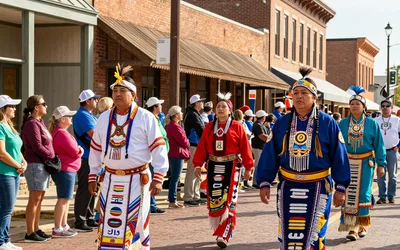
For most of the twentieth century, Rapid City was not a place where Native people gathered in the street to celebrate who they were. Betty Handley, a Hunkpapa Lakota elder born in 1940 and descended from Sitting Bull's camp, put it plainly to a reporter in 2024: "I've lived here since 1945 and we never saw anything like this. We never had powwows, dancing or anything." Handley had grown up speaking Lakota in a small clapboard settlement called Camp Oshkosh along Rapid Creek, and like many boarding school survivors she eventually lost her language and parts of her culture. The most celebration she remembered was watching dancers from Pine Ridge brought into town to perform for tourists.
That history is the backdrop for the Indigenous People's Day parade that now runs down Main Street each October. The event is organized by the Great Plains Tribal Leaders' Health Board, a Rapid City-based tribal health organization. The board first staged the parade in 2023, and by the fall of 2024 it had become the Saturday centerpiece of an entire weekend of Indigenous celebration in the city -- a weekend that also included the long-running Black Hills Powwow, or He Sapa Wacipi, at the Monument convention center, where more than 1,500 dancers competed in one of the nation's most prestigious powwows.
The parade's theme, "We Dance For The People," carries a meaning rooted in Lakota and broader Native tradition, where dance is understood as an offering made on behalf of the community -- for those who came before, for those still to come, and for those in need of healing. It is a phrase that also echoes the jingle dress tradition, in which the dress itself is regarded as a gift and a sacred responsibility.
The timing of the parade is deliberate. Indigenous Peoples' Day is observed on the second Monday of October in a growing number of American cities as an alternative to Columbus Day, and Rapid City's observance has grown into a multi-day affair. In 2024 the weekend ran from Friday's powwow through Saturday's parade and on to Monday, when the NDN Collective -- an Indigenous-led organizing and advocacy group headquartered in Rapid City -- hosted its own Indigenous Peoples' Day celebration at Main Street Square, drawing more than a thousand people downtown for a rally, a march, and a free community concert.
The two events are distinct but complementary. The health board's parade is the morning procession down Main Street; the NDN Collective's gathering is the afternoon rally and concert at the square. Together they have turned a holiday that once passed quietly in Rapid City into something the whole downtown can see.
That visibility has not come without friction, and the people who built these events are quick to name it. At the 2025 NDN Collective gathering, movement elder Madonna Thunder Hawk of the Cheyenne River Sioux Tribe told the crowd how much the city had changed. "It's good for me to see it like this, with all these signs and the young people coming together because back in the day, Rapid City wasn't like this. We had to fight our way in," she said. "So when you come to events like this, I hope you remember that people had to fight for us to be here. I'm so grateful to all of you for coming here and still standing here. It's important, not just for us but for those who are watching us." Then she added, with a smile, that wasicus -- white people -- "really get nervous when Indians gather," and that it was "kind of fun to do this every now and again, to give them a little something to worry about."
The 2025 edition of the celebration was the third year NDN Collective had hosted its event in Main Street Square, in the place the Lakota call Mni Luzahan. That year's rally drew community organizers, tribal leaders, elders, and allies before the crowd lined up to march down Fifth Street toward the square. An ATV pulled up to the front of the gathered people, and from it emerged Leonard Peltier of the Turtle Mountain Band of Chippewa, recently freed after decades in federal prison -- a moment that underlined how much of this history is still living memory for the people in the street.
The legal ground beneath all of it is also relatively recent. It was not until the American Indian Religious Freedom Act passed in 1978 that Native people across the United States could freely practice and celebrate their religious and cultural traditions without legal penalty. The dancing, the drumming, and the parade itself are, in that sense, younger than many of the elders who watch from the sidewalk.
For the 2026 observance, the parade is scheduled for Saturday, October 10, stepping off at 10 a.m. from Fourth and Main Street in downtown Rapid City. Before the parade begins, a 9:30 a.m. performance by Rezcoast Grizz and AntoineX is planned at Main Street Square. The event is free and open to the public -- no ticket, no gate, just a stretch of Main Street and whoever chooses to line it.
That openness is the point. Handley, watching the festivities in 2024, framed the stakes simply: "We have to stand up, speak for ourselves, and show that we are proud to be here." A parade down Main Street is one way of saying it out loud.