


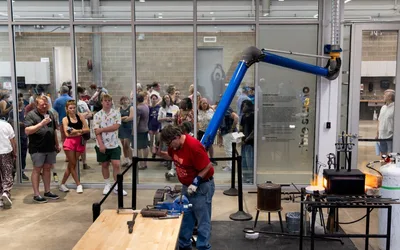
On a sweltering September Saturday, hundreds of people streamed into the old Memphis College of Art building in Overton Park, drawn by a clang that carried a distinctly Memphis rhythm. Three times, museum officials struck a hammer against an anvil to announce the opening of a new chapter — the Metal Museum's arrival in its new home at 1930 Poplar Avenue. It is the most significant transformation in the institution's 47-year history, and it marks the end of a long, deliberate journey from the bluffs of the Mississippi River to one of the city's most storied cultural corners.
The weekend was anything but a single day of celebration. On Friday, September 4, officials gathered for a ribbon-cutting ceremony and kicked off a "Metal Night" at the Overton Park Shell, part of the venue's Orion Free Concert Series, with a Nashville-based tribute band performing the hits of KoRn. On Saturday, September 5, the museum threw open its doors for a public grand opening celebration featuring inaugural exhibitions, live demonstrations, hands-on activities, entertainment, and food trucks. Then, on the following Friday, September 11, the museum began full-time operations, opening its 75,000-square-foot space to the public Wednesday through Sunday.
The move is a homecoming of sorts for Memphis's art community. For decades, the building now ringing with the sound of hammers and the glow of molten metal was Rust Hall, home of the Memphis College of Art. Designed by modernist architect Roy Harrover, Rust Hall sits on the National Register of Historic Places. The college closed in 2020, and the building had sat vacant since, awaiting a new purpose.
That purpose arrived through the Metal Museum, the only institution devoted exclusively to the preservation, promotion, and advancement of the art and craft of fine metalwork. The museum's journey to Overton Park began on the banks of the Mississippi, where it has lived for nearly a half century, once known by the charmingly unwieldy name of the National Ornamental Metal Museum.
Its old home was no ordinary address: it occupied part of a former United States Marine Hospital. But the bluff-top campus, roughly 17,500 square feet, had limits the museum had simply grown to exceed.
Executive director Carissa Hussong said the new location finally lets the museum reach a much larger part of the Memphis community, in a space that is accessible, inviting, and able to hold the full breadth of its programs. "We're just so excited to be able to open our doors and begin programming, being able to reach a much larger part of the Memphis community, being someplace that's accessible, that is really inviting and has the space that will enable us to really be a critical part of the cultural community in Memphis," Hussong told WMC Action News 5.
The practical benefits were stark. "We can't even hire more people at that current location because we don't have places for them to work," Madison Miller, the museum's director of development and communications, told the Commercial Appeal as construction neared completion. "We do so much with such a small space. And just thinking about what we can do in a space that's so much bigger and has so much more to offer, I think it's going to make a huge difference for us."
The new 75,000-square-foot campus is designed to accommodate up to 80,000 visitors a year. The renovation involved transforming Rust Hall into a modern home for metal arts. The design was led by Los Angeles-based wHY Architects, with Memphis firm LRK. Tony Pellicciotti, LRK's managing principal, pointed to "the entry and the new foundry building" as the two most significant moves, crediting LRK architect Krissy Flickinger for leading a team that combined new design with the historic building. "The new building is trying to be referential to the existing one," Pellicciotti said.
The result is a facility that expands everything the museum offers. Beyond expanded galleries, there are classrooms, a library, a significantly expanded gift shop, a proper café and restaurant, outdoor sculpture gardens, and a major new foundry facility with a blacksmith shop, fabrication yard, and demonstration area.
The project carried a heavy price tag — roughly $35 million, spanning roughly a decade from early planning to opening day. More than $29 million of the capital campaign goal had been raised as of late 2025.
For many who wandered the halls and open spaces at the grand opening, the building was deeply familiar from its college days. Former students, staff, and faculty admired the improvements — from better lighting to additional elevators — but above all they appreciated that the heart of creativity and art-making had remained in place and was destined to carry on. Former Memphis College of Art professor Maritza Dávila, who taught printmaking in the building for 36 years, was among those taking it in.
The grand opening also drew elected officials. U.S. Rep. Steve Cohen, winding down his service to the Ninth Congressional District, was on hand, introducing Chaz Molder, the mayor of Columbia, Tennessee, and a Democratic candidate for the Fifth Congressional District. Visitors braved the heat to stroll the sculpture garden, peer down into the foundry, and enjoy live music and food trucks, while inside, workshops and demonstrations for all ages ran throughout the day.
The old downtown location on the bluffs has not been abandoned. It will be repurposed as the "Metal Museum on the Bluff," devoted to the museum's artist-in-residency program, keeping the site's deep history alive even as the institution's public face moves east to the park.
With its larger footprint and central park location, the new Metal Museum campus is poised to be a major hub for arts education, exhibitions, and community engagement in Memphis. For a museum that spent decades tucked below the bluff line, the move to Overton Park is something more than a change of address; it is the forging of a new identity, announced to the city with the sound of a hammer striking an anvil, three times.