


On the first Tuesday of October, the upstairs taproom at Strawberry Alley Ale Works will fill with the usual crowd of Clarksville regulars — professors, alumni, students, and curious neighbors — nursing a beer and listening to a biologist talk about caterpillars. It is a scene that has repeated itself, more or less, on the first Tuesday of every month during the academic year since September 2019, when Austin Peay State University's College of Science, Technology, Engineering and Mathematics launched a lecture series built on a simple premise: science, and local brews.
That first night, Dr. J. Allyn Smith, an astrophysicist, stood in what the university called The Pilsner Room and explained black holes to roughly 70 people. He described a hypernova as a "self-eating watermelon" that devours its own star from the inside out, and warned that anyone unlucky enough to fall into a wormhole would be "agonizingly stretched" for what, to them, would feel like hundreds of millions of years. The audience ate it up. "The target audience is the average Clarksvillian, not necessarily an APSU student," Smith said at the time. "Not everybody knows about black holes, so there needed to be a few slides on what the heck a black hole is."
The series had been in the works for two to three years before that debut, according to Smith. Dr. Karen Meisch, then interim dean of the College of STEM, framed the mission plainly: "to bring science, as much as we can, into the community." Since then, the topics have ranged widely — the science behind the Bell Witch, the mathematics of March Madness, sinkholes and limestone caves, the Southeastern Grasslands Initiative, and a talk titled "Mystery, Passion and Chocolate: The Scientific Method." The format has stayed constant: free, all ages, doors at 4:30 p.m., talk at 5:30 p.m., upstairs at the brewery on Strawberry Alley in downtown Clarksville.
On October 6, the microphone passes to Dr. Mollie Cashner, a professor in the Department of Biology, whose talk is called "Backyard Dramas in Three Acts: Evolution and Ecology in your Garden." Cashner earned her PhD in ecology and evolutionary biology at Tulane University in 2010, after a master's at the University of Southern Mississippi and a bachelor's at Hanover College. Her published research focuses on the evolution of reproductive and social behavior in freshwater fishes — the reproductive ecology of nest-associating minnows, the population genetics of Seaside Sparrows along the Gulf of Mexico, and whether spotted bass are drawn to the chemical alarm cues of wounded prey. At Austin Peay, she teaches Principles of Evolution and Animal Behavior and coordinates the Department of Biology's master's program.
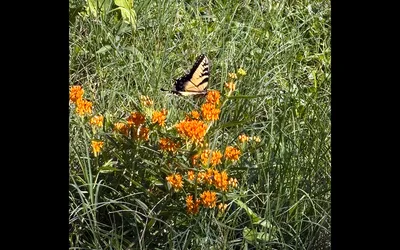
Her October talk steps out of the water and into the garden, structured as three acts. The first concerns the intricate relationships between caterpillars and their host plants — the specific, often single-species dependencies that determine which butterflies and moths can survive in a given yard. The second takes on pollinator diversity, and the third examines the predatory interactions playing out among backyard wildlife. Cashner's aim is to push past what she calls the oversimplified "Bee Movie view" of insect-plant relationships, in which a bee and a flower simply trade nectar for pollen and everyone goes home happy. The reality, she argues, is far more tangled.
What makes the presentation unusual is its source material: every photograph in it was taken in Cashner's own native plant garden. Rather than stock imagery or lab slides, the audience will see the actual creatures and plants of one Clarksville-area yard, documented by the person explaining them.
"There's always room for added appreciation of things that are under our noses," Cashner said. "You don't just have to be a scientist to be able to experience the things I'm showing people. It's more approachable, more tangible to the general public."
That accessibility is the through-line of the whole series. Science on Tap is not a seminar; there is no registration, no fee, no prerequisite. The venue itself is a downtown gathering spot across from City Hall, a locally owned brewery and restaurant known for scratch-made food and house-brewed beer, with an upstairs taproom that welcomes all ages until 9 p.m. The event is designed so that someone who wandered in for a burger could stay for the lecture and follow along.
For anyone who has ever wondered what is actually happening among the plants in their own yard — which caterpillar eats which leaf, which insect is hunting which other insect, and why the whole arrangement is more competitive and more interdependent than it first appears — the answer will be upstairs at Strawberry Alley on the first Tuesday of October, at 5:30 p.m. The doors open an hour earlier. The talk is free, and the beer is local.