


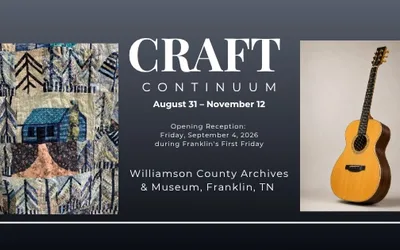
For six days in early October, a county archive in downtown Franklin will become a conversation between two centuries of Tennessee hands. Craft Continuum, presented by the statewide nonprofit Tennessee Craft, opens at the Williamson County Archives & Museum on October 5 and runs through October 10, with free admission throughout. It is a small exhibition with an unusually large frame around it: the show is part of Handwork: Celebrating American Craft 2026, a semiquincentennial initiative organized by the Los Angeles–based nonprofit Craft in America.
The premise of Craft Continuum is deceptively simple, and it is the reason the show is worth a trip rather than a glance. The exhibition's curator, Sherri Warner Hunter, began not with the artists but with the archive. She went through the Williamson County Archives & Museum's historical collection and selected handcrafted objects — the kinds of utilitarian things that settlers in Middle Tennessee made out of necessity, and that later generations began to see as art. Then she invited Tennessee Craft artists from across the state to create or submit new work responding to those objects. The challenge given to each maker was to find a connection — through shared materials, techniques, function, history, or contemporary reinterpretation — between what they make now and what someone made here generations ago.
What results is not a conventional craft fair or a tidy historical display. It is a deliberate pairing of old and new, arranged so that a contemporary piece and its archival counterpart sit near each other and start to talk. The museum describes the effect as a conversation between historic craftsmanship and the work of today's Tennessee makers, one that shows how craft traditions keep evolving while staying tethered to the past.
That framing is more than curatorial language. It echoes the actual history of craft in Tennessee, which, as Tennessee Craft's own account puts it, "began from necessity." Settlers carved wooden bowls for food preparation, threw pottery crocks for canning, stitched quilts for bedding, and wove baskets for storage. Through trial and error they learned which local woods worked best for furniture, musical instruments, and toys; they harvested fibers to spin and weave into clothing; they dug clay from the earth for pots, jugs, and bowls. Over time those purely functional pieces crossed over into decorative work, enriching the lives and homes of the people who made and used them.
Then the Industrial Revolution arrived, and for a while it looked as though all of that might be lost. Efficient processes and low costs reshaped American culture; manufactured goods and mail-order catalogues filled the nation's homes, and makers found themselves overshadowed by machines. The response was the Arts and Crafts Movement, an international current that tied the moral and social health of a nation to the quality of its architecture and design, and that held that a healthy society depended on skilled, creative workers. Tennessee Craft — a statewide nonprofit whose mission is to encourage, develop, and promote the crafts and craftspeople of Tennessee — is an heir to that impulse, and Craft Continuum is a fairly literal expression of it: the past and the present in the same room, each explaining the other.
The setting matters as much as the premise. The Williamson County Archives & Museum sits at the Five Points intersection in historic downtown Franklin, and its collection reaches back to the founding of Williamson County in 1799. It is a working archive as much as a museum, which is precisely what makes it an apt host for an exhibition built out of archival objects. The museum is also currently home to a Founding Voices: America 250 exhibit highlighting Benjamin Franklin and Hugh Williamson, the namesakes of the city and county, and outside the building stands Ben on the Bench, a bronze statue by sculptor George Lundeen that invites visitors to sit beside Franklin himself. Admission to the museum is free, and on-site parking is available.
Craft Continuum's place in the larger Handwork 2026 project gives it a second layer of context. Handwork 2026 was started by Craft in America founder Carol Sauvion and timed to coincide with the United States Semiquincentennial — the 250th anniversary of American independence. The initiative brings together organizations in all 50 states and Puerto Rico, and it includes not only exhibitions and events but a four-episode season of the Peabody Award–winning PBS series Craft in America, a book published by Phaidon titled Handwork: Handcrafted Objects That Made America, national K–12 educational programs and university residencies, and new short-form digital content. The whole effort culminates in November 2026 with an exhibition at the Renwick Gallery of the Smithsonian American Art Museum in Washington, D.C. Tennessee Craft is a featured participating organization, which puts a Franklin county archive on the same national map as the Smithsonian.
The exhibition itself has been on view since August 31 and remains up through November 12, so the October 5–10 window is one stretch of a longer run rather than the whole of it. An opening reception was held on September 4 during Franklin's First Friday, coordinated by the Arts Council of Williamson County. Visitors planning around the October dates should note that the daily hours listed for the event are 8:30 a.m. to 5:30 p.m., though the museum's own schedule is worth confirming before a trip, since the exhibition's hours may follow standard museum hours rather than extended ones.
What the show ultimately offers is a chance to see a specific idea made visible: that a bowl turned from local wood in the 1800s and a vessel made by a Tennessee artist in 2026 are not separated by a break in tradition but by a continuous line. Craft Continuum takes that line seriously enough to put both ends of it on display at once — and to let a county's own archive supply half the argument.