


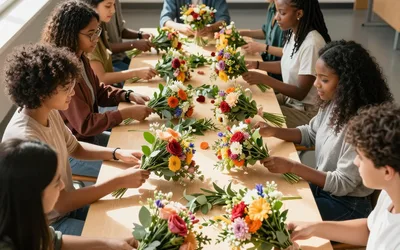
On an October afternoon in Knoxville, students will file into the Student Union with an unusual assignment: build a bouquet, and make every stem mean something. The event is called Let Love Bloom, and it runs from noon to 3 p.m. on October 15, 2026, at 1502 Cumberland Avenue. The premise is simple and a little disarming. Participants choose flowers that stand for the qualities that help relationships thrive — trust, respect, communication, boundaries, support, independence — and arrange them into a personalized bouquet to carry home. The takeaway is meant to be a colorful reminder that healthy relationships, like gardens, grow only when someone tends them.
It is a free, drop-in style campus event, the kind that fills a student union atrium with scissors, ribbon, and the low hum of people deciding which flower best represents the way they want to be loved. And it is not an accident that it lands in the middle of the fall semester, in a building designed to be the crossroads of student life.
The Student Union itself is a relatively new chapter in a much older story. The University of Tennessee, Knoxville traces its founding to 1794, two years before Tennessee became a state, and it has grown into the flagship campus of the UT system with fourteen colleges. Its student union, though, has a stranger and more interesting lineage. The university's first student center was envisioned in 1950 as a "Student-Faculty Center" and opened in 1954, in the early days of television and rock 'n' roll. For six decades it served as the campus living room, and its quirks became legend — including a chandelier that hung in its stairwell and left an impression strong enough that its memory was built into the building that replaced it.
The current Student Union opened in phases, with the first portion arriving in 2019 and the second phase following that January. The new building brought the Volshop, VolTech, dining locations, and the Center for Career Development, along with a 997-seat auditorium and a recreation area with video gaming, billiards, and table tennis. It also brought a piece of public art that has become a campus landmark: a thirty-foot, more-than-4,000-pound glass Torch sculpture made of 319 individually fire-blown pieces, created by Knoxville artist Matthew Cummings of Pretentious Glass. The torch pays homage to that old chandelier, a deliberate thread tying the new union to the one it replaced.
What makes the building especially fitting for an event like Let Love Bloom is who runs it. The Student Union hosts nearly 10,000 events a year and welcomes more than 2.5 million visitors, and much of the work of opening, closing, and producing those events is done by UT students themselves. The union's stated mission is to invest in students, prepare them to lead, and produce workforce-ready graduates. So an event where students teach other students about relationships is not a departure from the building's purpose — it is the purpose, in miniature.
The ideas behind the bouquet are more structured than they might first appear. The University of Tennessee's Center for Health Education and Wellness, known on campus as CHEW, maintains a healthy relationships curriculum built around the concept of the Equality Wheel. The wheel's premise is that healthy relationships are built on equality — working together to make decisions, ensuring all voices are heard, and giving each person an equal role in shaping the relationship. From that core radiate the specific qualities that Let Love Bloom asks participants to represent with flowers: trust and support, in which people can believe, rely on, and be kind to one another and support each other's passions and goals; honest communication; respect for boundaries; and the independence to remain a whole person inside a partnership.
CHEW's framing is deliberately broad. Its materials note that relationships are not only romantic — they include friends, roommates, family members, and classmates — and that the signs of power and control can surface in any of them. Practicing healthy habits across all those relationships, the center argues, normalizes healthy behavior and makes red flags easier to recognize when they appear. That is the quiet logic underneath the craft supplies: by asking students to name trust or boundaries out loud and pin a flower to it, the event turns an abstract checklist into something they can hold.
The center's work on campus runs through several channels. Its Vols 2 Vols program trains students as peer health educators who host programs and events throughout the year, and the center also runs initiatives including the "Consent Is" campaign, Sexual Assault Awareness Month programming each April in partnership with the Office of Title IX, Rocky Top Recovery for students in substance use recovery, and Vols ACT, which trains students, faculty, and staff to recognize warning signs and intervene. The center describes its guiding commitment as a community health model summed up in a single phrase: "Vols help Vols."
That peer-to-peer approach is what distinguishes a program like Let Love Bloom from a lecture or a pamphlet table. The people explaining what a healthy boundary looks like are, in many cases, the same age and in the same dorms as the people listening. The bouquet format adds a second layer: it is participatory, tactile, and personal. A student who spends ten minutes choosing between a sunflower and a sprig of eucalyptus to represent independence has already done a small act of reflection that a slide deck rarely produces.
The timing matters too. Mid-October sits well past the first weeks of the semester, when new friendships and new relationships have had time to take shape — and, sometimes, to reveal their fault lines. It is also far enough from Valentine's Day that the event is not framed as romance. The flowers are not about courtship. They are about the everyday maintenance of any bond worth keeping.
For anyone planning to attend, the practical details are straightforward. Let Love Bloom runs Thursday, October 15, 2026, from 12:00 p.m. to 3:00 p.m. at the Student Union, 1502 Cumberland Avenue, Knoxville, Tennessee 37996. The event is open to the campus community and free to attend, with no ticket link required. Participants build and keep their own bouquets. The full listing is available on the university's official events calendar at calendar.utk.edu.
What a visitor will carry out the door is a handful of flowers and, ideally, a slightly sharper vocabulary for the things that make relationships work. Trust, respect, communication, boundaries, support, independence — six words that are easy to say and hard to practice. Arranged in a vase, they are a reminder. Arranged in a life, they are the whole garden.