


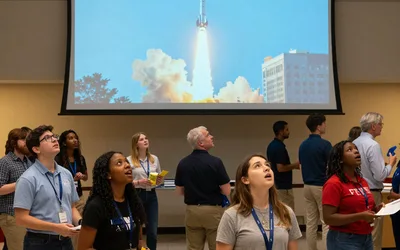
On a Monday afternoon in October, a corner of the University of Tennessee's agriculture campus will look less like a research facility and more like a launch viewing party. The Space Launch Party runs from 1 to 3 p.m. on October 19, 2026, in the Agriculture and Natural Resources Building at 2431 Joe Johnson Drive in Knoxville. There will be food, giveaways, and a speaker from NASA, and it is open to anyone who wants to walk in.
The occasion is not a simulated mission or a mock-up. It is a celebration of UT students whose work is actually scheduled to fly. The Herbert College of Agriculture was accepted into the Student Spaceflight Experiments Program, or SSEP, for Mission 20 to the International Space Station. SSEP is run by the National Center for Earth and Space Science Education and the Arthur C. Clarke Institute for Space Education, and it gives student teams a genuine shot at sending an experiment into orbit.
The path to that flight ran through a new course. In spring 2025 the Department of Plant Sciences offered PLSC 493: Space Research, in which undergraduate teams designed microgravity experiments of their own. One of those experiments was selected to launch to the station through SSEP. The class did not stop at the lab bench. Organizers turned the course into a statewide invitation, running a Mission Patch Design Competition for Tennessee students in grades 6 through 12 and a separate patch competition for UT undergraduates. Students were asked to design mission patches of the sort astronauts wear on their spacesuits, and one winning patch from each competition would fly alongside the selected experiment. Entries were due in November 2025.
The scale of the competition behind that single flight slot is worth pausing on. Across the four communities participating in Mission 20, 41 proposals came in, representing 158 students in grades 11 through 16 who were fully engaged in designing experiments. Thirty-eight proposals advanced to local Step 1 review boards, which each forwarded up to three finalists. That produced 12 finalist proposals for the national Step 2 Review Board, which met by Zoom on March 31, 2025, and chose one experiment per community, four flights in all. Communities were formally notified by April 8, 2025.
For the students in that Knoxville classroom, the odds were steep and the payoff is literal: their design is manifested for the station. The October gathering is the campus's chance to mark that before the hardware goes up.
The setting fits the moment. The Agriculture and Natural Resources Building opened for its first classes in the fall of 2024, and it is a striking, easy-to-miss structure set back from Joe Johnson Drive behind a line of sawtooth oaks. Crab Orchard boulders sit outside an entrance plaza of steel, limestone, and glass. Inside, a soaring hall two and a half stories tall and 300 feet long, nicknamed the living room, links a 500-seat auditorium to classrooms and to a café called Orange Acres that serves UT farm-to-table beef. It is a building designed for exactly this kind of gathering, where a research result can be explained to a crowd that includes people who are not scientists.
That is part of what makes the event unusual. Most campus celebrations of research are closed affairs, poster sessions for departmental colleagues. This one advertises food and giveaways and a NASA speaker and asks nothing of attendees but their attention. The students being honored did something genuinely rare, and the university is treating it as a public occasion rather than an internal one.
For anyone in Knoxville with a free Monday afternoon, the doors are open. The party runs two hours, from 1 to 3 p.m. on October 19, 2026, at the Agriculture and Natural Resources Building, 2431 Joe Johnson Drive.