


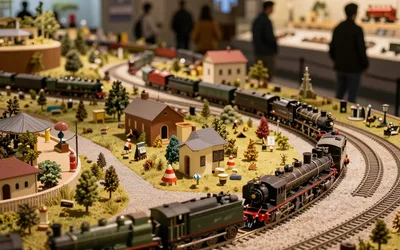
On the second floor of the Texas City Museum, past the exhibits about shipwrecks and refinery fires, a miniature world runs on its own schedule. Trains thread through snow-capped mountains and past small-town depots. A hot air balloon hangs above a village. Look closely and you might spot a T-Rex, or Santa Claus and his reindeer, tucked into a scene where they have no business being. This is the home of the Galveston County Model Railroad Club, and on Saturday, Oct. 3, 2026, the club and the museum will host the annual Model Train Fest, opening those layouts to the public from 10 a.m. to 4 p.m.
The festival is a partnership between the museum and the club, and it has become a fall ritual on the Gulf Coast. The club traces its founding to 1989 in Galveston, where its first project was a single six-foot module built for the Galveston Railroad Museum. Space there was tight, and the members were eager to build more than one module could hold. They moved to the Galvez Mall in Galveston, where they had room to expand, and stayed until the mall closed in 1995. The following year, they found their permanent home: the vacant second floor of the old J.C. Penney building in Texas City, which had just been acquired by the city for use as a museum.
That building has a history of its own. The roughly 30,000-square-foot structure at 409 6th Street was donated to the city and redesigned as a museum. When the model railroad club arrived, the second floor needed what its own history describes as a lot of refurbishing and TLC — years of cleanup, maintenance, and code upgrades before it was fit for trains. What the members built in that space is substantial: an E-shaped N-scale layout measuring 32 by 52 feet, an HO layout of 26 by 36 feet, an 8-by-50-foot Lionel layout, and a smaller traveling layout that has won awards around the region. The club says it operates the largest model railroad in Southeast Texas, running across more than 5,000 square feet.
The club is small and volunteer-run. Its roster lists 22 operating members, two senior members, and six honorary members, with interests spanning scratch model building, electrical work, track work, animation, and landscaping. The train room is normally open to the public on Saturdays from 10 a.m. to 4 p.m., with members on hand to answer questions. The annual festival is the one day a year when the operation expands well beyond that regular Saturday.
For the festival, model railroad clubs from across the region bring traveling layouts in every scale, from the grand G gauge down to the tiny Z. The Texas Brick Railroad, a group that builds elaborate scenes entirely out of LEGO, has been a recurring crowd favorite at the Texas City show, appearing at the museum's train festival in years past. Children get a hands-on turn at the controls, stepping into the role of conductor to start and stop the trains themselves. The day also typically includes trackless train rides and access to the rest of the museum's exhibits, and in some years the event has spread beyond the museum to the nearby Showboat Pavilion to accommodate all the displays.
Admission in recent years has been $10, with free entry for anyone 17 and under accompanied by an adult. The event runs as a drop-in affair rather than a ticketed performance, with no reserved seating and no advance purchase required.
What gives the setting its weight is the museum surrounding the trains. The Texas City Museum tells the story of a city defined by both industry and catastrophe. Its logo shows a phoenix rising above two cannons, and its exhibits cover the USS Westfield, a Staten Island ferryboat converted into a Union gunboat that ran aground during the Battle of Galveston on Jan. 1, 1863, and was scuttled by its own crew to keep it from Confederate hands. Remains of the Westfield were excavated from the Texas City shipping channel in 2009, and the museum displays a partial reconstruction along with a restored nine-inch Dahlgren cannon known as the Big Gun of Texas City, capable of firing shells up to a mile and a half.
But the museum's most sobering subject is April 16, 1947, when the French-registered freighter Grandcamp, docked at the port with roughly 2,300 short tons of ammonium nitrate fertilizer aboard, caught fire and exploded at 9:12 a.m. The blast triggered a chain reaction of fires and explosions aboard other ships and at nearby oil storage facilities. At least 581 people were killed, including all but one member of Texas City's volunteer fire department, and roughly 5,000 were injured. It remains the deadliest industrial accident in American history and one of the largest non-nuclear explosions ever recorded. Among the museum's artifacts is a clock stopped at 9:12 a.m., the moment the shock wave broke it.
Set against that history, the model railroad upstairs reads as something more than a hobby. It is a room full of small, orderly towns where the trains run on time and nothing catches fire — built and maintained by a few dozen volunteers who have kept it running since 1996. On the first Saturday of October, the public gets to walk through it at its own pace, and the members will be there to explain how it all works.