


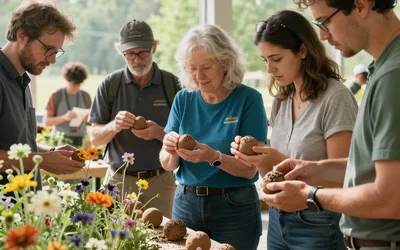
On a Saturday morning in mid-October, the Nature Center at Ray Roberts Lake State Park's Johnson Branch Unit will smell faintly of clay and potting soil. That is the tell that something is being made rather than merely displayed. From 11 a.m. to noon on October 17, 2026, park staff will host Wildflowers & Seed Bombs, an hour-long program that begins with a conversation about the native wildflowers growing in this corner of Denton County and ends with visitors rolling their own seed bombs to carry home.
The premise is simple and slightly subversive. A seed bomb, sometimes called a seed ball, is a small sphere of clay, compost, and native seed. The clay shields the seed from birds and wind and keeps it from washing away before it can germinate; the compost feeds the seedling once moisture finally breaks the ball down. The technique is often traced to Japanese natural farming and was popularized in the United States by guerrilla gardeners who tossed the balls onto vacant lots. At Ray Roberts, the intent is gentler: take a few home, drop them into a bare patch of yard, and wait.
What makes the program worth an hour of anyone's Saturday is the setting. Ray Roberts Lake State Park sits at the seam of two ecoregions, the Eastern Cross Timbers and the Blackland Prairie. That is rarer than it sounds. Blackland Prairie once covered roughly 12 million acres of Texas in a band running from the Red River down past San Antonio; today only a sliver of the original remnant survives, most of it in small, scattered fragments. The wildflowers blooming along the Johnson Branch trails in spring and fall, Indian paintbrush, bluebonnets, and the prairie grasses that grow up around them, are descendants of a landscape that predates the lake by a very long time.
The lake itself is young by comparison. The reservoir on the Elm Fork of the Trinity River was named for Herbert Ray Roberts, the Democratic congressman who represented Texas's 4th District from 1962 to 1981 and who spent much of his career on water issues. Roberts had an unusual political pedigree: he won his seat in a 1962 special election to succeed Sam Rayburn, the legendary Speaker of the House, and he went on to chair the House Veterans' Affairs Committee. He died in Denton in 1992, a year before the state park that carries his name opened.
The park came together in pieces. The Isle du Bois Unit, on the south side of the lake, opened in 1993; the Johnson Branch Unit, on the north side, followed in 1996. The units are named for the families and communities that were here first, and the Johnson Branch takes its name from the Johnson family, early settlers in this part of Denton County. The lake supplies water to Dallas and Denton and doubles as flood control, a role it performed with some vigor during the floods of 2015, when the water rose high enough to spill over the berm separating the lake from the unit's kids' fishing pond. Rangers afterward had no idea what fish had ended up where.
Interpretive programming like Wildflowers & Seed Bombs is a relatively small part of what a park this size does, but it is the part that tends to stick. The hour is pitched at all ages, and the format is drop-in rather than lecture: show up, listen for a while, get your hands dirty. Participants are asked to bring water and clothes appropriate for the weather, though the program is held indoors. The Nature Center is served by a ramp off the wheelchair-accessible concrete trail, and the park offers adaptive devices for visitors who need them, arranged in advance by emailing the Johnson Branch office.
There is no separate ticket. The program is included with ordinary park entry, which for the Johnson Branch Unit runs $7 per day for visitors 13 and older. Programs are subject to cancellation in bad weather, with updates posted on the park's calendar page or available by phone at park headquarters.
The case for native seed over the garden-center alternative is not merely aesthetic. Native wildflowers and the pollinators that evolved alongside them are a matched set; a bed of non-native ornamentals can be lovely and still function as a desert for bees and butterflies. Texas has roughly a thousand species of native bees, most of them solitary rather than hive-dwelling, and they need the plants they co-evolved with. A seed bomb is a small intervention, but it is one a person can make in an afternoon and then forget about until something comes up green.
That is more or less the pitch the park is making: become a wildflower warrior, take home a few clay balls, and see what happens. The hour ends at noon. The seeds take considerably longer.