


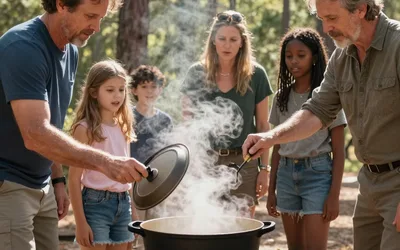
The smell gets there before the ranger does. At Campsite #11 in Blanco State Park, a stack of cast iron is set over coals, and within a few minutes the whole loop of the campground knows something is cooking. This is the Dutch Oven Cookout, a Texas Parks & Wildlife Department program that treats a piece of frontier hardware as a living kitchen appliance rather than a museum piece. The premise is almost aggressively simple: show up at 10 a.m., bring water and an appetite, and if you happen to own a Dutch oven, haul it along and cook with the rangers instead of just watching them.
The park's own event listing dates this program Saturday, November 21, 2026. Anyone planning to attend should confirm against the TPWD calendar page before making the drive. The rest of the details are as advertised. The program is open to the public and free with a paid park entrance fee of $5 per person ages 13 and up; children 12 and under are always free, and entry is waived entirely for holders of the Texas State Park Pass. No registration is required. There is no roster, no waitlist, no confirmation email — the entire enrollment process is walking up to the campsite.
That open-door format is unusual for a state park program, and it is a deliberate fit for the subject. Dutch oven cooking is not a demonstration sport. The pot rewards people who are willing to get their hands black with soot and learn by feel — how many coals go on the lid versus underneath, how the wind changes everything, how a lid full of coals turns a cast iron pot into an actual oven capable of biscuits and cobblers. Letting visitors bring their own ovens turns a ranger talk into something closer to a potluck with a shared heat source.
The tool itself has a longer history than most people assume. The Dutch oven — a thick-walled pot with a tight-fitting lid, usually seasoned cast iron — is a vessel built for cooking over open flame. The design traveled well because it solved a specific problem: a heavy lidded pot holds heat evenly and lets you bake without a built-in oven, which is precisely what you need when your kitchen is a fire on the ground.
In Texas, that pot became inseparable from the cattle trail. The chuck wagon, the mobile kitchen that followed herds across the plains, carried food and cooking equipment for men who might be out for months, and the Dutch oven was central to it — a single vessel that could stew, fry, and bake. The chuck wagon was designated the official state vehicle of Texas in 2005, which is a fairly remarkable honor for a wagon, and a marker of how deeply the image of cowboy cooking is woven into the state's self-image. When a ranger at Blanco says Dutch ovens are "a timeless frontier method," that is not marketing language. It is a literal description of the equipment that fed the cattle drives.
There is a second layer of frontier history sitting under the campsite itself. Blanco State Park is a small park hugging roughly a mile of the spring-fed Blanco River, about an hour from both Austin and San Antonio, and much of what visitors use today was built by the Civilian Conservation Corps. During an eleven-month stretch in 1933 and 1934, CCC crews built the picnic pavilion with its stone walks and stairs down to the river, along with picnic tables and benches, stone dams, and bridges. The Falls Dam and the small swimming pool beside it came out of the same period. The park opened to the public in 1934. Cooking over live coals at a campsite in a park whose stonework was laid by Depression-era work crews is about as layered a setting as a cooking class gets.
The park's program calendar is broader than its size suggests — archery sessions, kayaking classes, star gazing, watercolor by the river, bat walks, fishing with a ranger, and guided hikes along the Pumphouse Trail all appear alongside the cookout. Some of those require registration and some get cancelled for weather; the kayaking classes on the current calendar show both a full session and a cancelled one. The Dutch Oven Cookout is in the no-registration camp, which makes it one of the easiest entry points into the park's interpretive programming.
One caveat applies to all of it. TPWD notes that events and programs are subject to cancellation due to weather or burn bans, and that if a program is cancelled, an update will be posted to the event page. For a cooking program built around live coals, a burn ban is not a technicality — it is a hard stop. Checking the listing before driving out is the difference between lunch and a wasted tank of gas.
For anyone who does go, the practical advice is unglamorous. Bring water, as the listing says, and more of it than you think — you are standing near a fire in Central Texas. Bring an appetite. If you have a Dutch oven, bring it, and expect to learn something about it that a recipe cannot teach. And bring the $5, or the park pass, because the fee is per person and the rangers do collect. Beyond that, the program asks nothing of you. No sign-up, no reservation, no preparation. Just a campsite number and a time.