


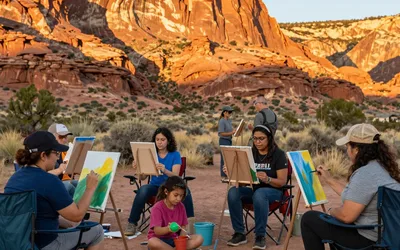
Palo Duro Canyon has been a subject for painters for a very long time. On Saturday, December 5, 2026, from 1 to 2:30 p.m., the park invites the public to add to that tradition with Art in the Park, a painting session open to adults and children alike, meeting at the Visitor Center. The park supplies the materials; visitors are asked to bring only their excitement for creating. Attendance is free after regular day-use or camping fees, and park admission is free for holders of a Texas State Park Pass purchased before the event.
The setting is the draw. Palo Duro is often called the Grand Canyon of Texas, and the comparison is not pure boosterism. The canyon reaches up to 20 miles wide in places and drops about 800 feet from rim to floor, with walls of multicolored rock layers and steep mesa walls. The Prairie Dog Town Fork of the Red River runs through it. Erosion left behind hoodoos, mesas and cliffs, including the sandstone-capped pillar known as the Lighthouse, the landmark most visitors come to see.
The park itself covers about 28,000 acres across Randall and Armstrong counties, near the town of Canyon and about 25 miles south of Amarillo. It was established in 1933 and opened in 1934, and it is managed today by the Texas Parks and Wildlife Department. The Civilian Conservation Corps did much of the early development, and the Visitor Center where the painting session meets has a history of its own: it was formerly El Coronado Lodge, completed by the CCC in 1935, originally a grill and souvenir shop and now an interpretive center and bookstore on the canyon rim. It is a fitting room to gather a group of painters in, given that the building was put up by hand labor in the middle of the Depression.
What makes the event more than a pleasant afternoon is the canyon's place in American art. In 1916, a 29-year-old Georgia O'Keeffe arrived in Canyon to teach at West Texas State Normal College, now West Texas A&M University. She was, by the account of her biographers and the scholars who have studied the period, still searching for her artistic voice. The canyon gave her something. Not long after she arrived, she wrote to a friend about an afternoon out there that kept her awake until after four in the morning: "wonderful color - I wish I could tell you how big - and with the night the colors deeper and darker ... I'm so glad I'm out here - I can't tell you how much I like it." On at least one occasion she walked the twelve miles from town to the rim.
O'Keeffe stayed in Canyon from 1916 to 1918, and during those years she made a series of watercolors, most of them of Palo Duro Canyon, working from the landscape's colors and its sunrises and sunsets. Art historians regard the Texas years as a period of rapid growth for her work; Amy Von Lintel, a West Texas A&M associate professor of art history, published a catalogue of fifty watercolors O'Keeffe made during her time in Canyon. Many of those early paintings, as the Houston Chronicle put it, were slashed with Palo Duro red. The Panhandle-Plains Historical Museum in Canyon holds O'Keeffe material from the period, including a painting and her wardrobe trunk.
That history is the quiet argument for showing up with a brush. The park's own listing is modest about the event, describing it simply as a creative day in the canyon where participants paint on nature's own canvas, explore the canyon's beauty and make a masterpiece. The organizer listed is Mysti Garvin, the park interpreter and volunteer coordinator, who is a familiar voice in local coverage of the park; she has spoken to Amarillo television about the park's heat-advisory trail closures and the reasoning behind them, noting that the five major trails shut down during advisories are the ones where most rescues happen. Interpretive staff like Garvin are the people who turn a state park from a scenic drive into a place where visitors learn something, and a free painting session with materials provided is squarely in that tradition.
Practical details are few, which is part of the appeal. Meet at the Visitor Center. Everything else is supplied. The event is open to the public, adults and children both, and the only cost is what it takes to get into the park in the first place, either a day-use fee or a camping fee, or nothing at all with a state parks pass bought ahead of time. The park notes that the pass must be purchased before the event.
December is a different canyon from the one O'Keeffe knew in the summer heat. The light comes in lower and longer, the crowds thin out, and the rock bands that read as iron-rust orange and sulfur gold in the morning take on deeper tones as the afternoon goes on. A 90-minute session starting at one o'clock puts painters on the rim with the best of that light. Visitors who want to make a day of it have more than 30 miles of hiking, biking and equestrian trails to work with, campsites with water and electricity, tent sites, equestrian sites and backpack areas, three cabins on the canyon rim and four Cow Camp cabins on the canyon floor, plus the park store at the Visitor Center and The Trading Post down in the canyon. In summer the park hosts the TEXAS Outdoor Musical; in December the entertainment is the canyon itself.
For anyone who has ever looked at a Palo Duro sunset and wished they could take it home, this is the park's answer: come down, take a seat, and try. The materials are on the house. The view has been under development for about a million years.