


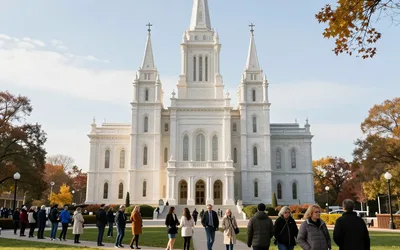
For a few weeks this September, the small central Utah town of Ephraim will do something it has never done before: open the doors of its newest landmark to anyone who wants to walk through. From Wednesday, September 2, through Saturday, September 19, the Ephraim Utah Temple of The Church of Jesus Christ of Latter-day Saints will host a public open house, welcoming visitors of every faith — or none at all — to tour a building that, once dedicated, will be closed to all but church members holding a temple recommend. Admission is free, no reservation is required, and the roughly 45-minute walking tour runs Monday through Saturday from 9 a.m. to 8 p.m., with the temple closed on Sundays.
The open house is a rare and deliberate moment of welcome. Temples are sacred buildings designed to help God’s children feel close to Him and His Son, Jesus Christ. Once dedicated, entrance is reserved for church members. For the general public, the open house is the only chance to see the interior before the building is dedicated on Sunday, October 11, at 10 a.m., when Elder Ronald A. Rasband of the Quorum of the Twelve Apostles will preside. After that, the doors close to all but recommend-holding members.
But the story of this temple begins long before the first shovel of earth was turned, and it is rooted in the very ground on which the building now stands. The Ephraim Utah Temple is the twenty-seventh temple built in Utah and the second in Sanpete County, joining the historic Manti Utah Temple, which was built in 1888. The two sacred structures sit less than ten miles apart, both within the boundaries of Manti High School.
The valley was settled largely by Scandinavian pioneers, and that heritage is woven into the very fabric of the new temple. Its color palette of golden yellows and varied shades of blue, its art glass, and its carved millwork all carry motifs of wheat, oxeye daisy, and forget-me-not blossoms. The wheat honors Ephraim's agricultural legacy, recalling the historic Ephraim Relief Society Granary, once known as the "granary of Utah." The oxeye daisy and forget-me-not — flowers long cherished in Scandinavia — reflect the cultural roots of the town's earliest settlers.
The temple's origins trace to a decision announced on May 1, 2021, when then-President Russell M. Nelson delivered a prerecorded message to a press conference held inside the historic Manti Tabernacle. The announcement included both the preservation of the murals in the Manti Utah Temple as part of an upcoming renovation and the construction of a new temple in neighboring Ephraim.
The choice of Ephraim was deeply personal to President Nelson. At the groundbreaking ceremony on Saturday, August 27, 2022, he explained his connection to the place. "My dear mother was born in Ephraim, not far from this very temple site," he said. "My father was born in Manti. Three of my four grandparents were born here in Ephraim. All eight of my great-grandparents lived in Ephraim." His family had helped settle the Sanpete Valley in 1849.
In his dedicatory prayer, President Nelson expressed gratitude for ancestors who "laid a foundation of faith that undergirds our spiritual strength."
The temple that rose on the 9.16-acre site at the intersection of 200 North and 400 East is a striking addition to the valley's skyline. Rising 156 feet 8 inches to the top of its spire, with two attached end towers, it stands as a new landmark in the Sanpete Valley. The roughly 41,680-square-foot building houses four instruction rooms, three sealing rooms, and a baptistry. Its interior is a study in craftsmanship: custom broadloom carpet in gold-beige tones patterned with floral and wheat motifs, Scandinavian-style area rugs in blues, greens, and golds, and art glass in every exterior window and select interior doors, designed by Method Studio in collaboration with Holdman Studios of Lehi. The primary stones — Botticino Classico and BS Beige in warm tones of beige, cream, and gold — are accented with stones quarried in Italy, Turkey, Bolivia, and Brazil, and some decorative light fixtures feature crystal handcrafted in Cairo, Egypt.
The temple's location is no accident. It sits within walking distance of Snow College. Elder K. Brett Nattress, assistant executive director of the church's Temple Department, noted at the media day on August 31 that the temple is "within walking distance of students. As they obtain an education, think about the education and how it's enhanced as they come and learn of higher and holier things in the house of the Lord." Snow College student Kaystan Larsen said he likes that the temple is in view as he attends classes on campus, helping him "stay aligned with God and focused on what's most important in life."
Utah, the church's global headquarters, is home to more than 2.2 million Latter-day Saints who meet in nearly 5,400 congregations, and there are now 32 temples in the state in operation, under construction, under renovation, or announced.
For visitors, the open house is a chance to see all of this up close. The tour is a walking tour, wheelchair accessible, with restrooms and drinking fountains on site and parking available at the temple. Visitors are asked to come as they are, though business casual clothing and comfortable shoes are suggested. Photography and video are not permitted inside, and service animals are not allowed in the temple. After the tour, church representatives will be available to answer questions.
The open house comes at a moment of anticipation for Latter-day Saints across Utah, as the church prepares for the Salt Lake Temple Celebration, which will run from April 5 through October 1, 2027, following a seven-year renovation of that historic structure. But for the people of Ephraim, this September is about their own temple — a building that honors the Scandinavian pioneers who settled the valley and the agricultural legacy of the Ephraim Relief Society Granary. For a few short weeks, everyone is invited to walk through its doors and see what all the rejoicing has been about.