


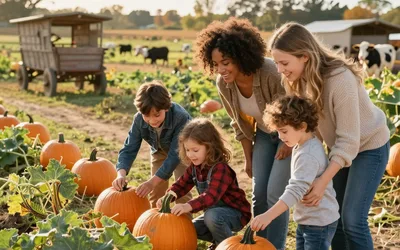
The drive to Paragonah takes you off the interstate and into a different kind of Utah. Four miles northeast of Parowan, up against the mountains of Iron County, the town sits at just under 6,000 feet, a place of about 536 people where the fields run right up to the foothills. In the fall, one of those fields turns orange, and for a few weeks each year it becomes the Judd Pumpkin Patch.
The patch is a modest operation by the standards of the big commercial farms, and that is exactly the point. The pumpkin field covers two and a half acres, planted with a mix of varieties, and the whole idea is that visitors walk out among the vines and cut their own pumpkin rather than choosing from a bin someone else filled. There is no entrance fee at all. The farm animal zoo, which includes pigs, a calf, goats, sheep, a mini horse, bunnies, ducks and chickens, is likewise free to walk through. Feed for hand-feeding the animals costs a dollar.
The patch is open Monday through Saturday from 9 a.m. to 7 p.m., and it stays open until the pumpkins are gone or until October 28, whichever comes first. This year's season runs from October 1 through October 28, 2026.
What sets the Judd operation apart from a simple u-pick field is the way it has layered small, inexpensive experiences on top of the harvest. Wagon rides run $3 per person, with children three and younger free, and the ride is not a quick loop around a parking lot. It is pulled by a restored 1944 Farmall H tractor and lasts about half an hour, touring the farm's hay fields and the neighboring farms along back country roads. Depending on the timing, riders may spot deer and other wildlife moving through the fields. In recent seasons the farm has also added a string maze.
The wagon ride schedule has shifted over the years. On the farm's own blog, an early listing advertised rides only on Monday and Friday evenings from 5 to 7 p.m. and all day Saturday, at $1.50 per person, with reservations available for groups of ten or more at other times. Today the rides are offered more broadly, and the price has crept up to $3, a reminder of how long the patch has been running and how it has grown.
That history stretches back at least to 2012, when the farm's blog first posted about the wagon rides and the pumpkins. By 2013 it was advertising a farm animal zoo as a new addition, and by 2015 it was contributing animals to the Iron County Fair petting zoo before the pumpkin season opened. The blog entries, dated and plain, read like a family's own record of building something season by season: first the pumpkins, then the rides, then the animals, then the maze. It is a small archive of a farm figuring out, year after year, what families actually enjoy.
The food has become part of the draw. The farm sells cinnamon rolls for the drive home and pumpkin bread made from pumpkins grown right there in the field, a detail that has earned the patch mentions in roundups of Utah's best pumpkin patches, including a Deseret News list of top patches around the state. The appeal is easy to understand: the pumpkin bread is not a novelty item shipped in from somewhere else. It comes from the same two and a half acres the visitors just walked through.
Paragonah itself gives the outing its character. The town was first settled in the spring of 1851 by residents from nearby Parowan, who found meadows along Red Creek that were well suited to farming. Its name comes from the Southern Paiute word for the nearby Little Salt Lake, a shallow, salty body of water whose name carried connotations of marshland and many springs. The town was incorporated in April 1916. Farming has been the through-line for well over a century, and a pumpkin patch is, in its way, a continuation of that.
The setting matters to the experience. The patch sits nestled against the mountain range, and the farm's own description invites visitors to pick pumpkins off the vines while taking in the scenery, with the chance of seeing deer crossing through a neighboring field. For families coming up from Cedar City, roughly a half-hour away, or from further afield, it is a fall outing that costs almost nothing to start: no admission, no fee for the animals, and pumpkins priced by the pound.
That combination, free entry with a handful of cheap add-ons, is what makes the Judd patch an easy choice for a family with kids of different ages. A toddler can ride the barrel train and pet the goats; an older child can ride the wagon out to the hay fields; everyone can pick a pumpkin and carry it home. The farm accepts cash, cards and checks, and the phone number for questions is (435) 477-9783.
There is nothing slick about any of it. The tractor is from 1944. The blog still lives at a blogspot address. The animals are the kind you would find on any working farm in Iron County. But that is precisely the appeal of a place like this in a town of a few hundred people: the pumpkins are still on the vine, the fields are still working fields, and the bread on the counter was a pumpkin in the ground a short time ago. The Judd Pumpkin Patch opens October 1 and runs through October 28, or until the last pumpkin leaves the field.