


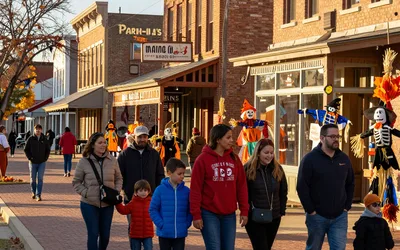
Parowan has no traffic lights. That is not an oversight; it is a point of pride. The little town off Interstate 15, founded in 1851 and known across southern Utah as the "Mother Town" because so many other settlements were staged out of it, has an old-fashioned Main Street lined with historic buildings, a noticeable absence of hurry, and a habit of celebrating its pioneer roots whenever an occasion presents itself. In October, the occasion is scarecrows.
Beginning the first days of the month and running through Halloween, Main Street fills with figures built by local businesses, clubs, and residents — not a single unified display but a block-by-block parade of them, each one designed and dressed by whoever volunteered to make it. The Cedar City tourism office, which promotes the event, describes the result as "hitchhikers, spooks, scarecrows, skeletons, and more," and the Salt Lake Tribune's southern Utah calendar calls it what it is: community-made scarecrows that turn downtown into a seasonal outdoor display. It is free, it runs daily, and the only way to see it is the way Parowan prefers — on foot, at your own pace, or slowly by car.
The scale is the surprise. When the Parowan and Brian Head Area Chamber of Commerce gave its semi-annual report to the city council in May 2026, chamber leadership mentioned Scarecrows on Main among the community's signature draws and noted that the event had grown to more than 100 displays. That is a remarkable number for a town of Parowan's size, and it explains why the event keeps showing up alongside the town's bigger, older traditions — the Iron County Fair, the July concert series, the swap meet that draws thousands — in the same breath. It is not a festival with a gate and a schedule. It is the town decorating itself.
Scarecrows on Main has been part of Parowan's fall for years, and its history is best measured in the way it has quietly expanded. A travel blog recounting an October 2016 visit to the area noted that Parowan's Fall Fest featured 50 scarecrows on Main Street that year. A decade later, the count had more than doubled. The event has also outgrown its original framing: what began as a feature of a single fall festival weekend now stretches across the entire month, with the scarecrows standing on their own as the attraction rather than as a side note to something else.
That evolution fits the town. Parowan's fall calendar has thickened over the years. Fall Fest on Main and Christmas in the Country were both described by the chamber as growing traditions. A newer "Cinnamon Roll Stroll" initiative aims to pull foot traffic into the same downtown blocks. The through-line is a small town using its walkable, historic core as the venue for nearly everything it does — and October is simply the month when the core gets dressed up.
The scarecrows themselves are the point, and they are deliberately unpolished in the way that only genuinely local things are. There is no corporate sponsor's template. A business or a club or a family decides what its scarecrow will be, and the result is a stretch of Main Street where the figures range from classic straw-stuffed farmers to hitchhikers, spooks, and skeletons — a mix of harvest warmth and Halloween mischief that the event's own description cheerfully lumps together. Some years the displays lean silly; some lean spooky; most lean toward whatever the maker found in the garage. That variety is the draw. Visitors are encouraged to walk or drive the street and take pictures of their favorite design, and the comparisons that follow are the closest thing the event has to a competition.
What makes it work is the setting. Parowan is a town that holds tight to its pioneer heritage — the Old Rock Church, the oldest church building in southern Utah and now home to the Daughters of the Utah Pioneers, sits near the town square, and the surrounding blocks include some of the oldest standing structures in the region. Main Street is tree-lined and unhurried, the kind of place where a scarecrow propped against a storefront reads as an extension of the architecture rather than an installation. The town's own promotional material calls it "a sweet slice of Americana," and in October that slice comes with a scarecrow on every block.
For families, the appeal is practical as much as atmospheric. The event costs nothing, requires no ticket, and has no start time. It runs the whole month, so a visit can be folded into a drive to Brian Head, a trip through Parowan Canyon on the Patchwork Parkway, or a stop on the way between Zion and Bryce Canyon. Children can run the sidewalk; grandparents can ride the passenger seat; the dog can come. The scarecrows do not care when you show up.
That is the quiet achievement of Scarecrows on Main. In a tourism landscape full of ticketed attractions and timed entries, Parowan's contribution is a month-long, free, self-guided walk past the work of its own residents. The town supplies the street and the occasion; the businesses, clubs, and neighbors supply the rest. More than a hundred of them, most years, standing along Main Street in the cold October air, waiting to be looked at — and, inevitably, photographed.
The 2026 edition runs from October 2 through October 31 along Parowan Main Street. There is no admission, no schedule, and no wrong way to see it. The only instruction the town offers is the obvious one: take a walk.