


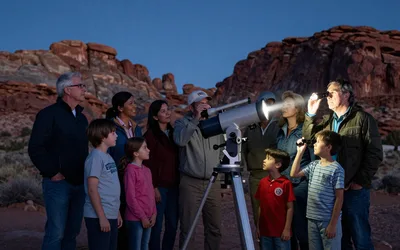
On the night of October 23, 2026, a patch of ground about fifteen miles northwest of Moab that is better known for what lies beneath it will turn its attention upward. Utahraptor State Park will host "Craters and Cosmos," an hour-long ranger program beginning at 8:30 p.m. at the park's historic site, where a short presentation on the moon will be followed by telescope viewing, weather and other factors permitting.
The program is free and open to anyone who shows up, though standard park day-use fees apply to enter. It is a modest offering on its face: an hour, one telescope, one moon. But the setting makes it something more than a routine interpretive talk, because Utahraptor State Park is one of the newest and strangest units in Utah's state park system, and the ground where the telescope will be planted carries an unusually dense layering of history.
Utahraptor State Park was created by the Utah State Legislature in March 2021, sponsored by state representative Steve Eliason. It protects roughly 6,500 acres east of U.S. Route 191 and west of Arches National Park, including the Dalton Wells Quarry, one of the largest dinosaur bone beds in North America. More than 5,500 bones representing at least ten dinosaur species have been recovered there over roughly 45 years of excavation, among them the armored Gastonia, the long-necked sauropod Moabosaurus, and the park's namesake, Utahraptor ostrommaysi. Paleontologists believe more than 100,000 bones may still be waiting in the rock.
The Utahraptor story has its own long arc. At more than 20 feet long and somewhere between 1,100 and 1,700 pounds, Utahraptor was among the largest of the dromaeosaurs, the feathered carnivorous theropods popularly known as raptors. The park's name is a fairly recent label on a landscape that has been yielding fossils for nearly half a century.
The "historic site" where the October program takes place refers to something else entirely, and it is the reason the coordinates in the park's event listing point to a specific spot rather than the visitor center. During the 1930s, Dalton Wells was the site of a Civilian Conservation Corps camp, one of the Depression-era work camps that put young men to labor on public lands across the West. In January 1943, the abandoned camp was repurposed by the federal government as the Moab Isolation Center, a detention facility for Japanese Americans who had been singled out within the internment system as alleged troublemakers. It operated only from January 11 to April 27, 1943, and held at its peak just 49 Nisei and Kibei men, among them Harry Ueno, the Manzanar kitchen workers' union leader whose arrest had helped set off the Manzanar uprising. The site, remote and desolate, was described at the time as the American equivalent of Siberia. Today a marker stands at the spot; little else of the isolation center remains.
So the ground beneath the telescope holds a Cretaceous bone bed, a New Deal work camp, and a World War II incarceration site, all within a short walk of each other. The park interprets all three, and its half-mile Utahraptor Historic Trail touches on the CCC camp and the isolation center alongside the paleontology.
What makes the October program unusual is less the subject than the venue. Utahraptor is a young park still building out its facilities, and its interpretive programming has leaned into the night sky in a way few Utah parks have. The park owns a Celestron CPC Deluxe 925 telescope and has been working toward International Dark Sky certification. Its offerings include ranger talks on paleontology, guided hikes to the quarry, nighttime scorpion walks, and star parties. Park manager Brad Walker has pointed to the ability to see the Milky Way from camp as one of the park's defining pleasures. The park's own dark-sky resources page points visitors toward the broader Utah State Parks dark-sky materials.
The park also sits in the orbit of a larger regional astronomy tradition. Canyonlands National Park, just to the west, hosts the annual Southeast Utah AstroFest, a multi-day event with daytime and evening astronomy programs, telescope viewing, and family activities at locations across the parks, and Utahraptor State Park's CCC Historic Site has been among the participating locations. A ranger-led moon night at Utahraptor is in that same lineage: public, informal, and dependent on clear weather.
That dependence is worth taking seriously. The listing carries the standard caveat, weather and other factors permitting, and late October nights in the high desert outside Moab can turn cold quickly after sundown. Anyone planning to attend should dress for a temperature drop and check park conditions beforehand; the park can be reached at 435-259-3770, and its visitor center is open daily from 9 a.m. to 5 p.m. during the in-season period of March 1 through November 30. Day-use passes run $15 per vehicle and cover trails, the historic site, the quarry, and the visitor center; they are not required for campers. The park also operates two campgrounds, the improved Gastonia Campground at $50 per vehicle per night and the primitive Fossil Flats sites at $30.
The moon itself will be the draw. A short ranger presentation will walk through the craters and other features that shape Earth's closest celestial neighbor, the kind of talk that tends to move quickly from the familiar face of the full moon to the specific, strange geography of it: the bright ray systems splashed out by relatively recent impacts, the dark maria that early observers mistook for seas, the heavily cratered highlands that record a far older surface than the smooth plains. Then the telescope comes out, and the abstract becomes a sharp-edged thing at the eyepiece.
There is a certain symmetry to holding a moon program at a park built around a bone bed. Both the craters overhead and the fossils underfoot are records of impacts and extinctions, of deep time written into hard surfaces. Utahraptor State Park happens to preserve both, one in the Cretaceous mudstone of Dalton Wells and one a quarter of a million miles away. For an hour on an October night, with a ranger and a telescope and whatever the weather allows, visitors get to look at both.