


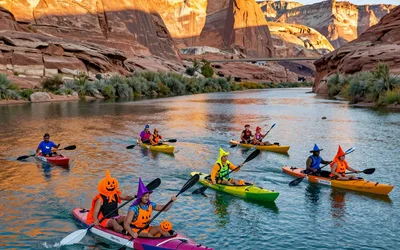
On the last Saturday of October 2026, the shoreline of Quail Creek Reservoir is scheduled to fill with pointed hats. The Dig Paddlesports Witch Paddle, listed on the Utah State Parks events calendar for October 24, 2026, invites paddlers to launch onto the reservoir in costume. The listing is spare — a single line reading "Dig Paddlesports Witch Paddle (Costumes Welcome!)" — but the event belongs to a tradition that has spread across the country's lakes and harbors over the past decade, and it lands at a small desert reservoir with an unusually good claim on the idea.
Quail Creek State Park sits at 3,300 feet between St. George and Hurricane, a 600-acre body of water that state parks officials describe as holding some of the warmest water in Utah, thanks to a mild winter climate that draws boaters and anglers year-round. The reservoir was completed in 1985 to supply irrigation and culinary water to the St. George area, and it opened to the public as a state park in 1986. Most of its water does not come from Quail Creek at all; it is diverted from the Virgin River and carried in through a buried pipeline. Two dams form the lake — the main earth-fill embankment and a south dam of roller-compacted concrete, built to replace the original earth-fill structure that failed in the early hours of New Year's Day, 1989. The reservoir reaches depths of up to 120 feet, cold enough to sustain stocked rainbow trout, while largemouth bass and bluegill thrive in the warmer upper layers.
It is the kind of setting where a costume paddle makes a certain sense: calm, warm, cliff-ringed water, minutes from Zion National Park, with a rental operation already parked at the water's edge. Dig Paddlesports has been that operation since 2014, when Quail Creek State Park became available for the company to run from the shoreline inside the park. The business was founded in 2011 by Bill and Michelle Ennis, who describe themselves on the company's site as "paddle-holics" and opened what they call Washington County's first dedicated paddle operation after repeatedly inviting friends out to paddle in the desert and finding nowhere to rent gear. "We kept inviting friends to paddle in the desert, and there are no available rental shops," the company's history reads. Visit Utah likewise identifies Dig as the county's first paddle shop, opened in 2011 and moved inside park boundaries in 2014. The Ennises write that they have grown and expanded since then "thanks to our customers' support and the cooperation and support of the state parks."
The witch paddle as a form is younger than the shop. Its best-documented American origin is in Portland, Oregon, where, according to Willamette Week, paddler Ginny Kauffman organized the first gathering about three years before the paper's 2019 coverage, inspired by similar events in California. That first Portland paddle drew around 30 participants; by 2019 the event had roughly tripled in size, with more than 300 RSVPs to its Facebook event, and it doubled as a clothing drive for Our House of Portland and the Sunshine Division. Wikipedia credits Kauffman with organizing the first event in 2017. From there the idea multiplied: the Minnesota Star Tribune reported in 2025 that witch paddles had become a fall tradition across the country, with events in Colorado and California approaching their fifth anniversaries. Colorado's Witch Paddle, founded by Anna Marie Madai at Chatfield State Park, began, in its organizers' words, as "a small group of witches on paddleboards" gathering before sunrise and has grown into a sold-out community tradition. Morro Bay, California, draws hundreds of witches and warlocks to Coleman Beach each October. Santa Barbara held its first during the pandemic Halloween of 2020, as a way to celebrate when other gatherings were off.
The common thread is not really the holiday. It is the sight of a normally serious outdoor pursuit briefly turned over to pointy hats and capes — and the fact that almost anyone with a board, a kayak or a canoe can join in. The Utah listing's only instruction, in effect, is the parenthetical: costumes welcome. Dig Paddlesports' own event programming at Quail Creek has followed a similar community-minded pattern, including a family-friendly paddle fundraiser that sends kayakers and paddleboarders to card stations around the lake for prizes, with beach activities, music and a silent auction benefiting a local family in need, and a charity paddle rodeo with kayak and SUP races supporting the Washington County Children's Justice Center. The shop also runs guided tours, paddle clinics, paddleboard yoga and lessons aimed squarely at beginners, and its stated mission is to be "a one-stop paddlesports shop for both novice and experienced paddlers."
That accessibility matters for an event like this one. A witch paddle is not a race and, in most of its incarnations, not a competition at all; it is a floating parade, and the spectacle is the point. At Quail Creek, the backdrop is red-rock desert and the water is warm enough that a late-October dip is less forbidding than it would be in most of the state. The park is open year-round from 6 a.m. to 9 p.m., and its campsites — including a newer southern loop with power and water at sites 25 through 50 — make it possible to turn the paddle into a weekend.
Details beyond the date and location are thin on the state parks listing, which gives the event a midnight-to-midnight time stamp rather than a start hour, and does not publish a fee, a route or a registration link. Anyone planning to attend should check with Dig Paddlesports or the park directly for launch time and any participation requirements; the park's phone number is 435-879-2378. Paddlers should also check the reservoir's algae conditions before heading out, which the park links to the Utah Division of Water Quality, and note that the park's water level fluctuates — the state parks page listed it at 58 percent.
What is known is the shape of the thing: a Saturday in late October, a warm desert lake, and an open invitation to show up in a costume. For a tradition that started with a few dozen paddlers on an Oregon river and now fills harbors and state park lakes from Colorado to the California coast, that is enough.