


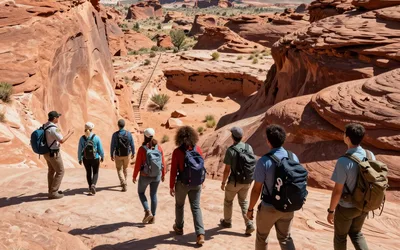
The road to Dalton Wells Quarry is not a gentle one. It climbs out of the red-rock country about fifteen miles northwest of Moab, and the last stretch demands four-wheel drive. That difficulty is part of why the place still feels like a discovery rather than an exhibit. On Saturday, November 7, 2026, from 9 to 11 a.m., a ranger will lead the season's final Quarry Hike up to Dalton Wells Quarry at Utahraptor State Park, walking visitors through the history of the quarry, the animal that made it famous, and what this corner of Utah looked like during the Early Cretaceous, roughly 125 million years ago.
The hike is weather-dependent, and the park asks that participants bring jackets, windbreakers, and hats. The quarry sits at roughly 38.72 degrees north, 109.69 degrees west, and the meeting point is Utahraptor State Park itself, off BLM 142 outside Moab.
The story of how those bones came to light is a good one, and it does not begin with the dinosaur most people picture. In the summer of 1975, paleontologist Jim Jensen collected hundreds of bones from the Dalton Wells Quarry, and among that haul were previously unrecognized bones of a large predator. The bones sat in collections for years. Then, in 1991, Utah state paleontologist Jim Kirkland and his crew were working the same bonebed, excavating an armored dinosaur that would eventually be named Gastonia. While digging, Kirkland found the front of a jaw from a theropod, the meat-eating lineage that includes Tyrannosaurus rex. Later that same field season, the crew turned up a sickle claw. The shape was unmistakable, the signature foot claw of dinosaurs like Deinonychus and Velociraptor, only far larger. As Kirkland later recalled, it was twice the size of the same claw on Deinonychus.
That claw became the emblem of a new animal, Utahraptor ostrommaysi, formally described in 1993 by Kirkland, Gaston, and Burge. The genus name means "Utah's predator." The species name honors John Ostrom and Chris Mays. The timing was uncanny: Jurassic Park arrived in theaters the same summer, and audiences who had just met the movie's oversized raptors learned that a real raptor of comparable heft had lived in Utah. The naming process itself had its moments of levity. Kirkland and his collaborators floated "Dinoraptor" as a candidate, and at one point someone suggested the species name "spielbergi" in hopes of courting the director for funding. They went another way.
Utahraptor was a formidable hunter, more than twenty feet long and weighing somewhere between 1,100 and 1,700 pounds depending on the estimate. It is the largest dromaeosaurid known, and it is now Utah's official state dinosaur, as well as an inspiration for the NBA's Toronto Raptors. A later excavation at a nearby site produced dozens of Utahraptor bones from multiple individuals, from yearlings to full-grown adults, encased in a nine-ton block of Cretaceous quicksand, a find that has continued to reshape scientists' picture of how the animal lived and possibly hunted.
Dalton Wells itself is one of the largest dinosaur bone beds in North America. More than 5,500 fossils representing more than ten dinosaur species have been recovered there over a history of excavation spanning roughly forty-five years, including Utahraptor, the armored Gastonia, and the long-necked sauropod Moabosaurus, named for the nearby town. Paleontologists believe more than 100,000 bones may still await discovery at the site. The park's visitor center displays excavated bones from the quarry, and for a playful comparison it also holds a movie-prop claw used in the original Jurassic Park film.
The land holds a second, harder history. The quarry sits within what is now Utahraptor State Park, created by the Utah State Legislature in 2021 and opened to the public in May 2025 as the newest addition to the state park system. The park spans 7,466 acres and interprets not only its paleontology but also the Dalton Wells Civilian Conservation Corps camp and the Moab Citizen Isolation Center Historic Site. In 1943, the abandoned CCC camp briefly served as an internment camp for incarcerated Japanese Americans before being shut down permanently.
Today the park also draws off-roaders, hikers, and mountain bikers to the Sovereign Trail System, a network of roughly fifty miles of motorized single and double track, and its dark skies have made it a destination for stargazing. A herd of pronghorn lives on the grounds. Park manager Brad Walker has spoken about the breadth of what the park offers, from interpretive programming to the ability to see the Milky Way from camp.
But the quarry hike is the experience that ties the whole place together. Standing on the ridge where Jensen pulled the first bones in 1975 and Kirkland's crew found the claw in 1991, visitors get the rare chance to see a famous fossil locality as a real landscape rather than a museum diorama. The ranger-led walk covers the quarry's history, the biology of Utahraptor, and the ancient environment of the Early Cretaceous, when this desert was a very different world.
Because the hike is the last of the season and depends on weather, would-be participants should plan accordingly. Four-wheel drive is required to reach the quarry, and warm layers are recommended for what can be a cold, windy morning on the ridge. The program runs two hours, from 9 to 11 a.m. on November 7, 2026, at Utahraptor State Park, BLM 142, Moab. Details are posted on the Utah State Parks events page.