


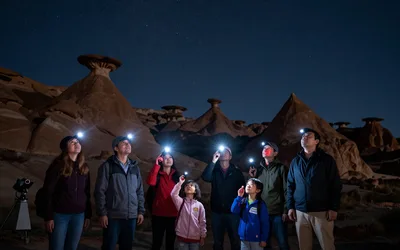
On the evening of November 7, 2026, the staff at Goblin Valley State Park will do something that has become a quiet tradition in this corner of the San Rafael Desert: they will turn off the lights, look up, and tell stories. The park's Constellation Tour begins at 6 p.m. at Observation Point, where rangers will walk visitors through the sky with an emphasis on the mythology that cultures around the world have attached to the stars and constellations. When the storytelling ends, the telescopes come out, aimed at planets and deep-space objects.
The event runs one hour, from 6 to 7 p.m., and is a ranger-led program. The park's address is 18630 Goblin Valley Road, Green River, Utah, though the nearest town of any size is Hanksville, about 32 miles away. The program is listed on the Utah State Parks events calendar, which is the authoritative source for the date, time, and meeting point.
What makes the night unusual is less the program than the place. Goblin Valley is a certified International Dark Sky Park, a designation it earned from the International Dark-Sky Association in 2016. The Salt Lake Tribune reported the designation that year, noting that the park is miles from the nearest city and became the second Utah State Park to earn the title, after Dead Horse Point. To qualify, park managers committed to protecting the park's natural darkness by removing extraneous light fixtures and shielding others so that light is projected only downward, where it is needed for safety. The designation also required the park to develop educational programming, and the Tribune noted at the time that full moon hikes and telescope viewing events were part of the plan. The first of those was a star party on October 1, 2016, with multiple telescopes and no reservations required.
The darkness itself is the product of geography. Goblin Valley sits in the San Rafael Desert, far from urban centers, and the National Park Service's Night Sky Team confirmed in 2015 that the park's skies are among the darkest on Earth. Utah as a whole has leaned into that asset: when Antelope Island State Park received its own dark sky designation, the International Dark-Sky Association noted that it was the ninth such designation for Utah, more than any other state.
The landscape beneath those skies is what gave the park its name. Goblin Valley is known for thousands of hoodoos, the mushroom-shaped sandstone formations that locals call goblins. The distinct shapes result from an erosion-resistant layer of rock sitting atop relatively softer sandstone, which leaves the harder caprock perched on a narrowing pedestal as the softer material wears away. The park was established in 1964 and covers roughly 9,915 acres, with the Valley of Goblins, a three-square-mile area where visitors are encouraged to wander freely among the formations, as its main attraction. The terrain has been compared to Mars and appeared in the film Galaxy Quest for its alien-looking scenery.
That combination, strange rock and dark sky, is what a constellation tour here can offer that a planetarium cannot. The mythology portion of the evening is a reminder that the names humans gave the stars, the hunters and bears and scorpions and sisters, were assigned by people watching from open ground with no light between them and the sky. At Goblin Valley, that condition still largely holds.
Visitors planning to attend should treat the calendar listing as the starting point and confirm details with the park before making the drive, since ranger programs can be affected by weather and staffing. The event page lists the start time as 6 p.m. at Observation Point. The park's own events calendar is the place to check for any change.
For anyone who has only seen Goblin Valley in daylight, when the hoodoos cast long shadows and the valley looks like a set built for another planet, the night version is a different park entirely. The goblins become silhouettes, and the sky above them becomes the main attraction. On November 7, the rangers will be there to explain what previous generations saw in it.