


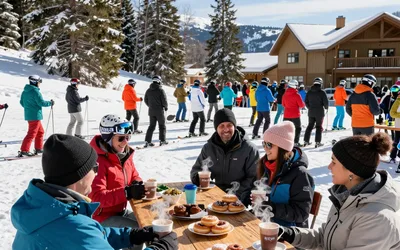
The first chair of a ski season is a strange prize. It is not faster than the second chair, or warmer, or better snow. It is simply first, and at Brian Head Resort that has been enough to draw people to the base of the mountain in the dark for years. When the resort opens its 2026-27 winter season on Friday, November 6, the ritual repeats: the Navajo Lodge and ticket office open at 9 a.m., the lift starts turning at 9:30, and the earliest arrivals get giveaways along with hot chocolate and donuts and music at the base.
Opening day at Brian Head is free to attend, a fact that matters at a resort where the mountain itself is the product. The lodge opens with rentals, ski and snowboard lessons, and food and beverage service, and the resort then runs seven days a week for the rest of the season.
Brian Head occupies an odd and enviable place in American skiing. It sits in Iron County, in the far southwest corner of Utah, closer to Las Vegas than to Salt Lake City, and it is the southernmost ski area in the state. It is also the highest at the base. The resort puts its base elevation at 10,000 feet, higher than the summit of many Utah mountains, and that altitude is the engine behind everything else: an average of roughly 350 inches of snow a season, cold enough temperatures for early snowmaking, and a snowpack that lasts into spring. Brian Head typically runs from early November into May, one of the longest seasons in Utah, and in 2025-26 it opened first in the state and stayed open 160 days, more than any other Utah resort that winter.
The land under the lifts has a longer story than the ski area. The peak was known to early surveyors as Monument Peak, and the origin of the name Brian Head is genuinely unsettled. One account credits William Jennings Bryan, the three-time Democratic presidential candidate. Another points to a Parowan family named Bryan. A third, cited by the resort itself, holds that explorer John Wesley Powell named the peak for an official in the Geographical Survey Office. Whatever the source, the spelling shifted from Bryan to Brian somewhere along the way.
Before it was a resort it was pasture. In the late 19th and early 20th centuries the area was called Little Ireland, after the Adams family of Irish heritage who ran dairy cattle and grazed sheep and horses there, and who logged the surrounding slopes. By the 1920s there was a hotel, a restaurant and a dance hall run by Minnie Adams Burton and known as Minnie's Mansion, popular for enormous breakfasts, fireworks and dancing. The Holyoak brothers of Parowan acquired the property in the 1930s, and in the early 1960s two men, Burt Nichols and Homer Vasels, looked at the mountain and saw a ski resort. They liked that it was close to Interstate 15, to the airlines and to the Union Pacific Railroad. Brian Head Corporation was founded in May 1964, and in January 1965 locals Milt Jolley, D.W. Corry and Pat Fenton bought 640 acres and pushed the project forward.
Six decades later the resort spreads across 650 acres on two peaks, Navajo Peak and Brian Head Peak, with a mix of newer Doppelmayr lifts and classic fixed-grip Yan chairs. The Navajo Express, the high-speed quad that will carry the first riders up on opening morning, is one of the resort's two high-speed chairlifts. In 2019 the Durango-based Mountain Capital Partners took over operations, adding Brian Head to a portfolio that already included Nordic Valley in northern Utah and resorts across Arizona, Colorado, New Mexico and Texas. James Coleman, the group's managing partner, cited the resort's family-friendly character and its proximity to southern Utah's red cliffs and national parks when the deal was announced.
This season's early opening date is not an accident of weather. Brian Head has spent more than $2 million on summer upgrades, about $1 million of it on snowmaking, including a new pipeline on Navajo Mountain that lets up to 24 snow guns run at once instead of 18. The added capacity is designed to seize on cold snaps and build terrain faster in November, which is exactly what makes a November 6 target realistic. The resort has also added RFID lift passes and self-service ticket kiosks, and it sells heavily discounted advance-purchase tickets, some dates from $9, with children 12 and under skiing free all season with no blackout dates.
The mountain is also in the middle of a larger argument about its future. The Dixie National Forest is weighing a proposal that would add 1,651 acres of national forest land to the resort's special use permit area, potentially nearly tripling the ski terrain. The Forest Service opened a 90-day public comment period on the expansion ending October 28, 2026, and its notice flagged possible effects on wildlife, water, cultural resources and forest scenery. Supporters see sustainable recreation on the Cedar City Ranger District; opponents see developed terrain where there is none now. Either way, the resort's next chapter is being written on public land.
Opening day itself is a smaller, older ritual. In 2022, when a run of October storms let Brian Head open on November 4, the earliest in its history, the first guests reached Navajo Lodge hours before the lifts started, and the first-chair group arrived at 6:30 in the morning. Staff brought out a Utah banner for them. The resort has made a habit of marking the day with music, giveaways and a hot chocolate bar, and of treating the first chair as a bragging right worth losing sleep over.
For 2026 the schedule is set: lodge and ticket office at 9, lift at 9:30, giveaways for the people who got there first. The drive is three hours from Las Vegas and an easy run down I-15 from southern California or Utah County, with Cedar Breaks National Monument less than five miles away and Zion and Bryce Canyon about 90 minutes out. Bring a coat, get in line early, and understand that the prize for being first is simply the chance to make the first turns of the winter at the highest base in Utah.