


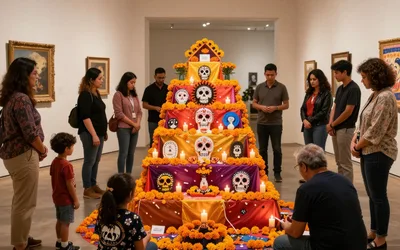
On the first Friday of November, the Southern Utah Museum of Art will leave the lights on a little later than usual and set out supplies instead of a lecture. From 6 to 8 p.m. on November 6, 2026, SUMA hosts a Day of the Dead First Friday: Ofrenda Open Studio, a free, all-ages evening in which visitors build their own ofrendas — the altars Mexican families assemble to welcome back their dead — with kits and materials provided by the museum.
The event is part of SUMA's monthly First Friday series, a free after-hours program that opens the museum from 6 to 8 p.m. each month for exhibition viewing, hands-on artmaking in the classroom, and what the museum describes as a chance to connect with art in new and meaningful ways. The programming team has framed the series around accessibility: the point is to lower the threshold for walking in, whether a visitor has ever set foot in a gallery before or not. Admission to SUMA is free in general, and First Friday keeps that promise while adding a project to take home.
That the museum would choose an ofrenda as a First Friday project says something about what an ofrenda actually is. Día de los Muertos, observed across Mexico and in Mexican communities elsewhere on November 1 and 2, is not a somber occasion in the way outsiders sometimes assume. Families build altars layered with marigolds, candles, food, drink, and photographs, and the holiday's mood is reunion rather than mourning. The ofrenda is the table where that reunion happens. Making one in a public museum, with a photocopier and a glue stick and a stranger at the next table doing the same thing, turns a private act of remembrance into something shared — which is roughly the definition of a community art project.
The setting for all this is one of the more striking museum buildings in the state. SUMA occupies the southwest corner of Southern Utah University's Beverley Taylor Sorenson Center for the Arts, a 5.5-acre arts campus that also houses the Utah Shakespeare Festival. The $39 million complex opened in July 2016 after years of planning, and by the time it opened, roughly $1,500 per Cedar City resident had been donated to make it happen — gifts that ranged from a dollar to a million. Governor Gary Herbert attended the opening, and then-SUU President Scott Wyatt told the crowd that what they were seeing was the capacity of arts to transform societies. The center is named for the late Beverley Taylor Sorenson, founder of the Sorenson Legacy Foundation, whose passion for arts education and whose donation were credited with making the project possible.
The museum itself, designed by the California firm Brooks + Scarpa, is a 28,000-square-foot building whose roof was shaped into deep indentations and a 120-foot cantilever, an explicit reference to the sandstone formations of nearby Bryce Canyon and Zion National Park. The roof parts and curves to form a canopy over a public plaza, adding some 6,000 square feet of covered outdoor event space. Architectural Digest named it the best-designed museum in Utah, and it is easy to see why the building gets described as an artwork in itself: the columns are exposed concrete panels rounded to look like weathered stone, and the interior cavities read as slot canyons. An ofrenda, with its candles and flowers, will look entirely at home under a roof built to resemble red rock.
Inside, the collection leans on the landscapes of the region — Maynard Dixon, Edith Hamlin, Jimmie F. Jones — alongside a notably strong print collection that includes Marc Chagall, James McNeill Whistler, Kawase Hasui, Thomas Hart Benton, and Käthe Kollwitz. The museum is in the middle of marking its first decade; it has been inviting supporters to give $10 to celebrate ten years, with the money going toward keeping exhibitions free, supporting art education for university and K-12 students, and bringing new voices to southern Utah. A 2026 exhibition, "Art from Abstract to Zion," draws on that decade of collecting, from Chagall to Dixon, Japanese woodblock prints to contemporary photography.
For anyone planning to attend the ofrenda studio, a few practical notes. SUMA sits at 13 South 300 West in Cedar City, on the SUU campus. From October through May the museum is open Monday through Saturday, 10 a.m. to 6 p.m., so the First Friday hours extend the day by two. The museum will be closed for Thanksgiving break from November 25 to 27, with the A Very SUMA Holiday Sale kicking off on Saturday, November 28, and it will close again for the winter holiday from December 21, 2026, through January 3, 2027, reopening January 4. None of that interferes with the November 6 event.
The evening is designed for families, and the format is deliberately loose: kits and supplies on hand and two hours to work. Visitors can wander the galleries first and then sit down to build, or come in with a plan and a stack of family pictures already in hand. Either way, the museum supplies the materials and the table; the memories are the visitor's own. It is a rare kind of museum night, one where the exhibit being made is the one you take home.