


The name on the sign is a small act of honesty. Cedar City sits in a valley of juniper and pinyon, not cedar, and the trees the first settlers cut to make charcoal were juniper all along. What drew them here was never the timber anyway. It was the ore. Iron Mission Days, the two-day living-history weekend at Frontier Homestead State Park on Nov. 13 and 14, 2026, exists to remember that origin — the strange, stubborn, ultimately failed industrial experiment that accidentally founded a town.
The story begins in 1851, when Brigham Young sent a company of settlers south from the base camp at Parowan to establish an iron works along Coal Creek. They were called iron missionaries, and the settlement they built became Cedar City. Young had little patience for men digging after gold or silver, but iron was different: the remote Mormon settlements needed tools, nails, hinges, horseshoes and plow points, and importing them across the plains was ruinously expensive. Southern Utah, by the accounts of the era's mining experts, had the raw materials in staggering quantity. Colonel A. W. Hamilton remarked that the iron deposits of Utah were measured in mountains and the coal measured by counties. John S. Newberry of the New York School of Mines called the region's ore the most remarkable deposit of iron yet found on the continent.
The operation was renamed the Deseret Iron Company in 1852. A coke oven and blast furnace went up, and that September the works turned out several hundred pounds of iron, cast into a bell, nails, hooks and rods. The furnace keeper was a man named David Barklay Adams. For a moment it looked as though the gamble might pay.
It did not. Floods, freezes and crop shortages hammered the settlement. Money ran short. Tensions with Native American communities added to the strain. By 1858 the iron works had closed, many of its people had moved on, and Cedar City settled into the agrarian life it would lead for decades afterward. The town bell survived — the only known remaining artifact from the original foundry, now part of the museum's iron industry exhibit — and so did the name Iron County, a permanent fossil of the enterprise that failed.
That history is the reason Frontier Homestead State Park exists. The museum tells the story of Iron County's development in the 1850s, when Young's missionaries came to mine and process iron, and it holds a collection of horse-drawn vehicles used between 1850 and 1920, pioneer artifacts, several historic cabins, a large assortment of horse-drawn farm equipment, and Cedar City's oldest remaining brick home, the Hunter House. A replica blast furnace, built to the specifications of the original, stands on the grounds. About 12,500 people visited the park in a recent year, according to Utah State Park visitation numbers — a modest figure that puts it near the bottom of the state park system by attendance, but the park manager, Michael Stewart, has argued that anyone who stops quickly finds it is more than a roadside museum. Stewart, a Cedar City native, has described the work as stewardship of his own heritage.
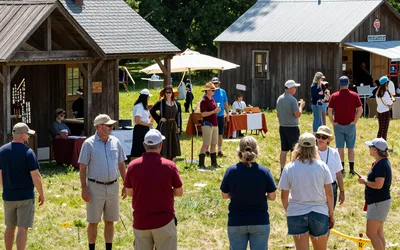
Iron Mission Days is the park's annual answer to that mission, a community birthday party for the town. Over the years the event has shifted shape to match the community's preferences and to line up with Cedar City's birthday festivities. The 2026 edition runs Friday and Saturday from 10 a.m. to 4 p.m. each day, and Friday's schedule includes demonstrations, craft vendors and self-guided pioneer activities. The weekend also carries the Old Town Market, a vendor fair that the park and the Frontier Homestead Museum Foundation launched as a first annual addition to Iron Mission Days in 2025, featuring original art and local makers alongside the historical programming.
What that looks like on the ground is a museum turned inside out. Visitors can step into a pioneer cabin, print on a 19th-century press, or try rug weaving; the park's interpretive programs run through the year, including Sheep-to-Shawl and Archaeology Day, but Iron Mission Days is the one that gathers the whole thing into a single weekend of living history, hands-on craft and frontier treats. The scale is deliberately unpretentious — an open gate for families who might not otherwise walk into a state park museum on a November afternoon.
There is something fitting about the timing. The event lands in the cool, crisp fall air of the same season when the original iron missionaries were settling in along Coal Creek, and it asks visitors to do what the park does best: put their hands on the past rather than merely read about it. The iron works itself lasted barely seven years. The town that grew up around its failure has now spent more than a century and a half commemorating the attempt. On a Friday or Saturday in November, you can stand where the furnace stood and see what the settlers made of it.