


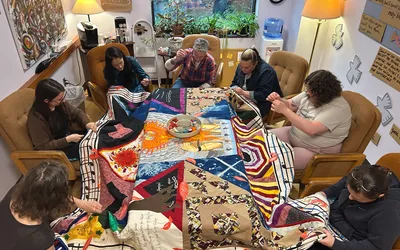
On the afternoon of September 9, the Brattleboro Museum & Art Center will open its doors to a work of art that took nearly a year to make and, in a very real sense, is still being made. "Fractured, Not Broken" is a quilt, but it is also a conversation stitched across the walls of a prison — a seven-and-a-half-by-eight-and-a-half-foot patchwork of cyanotype flowers, musical scores, survey data, and hundreds of hands that never met.
The quilt began in September 2025 inside Southern State Correctional Facility in Springfield, Vermont, where seven incarcerated men gathered for a quilting workshop led by Marie-Pierre Py, a restorative justice practitioner with Interaction: Youth Services & Restorative Justice. Py had been running support groups at the prison for about three years when she noticed something: many of the men wanted to participate, but were intimidated by the vulnerability of a talking circle. As a quilter herself, she thought an art project might offer a gentler path. "Working with your hands and making art is therapeutic," she said. "It's a way to allow things to start moving, even if you don't have words for them yet."
Over the following months, the seven men designed, pieced, and painted the quilt, weaving cyanotypes of flowers and leaves through each individual block. The border is made up of the score for "Quilted Forest," a piece of music composed by Alli Cooper-Ellis, a University of Vermont student who helped conduct research on life inside the prison. The incarcerated artists were not made available for interviews, but one quilter's artist statement offered a glimpse of what the work meant. "From the very beginning, I knew I wanted to depict a ship coming home from a long, hard voyage," he wrote. "I'm ready to go home. And ready to find peace."
The project, called "Fractured, Not Broken," is a partnership between Interaction and the Vermont Prison Research and Innovation Network, or PRIN, which is collecting data on safety, transparency and accountability at the Springfield prison. As part of the effort, researchers at the University of Vermont have been administering prison climate surveys at Southern State. The findings are sobering: according to Abigail Crocker, director of UVM's Justice Research Center, approximately 85 percent of incarcerated people said they do not feel prepared for release. "If you think about conditions people need to thrive," Crocker said, "feeling like you're part of community and the sense of belonging is one of them."
Those survey findings are literally stitched into the back of the quilt, alongside a cyanotype of a poem by Margaret Wheatley called "Turning to One Another." The quilt thus carries two kinds of data: the intimate, personal stories of the men who made it, and the cold statistics of a system that, by its own measure, is failing to prepare people for the world beyond its walls.
But the project was never meant to end at the prison gate. As the quilt took shape, Py and her collaborators decided it was essential to bring in the community that would one day welcome these men home. Throughout the spring and summer, Brattleboro residents were invited to add their own stitches and messages to the quilt at a series of community stitch events — at July's Gallery Walk, at the Brattleboro Food Co-op, at the Bobbin & Skein yarn shop, and at Brooks Memorial Library. The act of hand-quilting, Py said, was designed to build awareness and relationships between people inside and outside prison walls.
The gatherings drew people of every age. Suzanne Ruse, an Interaction volunteer, was especially moved when the mother of one of the incarcerated quilters "sat right down and started stitching." "It was incredible," Ruse said. "It was folks of every age there. And everybody sitting around this beautiful quilt and adding their piece to it." Katie Allaway, a longtime volunteer with Circles of Support and Accountability, a support program for formerly incarcerated people, stitched hearts onto the quilt as a symbol of love and support. "I think for a very long time, our society in the United States has thought that healing injustice is something you do on your own," Allaway said. "Participating in healing needs to be a community process."
The exhibit that opens September 9 will be more than a textile display. It will include audio components, among them Cooper-Ellis's song and "Redemption Road," a piece written by one of the incarcerated quilters whose refrain is featured on the quilt. The song was first performed at the prison in April by participants in a weekly music class. Another performance was recorded at Brattleboro's Community Bible Chapel, performed by Mel Dawson of the Greater Falls Community Justice Center, the Rev. Matt Miller, and members of a peer-led COSA group in Brattleboro.
Among those who helped record "Redemption Road" at the chapel were James Cashatt and Bob Havens, both of whom served time at Springfield and are on the Vermont sex offender registry. Havens, who accompanied the song on guitar, said he felt a strong connection to its plaintive melody and lyrics. "I have regret about things that I did and questions about redemption," he said, "and that's kind of what the song is about." Both men acknowledged that some people may struggle with the project's message because of the nature of their crimes, but they hope the music carries it through. "I pray that it does make us appear to be just as we are," Cashatt said, "human beings who are doing everything they can to become better than who they were."
The exhibit runs through November 1, with a free celebration planned for October 15. After its run at the museum, Py hopes the quilt will travel to more venues and ultimately return to the prison's visitor center — a final homecoming for a work that began behind bars.
The seven incarcerated quilters are identified only by initials — JA, DC, DF, QG, FN, JO, and TR. For now, the quilt speaks for them: in the ship coming home from a long voyage, in the flowers and leaves pressed into cyanotype blue, in the musical score stitched around the border, and in the hundreds of community stitches that now bind their stories to the town that will welcome them home.