


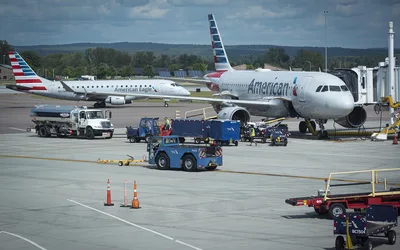
The smoke that drifts across the tarmac at Patrick Leahy Burlington International Airport on Saturday morning will be colored, the blood will be makeup, and the victims will be volunteers who signed up by the hundreds to lie still and be tagged. But for the first responders who converge on the airfield, the three-hour exercise called the Emergency Response Simulation is as serious as any real disaster they might ever face.
Beginning at nine o'clock on the morning of September 19, the airport — located in South Burlington but owned and governed by the City of Burlington — will close its attention to the far side of the airfield, away from the terminal and the traveling public, and stage the largest rehearsal of catastrophe that federal regulations require every three years. Ten to fifteen ambulances, a fleet of fire departments from across the region, the airport's own Fire and Rescue Team, and community volunteers will act out an emergency scenario with an intensity designed to replicate the chaos of a real aircraft incident, complete with heavy-stage makeup meant to simulate injuries so convincingly that they can test the clinical instincts of paramedics and the triage decisions of emergency room staff.
"Being prepared for an emergency is a responsibility we take very seriously at Leahy BTV," said Nic Longo, the airport's Director of Aviation, in a press release announcing the drill. "While we hope we never have to put these plans into action, this simulation allows us to work side by side with our fantastic emergency response partners, test our readiness, and learn how we can be even better prepared to protect our travelers, employees, and community."
The exercise is mandated by the Federal Aviation Administration, which requires every airport serving scheduled passenger operations to conduct a full-scale emergency exercise once every three years. The drills are designed to stress-test the Airport Emergency Plan. The triennial drill is the one moment when that plan, usually theoretical, is thrown against a simulated reality of smoke, sirens, and screams.
Jeff Bartley, the airport's director of innovation and marketing, said the exercise is designed to be intense. Colored smoke will billow across the staging area. Actors will perform with moulage makeup that renders simulated burns, fractures, and head wounds with unsettling fidelity. But the intensity is carefully contained. "You won't see fire trucks screaming through the communities," Bartley said. "They're staged here, and they're allowed onto the airfield in timed format." Even the ambulances that will simulate transporting victims to hospitals around the region will do so without sirens or lights, a measure intended to keep the exercise from alarming the public while still testing the logistical links between the airport and the region's health care system.
The simulation will unfold on the opposite side of the airfield from the passenger terminal, so most travelers will likely notice nothing at all. "They might not even see the exercise," Bartley said.
The drill is more than a firefighting exercise. It is a full-spectrum test of communication and coordination. A mock press conference will be held with local media participating, so that public information officers can practice the delicate art of conveying facts to a frightened public while still learning details themselves. "We're stress testing not just the emergency response but our internal emergency communications," Bartley said. "We're not posting on social media like we really would, but we're internally practicing." A debrief will follow, bringing together all the participating agencies to parse what worked, what didn't, and what needs to change before the next triennial cycle.
The volunteers who make the simulation real are central to its success. More than 200 community members signed up to participate, according to the airport's press release. "Their support not only allows us to create a realistic exercise," Bartley said, "but also enables other organizations, such as our local first responders and hospitals, to test their own systems and readiness." The volunteers will be the mock victims — the casualties who, in a real incident, would be the very people the plan exists to save. In the drill, they become the instruments through which the system is tested.
The airport that will host this elaborate rehearsal has been preparing for disaster since long before the Federal Aviation Administration made such exercises routine. Its origins stretch back more than a century, to 1919, when the federal government was seeking sites for airfields in the aftermath of the First World War. The airport was officially dedicated on September 22, 1921, and in May of 1920, two Army Air Service officers had already flown from Boston to Burlington in record-breaking time. The officers were touring New England "for the purpose of promoting airplane landing fields for the coming season," as the Barre Daily Times reported at the time.
Today's facility is a far cry from that grassy field. The airport serves more than a million and a half passengers annually and operates as a military-public joint use facility, home to the Vermont Air National Guard's 158th Fighter Wing — the Green Mountain Boys — which flies F-35 Lightning II fighters from the same runways that handle commercial jets. In 2023, the airport was renamed to honor Patrick Leahy, Vermont's longest-serving U.S. senator, who helped steer federal funding toward the airport's largest construction project in decades, the Project NexT terminal modernization. Renaming the airport was, in part, a recognition of the quiet way that federal investment shapes the infrastructure of daily life.
The triennial drill on Saturday is another of those quiet investments, less visible to the flying public than a new terminal but arguably more consequential. It is a rehearsal for the day that every person at the airport hopes never comes: the day when the smoke is real, the injuries are not makeup, and the plan — rehearsed on a Saturday morning with volunteers and colored smoke — may be the only thing standing between chaos and order.
As Longo put it, the exercise allows the airport to "learn how we can be even better prepared to protect our travelers, employees, and community." The learning happens in small increments — a communication gap discovered, a decision tree revised, a new contact entered into a directory. The drill is, in that sense, less a performance than an audit of readiness, conducted in public view on a quiet Saturday morning in September, when, for a few hours, the airport's most important work is the rehearsal of its worst day.